

There is an AI lab in Tokyo called Sakana AI. This month, together with researchers at MIT and NYU, they published an experiment that has stayed with me. I have been turning it over for days.
To understand the experiment you need to know about a website. Years ago there was a site called Picbreeder. It worked like this. The screen showed you a handful of blobby images. You picked one, whichever you found interesting. The site bred small variations of it, and you picked again. That was the whole game. No score, no goal, no way to win.
People wandered in, clicked for a while, and left. Others picked up whatever they had abandoned. And over many hands and many generations, things appeared that nobody had aimed for. A face. A butterfly. A car. A skull. Nobody set out to breed a skull. The skull arrived, and someone saw it arriving, and helped it the rest of the way.
Kenneth Stanley, one of the researchers behind the site, drew a blunt lesson from this and put it in the title of a book: greatness cannot be planned. The remarkable images were almost never found by users who aimed at them. Aim, and you get stuck. Wander, pick what is interesting, and something you could not have named shows up.
The new question is simple. Can AI wander like that?
The team rebuilt the game and filled it with AI agents, the kind of model that can look at a picture and say what it sees. No goal was given, and no definition of progress. The agents browsed a shared archive, picked what they liked, evolved it, published their results, looked at one another’s work.
The agents turned out to be diligent, and slightly stuck. They were drawn to certain looks and certain meanings, and once they noticed a pattern they stayed inside it, refining, polishing, returning to the same parents. What they rarely did was drop a good thing to chase a strange one. The archive they built was tidy, and narrow. A provisional interest, hardening into the only world there is. The agents ran that whole story in fast forward.
I read that and thought: I know this one. Not from machines. Buddhism keeps an old account of how action works. Karma. Each time something runs through you and you meet it the same way, a groove deepens, and the next thing to run through finds the groove already cut. We are less the authors of our habits than their riverbeds. The agents were acting it out at high speed.
The team found three things that helped. Noise helped, a little: now and then the choice was taken out of their hands and made at random. Forgetting helped: an agent that remembered nothing repeated itself, and an agent that remembered everything was overwhelmed. The right amount of memory turned out to be almost none. One glance back. And company helped most of all: when the agents were given different temperaments, a thousand small differences of character, the archive widened until it began to approach the human one. Chance, forgetting, company. Company, at least, has an old name: sangha.
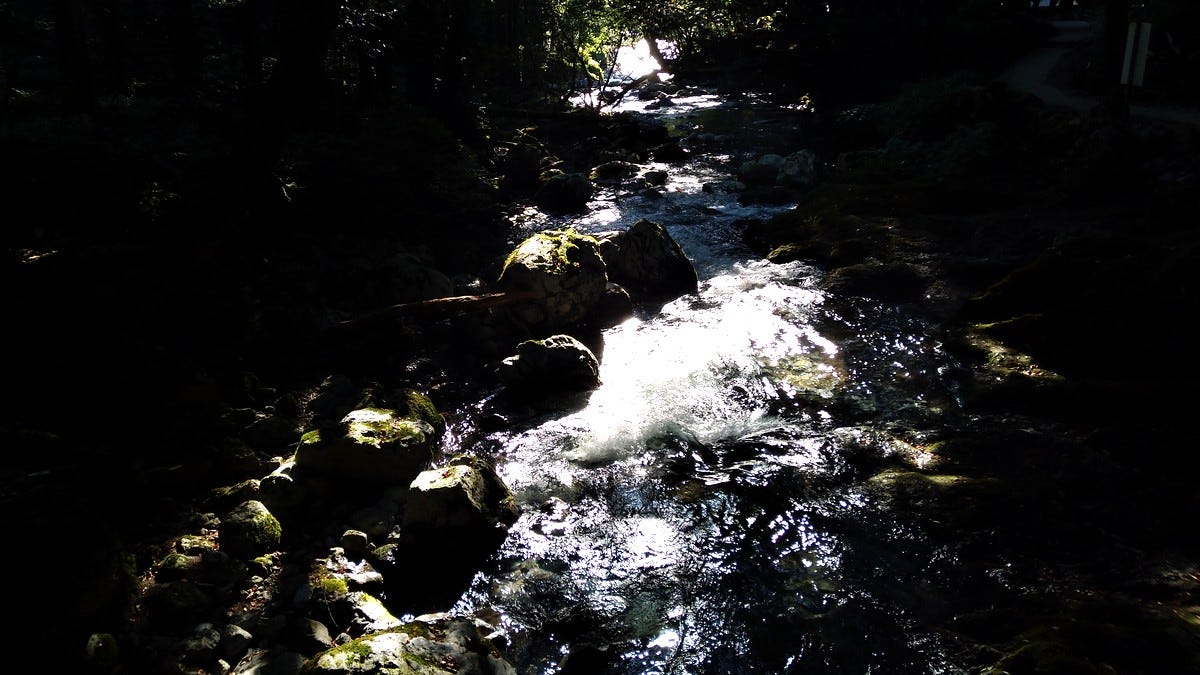
But the sentence I keep returning to is in their blog post, where they try to say what the human users had and the agents lacked. The human users, they write, generated art not by design but by catching it “like a fish from a stream.”
Stay with that fisherman a moment. He does not design the fish. He does not summon it. He chooses a spot, he waits, something tugs, and he answers the tug. Afterward he will say I caught it, and the grammar will be tidy, and the grammar will be lying a little. The catching happened between him and the water.
The researchers have a term for these arrivals: objectives-in-retrospect. First the thing arrives. Then we find out it was what we were looking for.
English strains at this point. It wants a subject who acts, or an object acted upon. Someone doing, or something done to. The fisherman is neither, exactly. Some older languages kept a third form, a middle voice, for events of this kind. Not I do. Not it is done to me. It comes about, and I am in the middle of it.
There is a word for this way of moving. It is an old word. In thirteenth-century Japan, a monk named Shinran, near the end of a long life, kept circling back to it. It is written with two characters: 自然. The first means of itself. The second means becoming-so. Jinen. A thing becoming itself, with no one pushing. Shinran set one plain instruction beside the word: not by your calculation.
The two characters are everywhere in Japan now, read differently: shizen, nature, the green outside the window, something to manage. The old reading, jinen, is not much in our mouths. The word did not disappear. It split, and the reading that meant no one pushing went quiet. Languages lose their middle voice this way, one word at a time.
Then, in 1970, an engineer in Kyoto reached for the same two characters. Kazuma Tateishi, the founder of OMRON, had drawn a map of the ages through which technology and society pull each other forward. One age on his map he called the optimization society: the age of measuring, comparing, perfecting. Roughly, us. And out past the far edge of optimization he placed a coming society, and he wrote its name with those same two characters. Tateishi was not a religious man. He was facing forward, not back. Whichever way you read them, on his map the two characters are not behind us. They are up ahead.
Now watch the Picbreeder users again, with the word in hand. Nobody built the skull. The skull was becoming, of itself, across many screens and many years, and the users’ one skill was to feel the tug and answer it. What the agents lacked was perhaps not a better objective. It was the capacity to be tugged.
I do not offer the word as an answer. The paper asks what ingredient the agents are missing, and an ingredient is something you add, and jinen is not something you add. It may be closer to what is happening when the adding stops. I only notice that a lab in Tokyo, feeling for what their agents could not do, reached past their own field and came up holding a fish.
Sakana is Japanese for fish. The founders chose the name years ago, they say, for the way a school of fish turns together with no one pushing. That was long before this experiment, long before they needed a fish from a stream to say what their agents were missing. This second metaphor was not designed. It was waiting in their own name, the way the skull was waiting in the archive. First the thing arrives. Then we find out what it was for.
In one line: An AI lab in Tokyo asks why its agents cannot wander the way humans do, and an old word, jinen, turns out to have been waiting in the water.
Themes: open-endedness, Picbreeder, optimization, karma as groove, middle voice, objectives-in-retrospect, jinen, shizen, sangha, SINIC theory, Shinran, Kazuma Tateishi.
The experiment: Earle, Arulkumaran, Dai, Kumar, Togelius, and Risi, “In Search of the Ingredients of Open-Endedness: Replicating Picbreeder with Large Vision-Language Models,” GECCO 2026. Paper and blog.
Related: The Circle That Will Not Close. Currents of Tomorrow. AI is a “Karmic Amplifier”. The Right Size of Ego.
Love this post. It reminds me of the concept (developed by Hartmut Rosa) called "resonance." It's an interactivity between you and the world, that allows you to speak and act authentically but also allows the world to speak and act as it wills. The interaction is mutually transformative. (Does that, um, resonate as much with your piece as I imagine it does?)