

People say they are tired of capitalism. They say the system is swallowing them. I feel it too, some days. But every time I say it, something snags. Am I really exhausted by capitalism itself?
Capitalism covers most of the world now. America runs on it, China runs on it. It is so large that when a nameless tiredness comes over us, we reach for it as the biggest word within reach. That is not wrong. But if we sharpen the focus a little, I think the thing we are really pointing at has another name.
That name is optimization.
A broom in the hand
Not long ago, at a gathering, I had people sweep a floor. As they swept, I asked a few of them what was running through their heads. Many were hearing the same voice.
Am I doing this right. Faster. Get it done.
There is not a trace of capitalism in that voice. No market, no price, no one taking a profit. It is only a floor being swept, and not a single coin has moved. Still the voice comes. Better, faster, cleaner.
That is the voice of optimization. And here is what matters: take away the market, and the voice stays. Take away capitalism, and the tiredness survives. But take away this voice, and the tiredness is gone. So the core of what we point at when we say “capitalism” may lie closer to optimization.
That is only the doorway. What I want to think about is further in.
Optimization runs inside a “let’s say”
The word optimization, by itself, is empty. You always optimize toward something. Toward “clean,” when sweeping. Toward “results,” at work. That “clean,” that “results,” becomes the target.
But look closely, and the target turns out to be something merely set in place. Let’s say clean means this. Let’s say results mean this number. Someone, somewhere, agreed to it. At the start, it was a provisional frame.
We are surrounded by these “let’s say”s. Let’s say a country’s wealth can be measured by GDP. Let’s say a company’s worth can be read off its market capitalization. Let’s say a person’s ability can be measured by a test score. Each began as a convenient yardstick set down for the time being. Wealth itself, worth itself, ability itself could never fit whole inside those numbers. And yet, once the yardstick is fixed, people begin to optimize along it. Raise the GDP. Raise the market cap. Raise the score.
And there is something worth noticing about every such yardstick. What optimization calls “the optimum for the whole” is never the actual whole. It places some frame as “the whole” and improves the inside of it. Even what we call global optimization, seen from the whole of the world, is always partial. There is no single, all-encompassing field that gathers every frame into itself. There is always an outside.
So optimization always works inside a provisional agreement, a “let’s say.” None of this is a problem yet. To place a provisional frame called “clean” over sweeping is the most natural thing.
The problem is that the provisional, at some point, stops being provisional.
When “let’s say” hardens into “it is”
“Let’s say clean means this” turns, somewhere along the way, into “clean is this.” The agreement we set down for the time being takes on the face of an unmovable fact. We forget there was ever another way, outside.
Why does this happen? Not for one reason.
One is sunk cost. Once you have bought in, subscribed, paid in your time and money and pride, leaving gets hard. After all I’ve put in, not now. The irony is that the more shrewdly a person calculates gains and losses, the more they stay, so as not to waste the past investment. The logic of optimization itself forbids the exit. And the frames of our world tend to take the form not of a single purchase but of a subscription, a little paid in every month, designed so that quitting always feels like a loss taken today.
Another is agreement with others. As long as I alone think “let’s say it’s clean,” the provisional feel still lingers. But once everyone around me starts moving by the same frame, the frame is no longer an assumption in my head. Right? Right? We’re agreed, aren’t we? Each becomes the ground of the others’ conviction, and the certainty climbs. No one holds any ground outside, and inside the closed ring the conviction only hardens. This is very close to the structure of a cult.
And there is a harder fact still. The more wholly a person believes the frame is real, the better they can optimize. Someone who half-thinks “well, this is only provisional” cannot give everything. To get the highest result, you have to believe the frame is real. So forgetting is not laziness. It is the correct outcome of high-performance optimization. The better it goes, the more success recasts the frame as real: it worked, so the frame was right, so it is real. It is not a lie. The frame really does function. And the fact that it functions overwrites, legitimately, the memory that it was only provisional.
The real shape of “capitalism is swallowing me” is probably here. Not optimization itself. It is the tiredness of a provisional frame hardened into “it is,” the outside gone from view, and no way to step down. And the frame of capitalism, even when I alone manage to remember “this is only provisional,” is reset every morning by the market, by prices, by the behavior of others. The system maintains my forgetting on my behalf. So no matter how often I remember, the outside vanishes again. That I cannot stop is not weakness of mind.
And still, the provisional cannot be wiped from this world
Here a cheap conclusion beckons. Let’s escape the frame, let’s see through the provisional as provisional, let’s wake up.
But we cannot. Short of becoming a buddha, we have no choice but to live inside some “we’re agreed, aren’t we.” To live in the world is to take up some provisional frame and live by it. A standpoint truly outside every frame, belonging to nothing, is not available to a human being. There is no view from the nonexistent whole. This world carries, more or less, a trace of cult. That cannot be erased.
So the question is no longer how to escape. It becomes how to live, while living inside a frame.
And let me be clear about one thing. To cut out a problem and present a solution: that gesture itself is a move of optimization. Set a frame, improve the inside. So I do not want to settle this and close it here. Not closing it is itself bound up with what this writing is trying to say. Still, I can leave a hunch about direction.
Holding many places to depend on
One direction is to hold many places to depend on.
The researcher Shinichiro Kumagaya has said that independence is increasing the places you can depend on. Stake everything on one frame, and that frame puts on the face of “the world.” The outside vanishes. When there is only one “we’re agreed” ring, that ring becomes a cult.
But place yourself across several frames, and each frame quietly regains the feel of being one frame among many. A person who can move from one “we’re agreed” to another knows, in the body and not in the head, that no single one is the world. Not by the effort of remembering, but by the experience of moving. This works precisely because it does not demand the labor of holding in mind, constantly, “this is a frame.” You do not have to remember. The ability to move guarantees the outside even while you forget.
There is a trap, though. “Hold many places to depend on” is instantly absorbed back into the language of optimization. Diversify your portfolio. Hedge your risk. The moment holding many dependencies becomes a clever survival strategy to be optimized, it is one more frame. So this dies if it is spoken as a strategy. Because you have not staked everything anywhere, you can be light everywhere, and in earnest everywhere. It is a quality in how you place yourself, not an object to be managed.
Shu, ha, ri, and a circle that will not close
When I think about these things, I always think of shu-ha-ri, the old account of how one learns a way. Three stages: keep the form, break the form, leave the form.
Shu is the stage of believing the form to be real and giving everything inside it. This is not a sickness. Unless you once believe wholly and immerse yourself, the form never enters you. A person half-thinking “this is only provisional” never even acquires the form. The immersion and the forgetting of shu are indispensable. Once, you have to buy in, subscribe, believe completely.
Ha is the stage of beginning to notice that the form is not the whole of the world. The cost paid in comes into view. Beyond the “we’re agreed” ring, there is the breath of something else.
Ri is often misread as casting off the form to become free. It is not that. Ri is becoming able to move in and out of the form freely. You can immerse in the form, you can step away from it, you can move to another. The “many places to depend on” from before, seen from inside, is this ri. From outside it looks like spreading across several frames; from inside it is the freedom of entering and leaving, never binding yourself to any one.
And shu-ha-ri is not a staircase you climb and finish. One who reaches ri enters a new shu again. It does not close. It does not end.
Let me try to put this into figures.
Shu is a circle drawn in a firm, closed line. And inside that circle, a self is pictured as a point. The circle is the frame that encloses the self. The self is a resident inside it, with no exit out. The line is closed not because it is admirable. The opposite: to the self that is a point, a closed line is a wall with no way out.
Ha is a dotted circle. The self, finding the long-familiar frame an obstacle, tries to break it. It wants to get as far from that frame as it can. To negate the frame, thin the line as much as possible, and if it could, erase it. So the line becomes dotted.
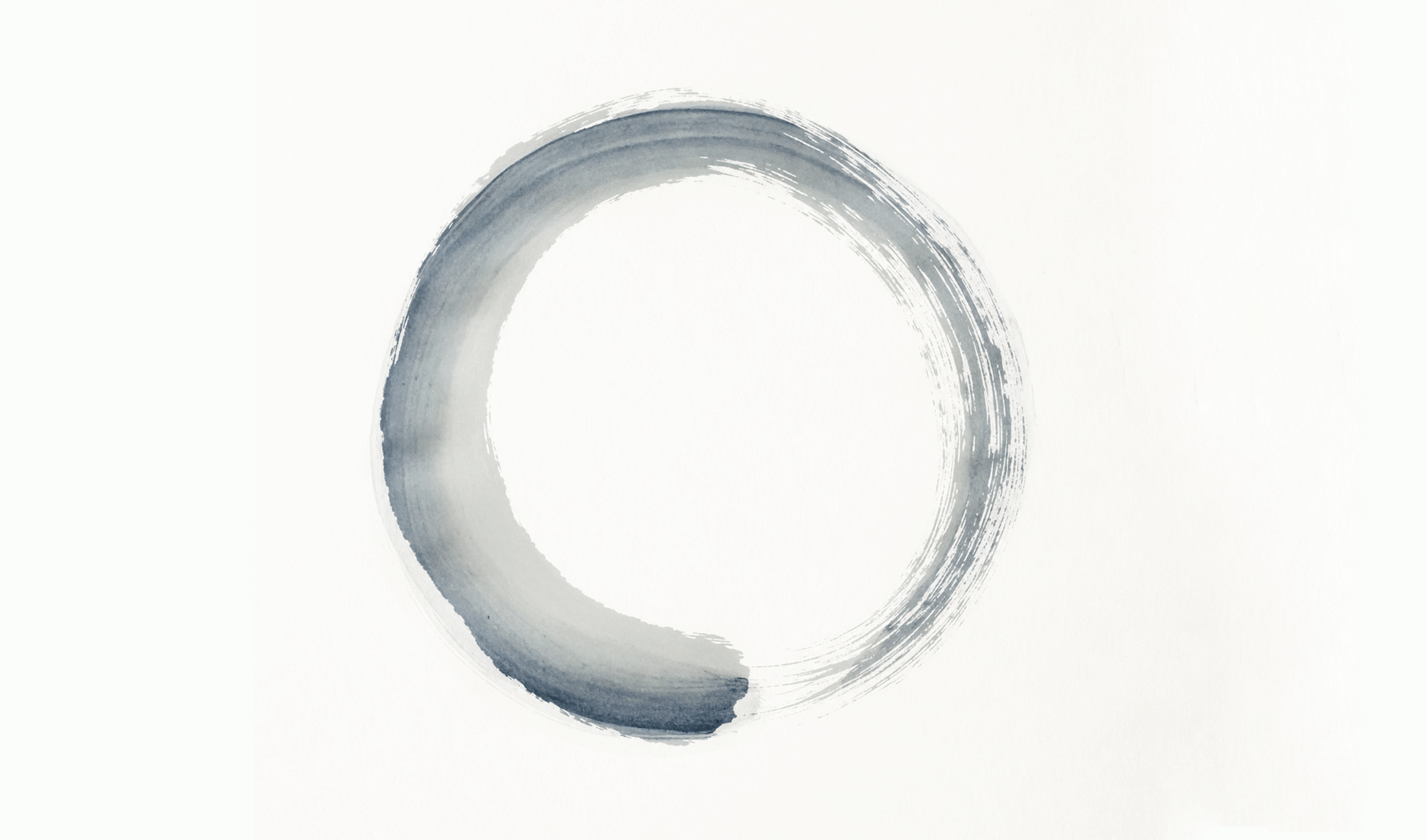
Ri is a circle drawn with a brush. It starts from one strong, jet-black stroke, and as it goes the brush is eased, until at the end the ink runs dry and goes white, and the circle does not close. Here something decisive happens. In ri, the self is no longer a point inside the circle. The self has become the very act of drawing the circle. The enclosed resident has become the motion that gives rise to the enclosure.
Move the brush, and something becomes clear. When you actually try to draw this circle, in the very moment the brush is eased, it is lifting up off the paper. The motion of the hand is not a flat circle. It draws a spiral. The circle of shu, the circle of ha, were figures on flat paper. Only ri leaves the plane and breaks into solid space. A third dimension is embedded in the two-dimensional sheet. And if we find, here, the axis of time in the single continuous motion of the brush, even a fourth dimension rises up.
The seeing self, and where it goes dry
Zeami, the master of Noh, spoke of a seeing that leaves the self: the actor watching his own dance from where the audience sits. Not the self seen from one’s own eyes, but a seeing from a place that has left the self. See yourself, he said, from the whole of the hall, your back included.
You can read this as a second self watching the first from outside. But read that way, something goes wrong. A second self grading the first from above. That is the most refined form of optimization. Watching yourself from overhead, am I detaching well enough. Leaving the self becomes the summit of optimization. The departed seeing turns into one more frame, and inside it optimization starts again. Set the seeing subject one step higher, and it is just another self-eye.
That dried, open circle has no seeing subject in it. This is what I found by making the figure. There is only the brush, the ink, the dryness. No one watches from outside. The instant the force is released, the brush lifts on its own. The writing hand, while writing, leaves the flat plane by itself and breaks into the solid.
Think back: in shu and in ha, the self was double. The self looking at the circle from outside, and the self shut inside it as a point. The self seeing the figure, and the self inside the figure. Ri is the moment both of these selves vanish. The one who sees from outside and the point inside, both gone, and only the motion of drawing remains. What disappears in this departed seeing is both of these selves.
This is the place where the world built of words and comparison falls quiet. No lending or borrowing, no weighing of better and worse. Optimization was exactly the working of that world of words and comparison. What appears here is what appears when that working stops.
The brush, near the end, lifts off the paper on its own. You do not decide to lift it. The pressure simply leaves your hand, and the line goes dry, and the circle stays open. There is no one standing outside the circle to close it.
The seeing self disappears.
But watch what just happened. I wrote the seeing self disappears, and to write it, I had to give it a subject. English will not let a verb stand alone. Something must do the disappearing. So the very sentence that announces the vanishing of the self has quietly placed that self back on its feet, as the grammatical subject, alive enough to perform its own disappearance. You read the words “the self disappears,” and in that instant your language handed the self back to you.
So I will stop trying to say it. I will let the line go dry instead.
The circle that will not close
So this writing, too, I do not want to close with an answer. Not that I do not want to. I cannot. To cut out a problem and hand over an optimized solution would be the one gesture to avoid.
When we say we are tired of capitalism, we are mostly pointing at the right thing. Only, the core of it is optimization, and more than that, it is a provisional frame hardened into “it is,” the outside gone from view. Yet to stand fully outside the frame is something no one can do. What we can do, perhaps, is to move back and forth among many places to depend on, knowing in the body that no frame is the world. And in the deepest part of that coming and going, to have the seeing self go dry, on its own, and vanish.
Here is something I have not yet resolved. The seeing self vanishes and becomes, for a moment, utterly alone. And yet this becoming alone may be the same motion as being opened to many places to depend on. When you stop staking everything on one frame, you become most singular and, at the same time, most widely open. The seeing self vanishing, becoming alone, being opened to the world: these may not be separate roads, but the several faces of one spiral, drawn by that dried, unclosed circle.
This is still a question, and I do not yet know the answer. Is this departed seeing the seeing self standing one step higher, or the seeing self vanishing inside the act? I have only that dried, unclosed circle as a handhold. The line goes white, and stays open, and I leave it there.
In one line: When people say capitalism is swallowing them, the truer name for what exhausts them is optimization — and beneath that, the way a provisional “let’s say” hardens into “it is,” until a single frame is mistaken for the whole world.
Themes: optimization, capitalism, the provisional frame, let’s-say and it-is, sunk cost, the structure of a cult, many places to depend on, shu-ha-ri, the unclosed circle, the spiral, the seeing self, Zeami, negative capability, jinen
Related: Long-Now Meditation. The Right Size of Ego.
love the shu-ha-ri! :)
...so challenging to get what you think and mean and so enlarging...thank you