

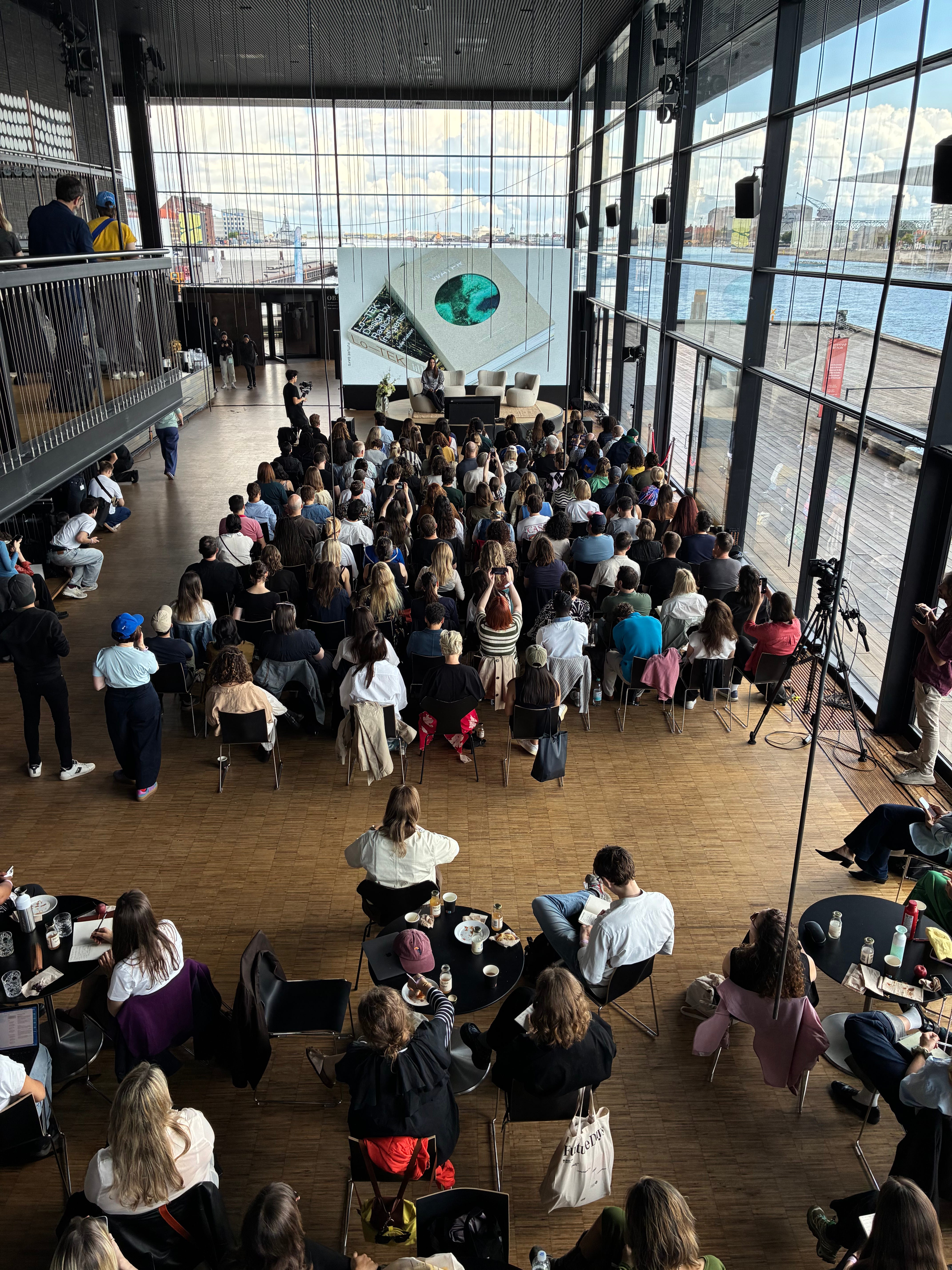
The morning before I spoke, I had tea with some urban designers in Copenhagen. I was there for Future Days, a gathering that brings together designers, futurists, and people working at the edges of culture and change. This was its third year. We talked about cities, and care, and how everything we are trained to do comes with a deadline, a budget, a box to tick. One of them said, “We are trained to say done.” Then she asked, “What happens to work that is never done?”
I carried her question onto the stage the next morning. I want to carry it here too.

Two words we misread
We use the word currency to mean money we keep. But the word comes from current. To run. To flow. Money was called currency because it moves. Currency that stops moving is just paper.
We made the same mistake with another word. Karma. In English it has become a kind of account. Good karma, bad karma. Points you earn, points you lose, something you store. But karma is not a thing you hold. It is a flow.
It is a current with three moments, all happening now. It arrives from before you, in your habits, your patterns, the voice in your head. You did not invent that voice. It came to you. It runs through you, in the way your hand moves before your mind has time to think. And it leaves grooves. Every action you take makes the next one a little more likely.
So you are shaping the current while it shapes you. Karma is never finished. It cannot be finished. It is not a task. It is a flow.
Why we sweep
In a Japanese monastery, monks in training spend more hours sweeping than sitting in meditation. Every night the leaves fall in the garden. The tree is not wrong. The wind is not wrong. The wind simply blows. And every morning the ground is covered again. So we sweep. And tomorrow the leaves return, and we sweep again.
The sweeping is never done. It is endless on purpose.
So why sweep at all? Because you cannot delete a current. But every stroke of the broom is already bending where it runs next. Not by thinking. Thinking is too slow. The body is faster. To sweep is to touch your karma with your own hands.
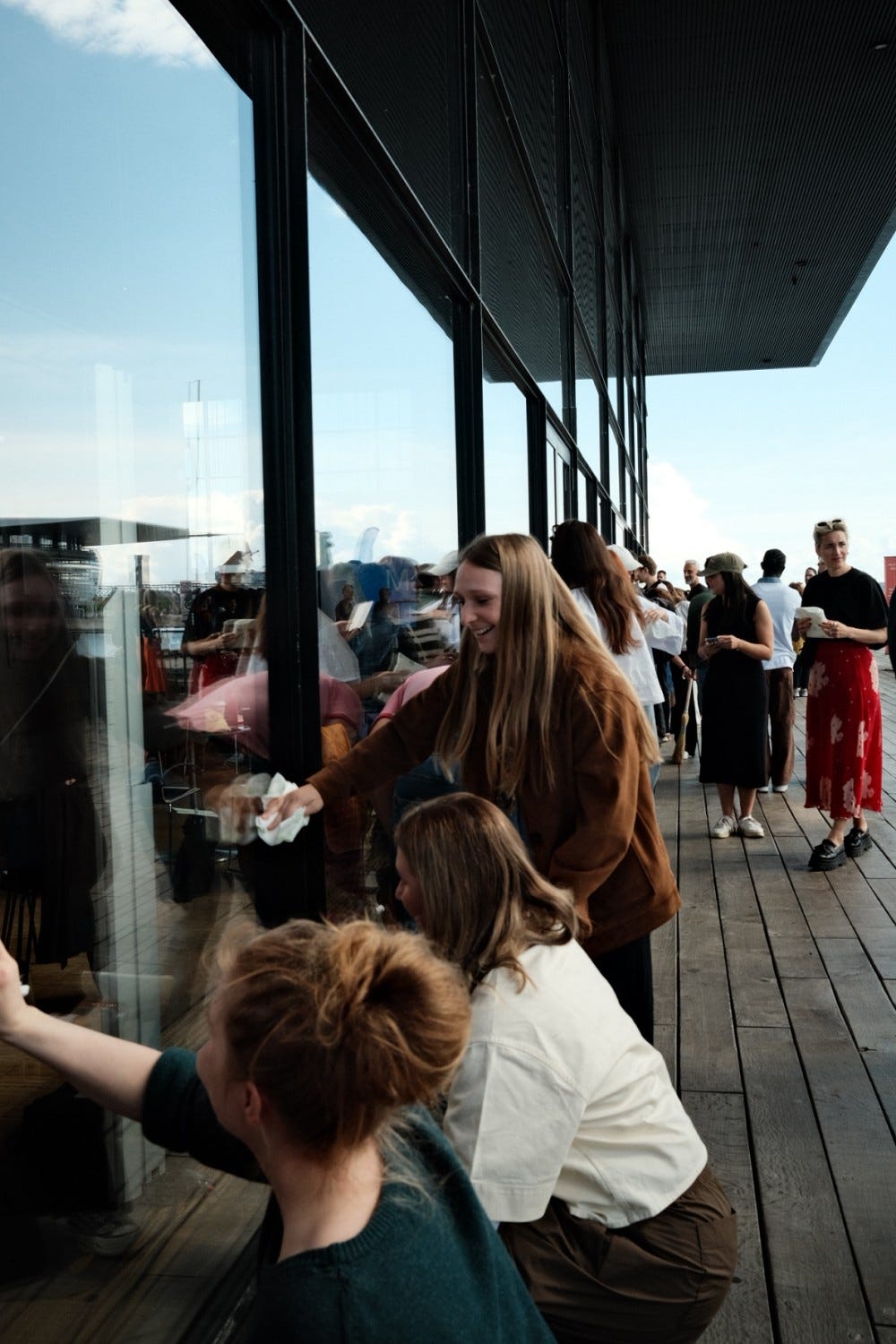
That morning, several hundred of us swept together. We sat in silence for twenty seconds first, to feel grounded in the room. Then we stood, found people we had not met, and took up brooms and cloths. We cleaned the floor, the windows, the terrace, the edge of the water. There was only one rule. When the broom comes to you, sweep. When you feel it is enough, pass it on. You do not need to finish. The next pair of hands will continue.
Some people did not sweep. They watched. That is also the practice. The river does not see itself. The one on the bank does.
The voice that wants to finish
While we were sweeping, many of us heard a voice. Am I doing this right? Am I covering enough ground? I have a name for that voice. The Optimizer.
The Optimizer believes every game can be finished. Score the points, fix the problem, close the file. And for a long time, this was a good strategy, because the world held still long enough to be completed. But that world is gone. The rules rewrite themselves while the ball is still in the air. The game changes faster than anyone can finish it.
Still the Optimizer arrives. It came to us through school, through work, through every system that praised us for finishing. It is an old current, and it keeps arriving. But it is not only arriving. It is being made, right now. Each time the voice says do it better and the body tightens, the groove gets a little deeper.
And maybe, somewhere in that morning, there was a single stroke where the voice went quiet and the hand simply moved. That stroke left a groove too. A new one. Very shallow, but real.
That is the whole of it. You are not the passenger of this current. You are not its owner either. You are the place where it bends.
The current leaves your hands
Here is what I did not expect.
When I finished speaking, I thought the current I had set in motion was mine to account for. It was not. It left my hands the way the broom left each person’s hands, and it kept moving without me.
I felt it in the days that followed. People stopped me in the hallway. I read what they wrote afterward, each in their own words. Messages arrived. And in all of it, the current that began on the stage came back changed, carrying things I had not put into it.
Someone heard the same voice I had named, and asked it out loud. Why bother, if the work is never done? And then answered it without me. Because each small, ordinary action bends the flow toward a world we would want to live in. The mundane matters.
Someone else, whose whole life is spent designing a better society, sat with the discomfort of work that is meant to be endless, and found that you navigate it not by carrying it alone and not by trying to finish it, but by contributing and then letting it continue through others.
Someone said that to let go is not a loss of control. It is a deliberate choice, so that something larger can move.
Someone heard, in the sweeping, not a lesson about floors but about minds. That to care for the place you stand in is often the first act of change.
And someone, caught in the rain that week, was told by a stranger trying to keep dry, very simply, “We don’t care.” The weather in Copenhagen that spring did the teaching on its own. Sun, then a sudden storm, then sun again. You cannot hold the currents. They pass.
None of these were things I said. They are what the current carried back, after it had run through other people. I am not even sure whose words are whose anymore, and I think that is exactly right. A current does not belong to the one who stirs it.
Holding, and letting go
While you held the broom, did you want to keep it a little longer? Or were you ready to pass it on?
Both are currents. Holding and releasing. There is no wrong answer. You simply met your own hand for a moment.
Tonight the leaves will fall again. Here, and in your life. The inbox fills back up. That is not a failure. Nothing went wrong. The work was never supposed to be done. It is endless on purpose. We do not finish. We sweep today, and someone sweeps tomorrow. You felt it already, when the broom left your hands and the sweeping went on without you.
This year, Future Days gave itself a theme. Currents of Tomorrow. I do not think tomorrow is something we build and finish. Tomorrow is a current already running through you, toward the people who come after you. We cannot keep it.
We can only pass it on. A little cleaner. A little lighter.
That is what currency really means.
In one line: Karma is not a score we keep but a current that arrives, runs through us, and leaves grooves, and to sweep together is to touch it with our hands and pass it on a little lighter.
Themes: karma as flow, the Optimizer and the completion mindset, collective cleaning, endless-on-purpose work, holding and releasing, becoming a good ancestor.
Related: A Monk’s Guide to a Clean House and Mind; the practice of samu; the surfboard and the right size of ego.