

Why I talk about surfboards, not selflessness by Shoukei Matsumoto
When people hear that Buddhism teaches no-self, they usually arrive at the same conclusion: the goal must be to erase the ego. To shrink it, starve it, dissolve it until nothing is left. And not only within Buddhism — almost everywhere, the ego has become the thing we are supposed to be ashamed of. The less of it you have, the more enlightened, the more spiritual, the better a person you must be.
I want to interrupt that assumption. Not because it is simply wrong, but because it leaves something essential out of balance, in a way that quietly makes life harder for the people trying to live by it. What the Buddha actually pointed to was something subtler. He did not say the self does not exist. He said there is nothing solid in it to grasp — nothing fixed enough to be the thing you must either defend or destroy. So I have stopped talking about selflessness. I talk about surfboards instead.
Start with the ocean, briefly
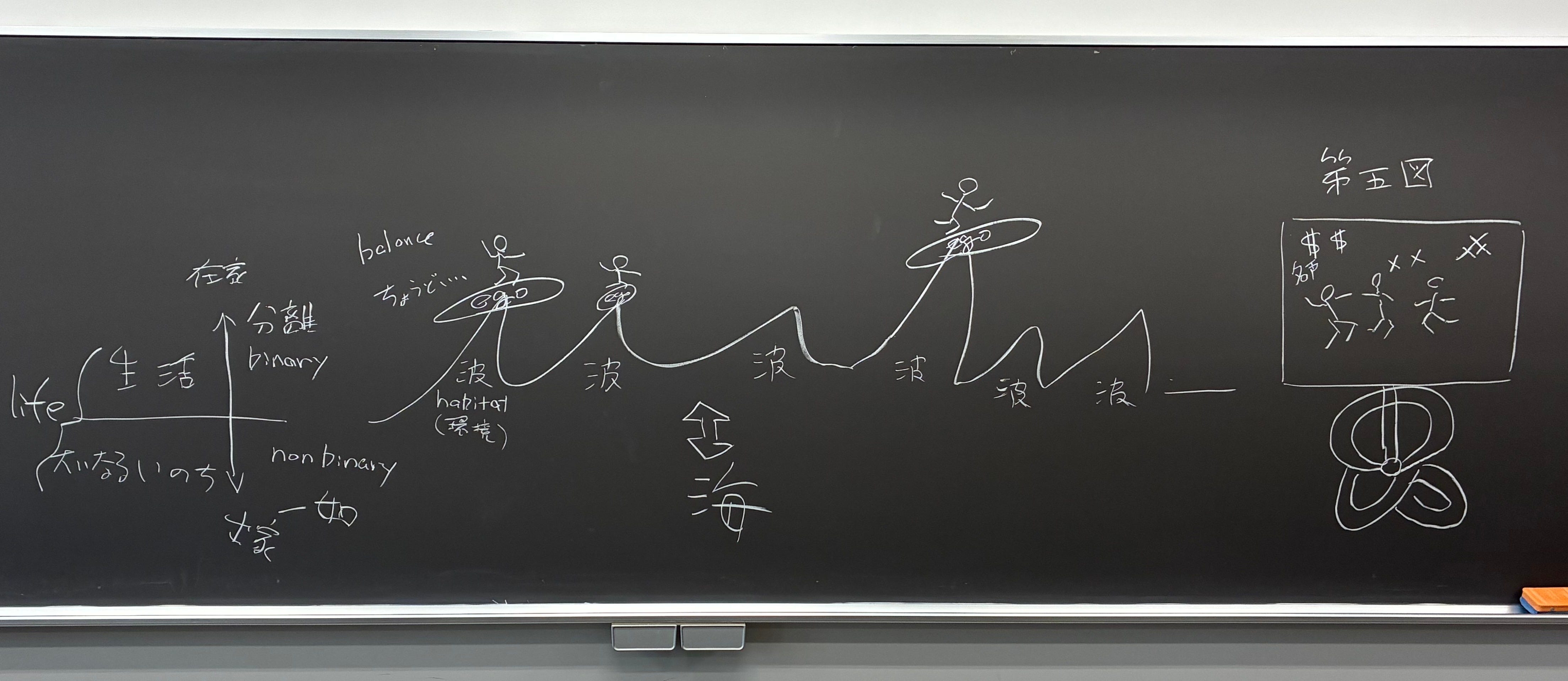
I should admit at the outset that the first image I reach for is an old one. Generations of teachers have used it — Thich Nhat Hanh among them, and countless monks before and since: each of us is a wave, and the ocean is what we are made of. The wave rises, holds its shape for a moment, and returns. There was never any separation. The substance was always just water.
It is a beautiful image, and it does not belong to me; I am only one more person grateful to have received it. But I want to use it as a doorway, because the interesting part is not the ocean. It is what happens when you try to live as a wave who has heard that, underneath, there is only ocean.
Because in this world, we cannot help seeing ourselves as separate waves. This is my wave. That is yours. Which one is bigger? That comparing, that sense of a distinct self with a name and a passport and a history — that is what we call identity. And a wave that has glimpsed the ocean still has to wake up the next morning and be a wave.
The surfboard
So here is the image I actually use, the one that carries the idea further. Picture not only the wave, but a surfer riding it.
Let me be precise about who is who. The wave is not you. The wave is your habitat — the place and circumstances you find yourself in, the people around you, even what you own: the whole moving situation of your life, rising and falling and never holding still. The surfer is you: this body, this particular self, meeting that wave. And under the surfer’s feet is a board. On the board, in plain letters, a single word is printed: EGO.
The ultimate destination, if you follow the logic of Buddhism all the way down, is to become the ocean — to be a Buddha, who has no ego, no board, no need to ride anything because there is no longer anyone separate to do the riding. But here is the part that rarely gets said plainly: if you actually arrived there, you could not stay in this world. You would have no identity, no agency, none of the equipment this particular world runs on. You would have to retreat to a monastery, or you would simply not survive here.
I have no wish to leave. I like this secular life — the work, the friendships, the wine, the ordinary mornings. And to stay here and ride well, I need my board. The ego is not a flaw to be sanded off. It is the thing that gives me alignment, that lets me meet the wave and move with it instead of being thrown.
Which means the real question is not how do I get rid of my ego? It is what is the right size for it? A board too large is unwieldy; it capsizes you, it harms others, it harms you. A board too small cannot catch the wave at all — you sink, you cannot function, you cannot stay upright in the world. What you want is a decent amount. Not too big, not too small. And then two ongoing tasks: tending the size of the board, and learning how to use it.
This is why I prefer the surfboard to the language of selflessness. “Selflessness” points only downward, toward less and less, as if zero were the prize. The surfboard points toward calibration — toward the humbler, lifelong work of getting the size right for the wave you are actually on.
A one-day ego
A few years ago I met someone who showed me what a well-calibrated ego can look like, and her answer surprised me.
It was Audrey Tang, Taiwan’s former digital minister. There is a quality to her that I can only describe as having almost no ego at all — completely natural, nothing to defend. So I asked her directly: do you have an ego?
At first she said no. Then she reconsidered. “I have an ego,” she said, “but my ego only lasts for one day. When I wake in the morning, it arises. When I go to sleep, it dies. The next morning, after eight hours of sleep, I am reborn.”
She renews herself daily. And I pressed her — if you live like that, how do you hold a dream, a purpose, even a schedule? This very meeting between us had been arranged a month earlier. How do you account for that?
Her answer has stayed with me ever since. “This meeting,” she said, “is a great gift from myself one month ago.”
A month ago, her self had already become her own ancestor. We usually think of being a good ancestor as something we do for future generations. But here it folded inward: to be a good ancestor is also to leave a gift for the self who wakes up tomorrow. Not a smaller ego, not a bigger one. A one-day ego — picked up in the morning, set down at night, never mistaken for something permanent.
A fresh board every morning
That, I think, is the heart of it. The one-day ego is not the absence of a surfboard. It is the practice of waxing a fresh board each morning and paddling back out — taking up the ego you need for today, and then, at night, setting it down again without clinging.
And the board can change, because the wave changes. The sea is never the same two mornings running; some days are glassy and small, some days are heavy and steep. You are allowed — you are meant — to choose a board suited to the conditions you actually wake up to, rather than forcing yesterday’s board onto today’s water. The self you need for a calm day is not the self you need for a storm.
Because clinging to the board is its own danger. If you grip too hard, if you become too attached to one shape of self, the very thing that was keeping you upright starts to pull you under. The leash around your ankle that connects you to the board can also drag you down if the wave turns and you refuse to let go. Some readers will hear an old echo here — the Buddha’s raft, the one you build to cross the river and then lay down on the far bank rather than carry on your back. The instinct is the same: what serves you is meant to be set down, not clutched. The only difference is that a surfer does not cross once and arrive. You paddle back out tomorrow, and take up a board again.
So the work is not to renounce the ego, and not to inflate it, but something quieter and harder: to hold it lightly. To trust that you can set it down each night and find a board again in the morning. For me this is where the surfboard finally touches what I can only call radical trust — the willingness to meet whatever wave comes, desirable or not, without needing to control the sea. You do not steer the ocean. You cannot. You can only choose, each morning, the size of the board you carry, and how lightly you hold it.
I have written elsewhere that only a sliver of any day is genuinely ours to steer; the rest is the momentum of habit and the weather of a world far larger than our intentions. The board is what we do with that sliver. Not a tool for conquering the wave. Just the small, daily art of riding it well, and letting it go.
So the next time you are out past the break, you might ask yourself, gently: the ego I am carrying today — is it the right size for this wave? And can I set it down tonight, and trust there will be another board in the morning?
In one line: Buddhism’s “no-self” is not about erasing the ego but about carrying one of the right size — a board you wax fresh each morning, suited to the day’s waves, and hold lightly enough to set down at night.
Themes: no-self, ego, the right-sized ego, surfboard metaphor, wave and ocean, habitat, one-day ego, Audrey Tang, good ancestor, radical trust, no control, Ambient Buddhism
Related: Not Everything Is Your Karma. The Buddha Said So.