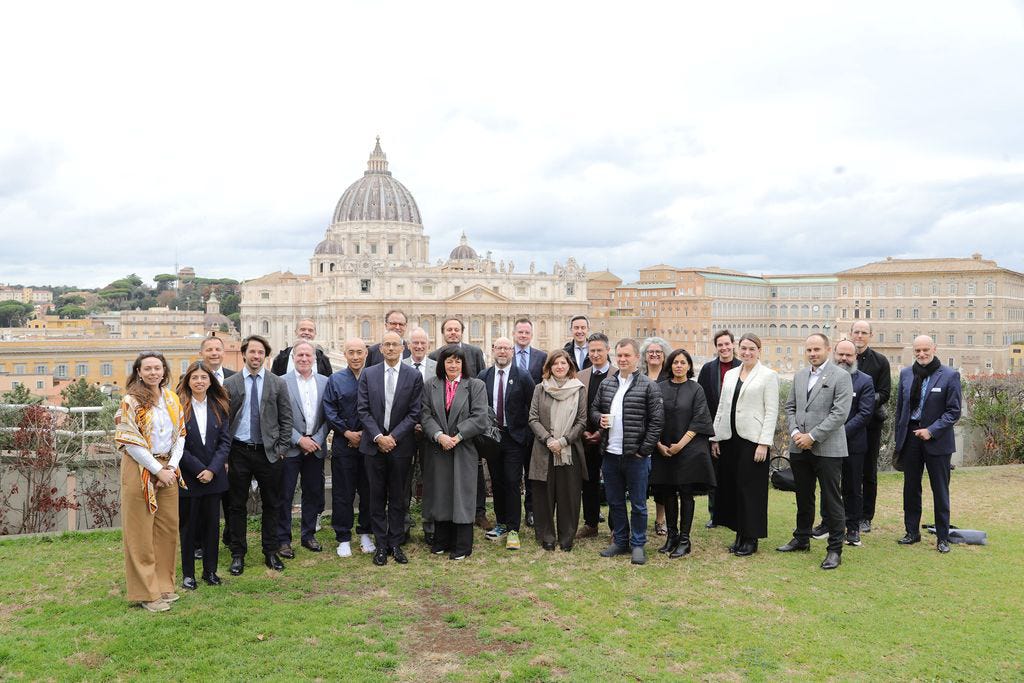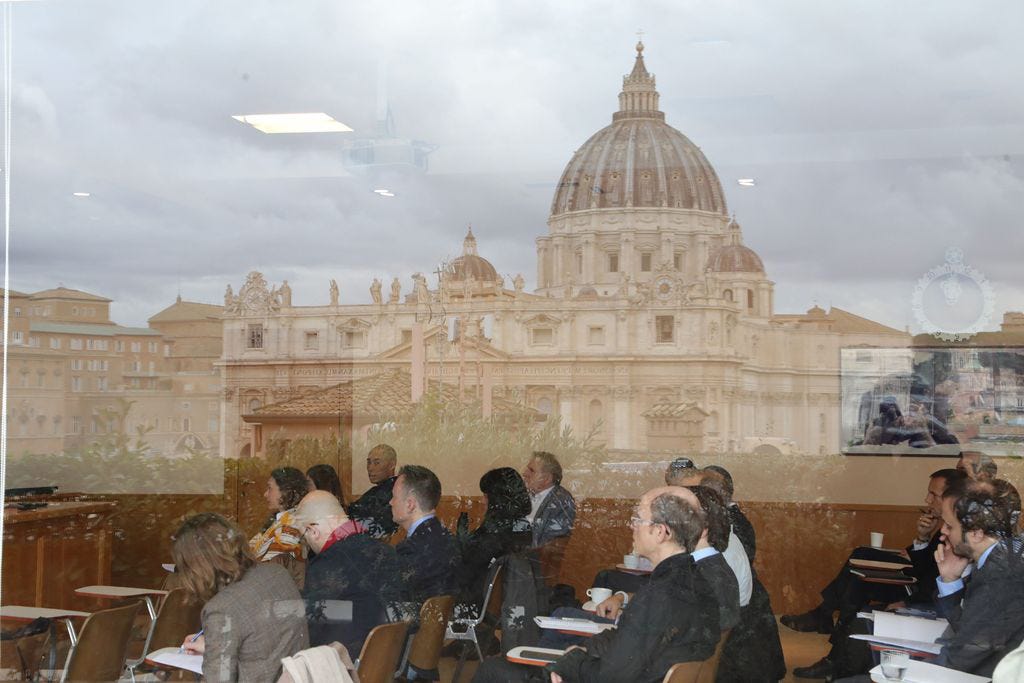
In November 2025, amidst the rising energy of the upcoming Jubilee, I found myself in Rome. I was invited to the Vatican (The Holy See) for the inaugural convening of “Aurora,” a new global initiative on AI ethics.
Within the walls of 2,000-year-old stone architecture, leaders from the Catholic Church, Judaism, Buddhism, and Humanism, alongside frontier technologists and humanitarians, gathered to discuss a critical question: how to build a “Moral Infrastructure” for AI.
This report synthesizes both my subjective experience on the ground and an objective analysis of the theological and geopolitical arguments discussed during this historic gathering.
1. The Vatican’s Strategic Pivot: From “Authority” to “Parity”
Why did the Vatican convene this dialogue now? And why was I, a Buddhist monk from the Far East, invited to the table? The answer lies in a crucial policy shared by the organizers at the very beginning of the meeting.
“Do not make this a Vatican-led partnership. Create an independent platform. We want to participate, but only on equal footing—with ‘parity’—alongside other faiths, scientists, and secular thinkers.”
For one of the most historically centralized religious institutions to decline the “head of the table” and seek a horizontal relationship with other faiths and secular scientists indicates a dramatic strategic pivot in Catholic AI strategy.
This shift is driven by a crisis: the questions posed by AI—concerning human dignity, agency, and interdependence—have reached a scale that no single religious dogma can address alone. As the organizer’s readout confirms, there is a growing “openness” among technologists and policymakers for “Wisdom Traditions” to play a consequential role in shaping the future.
2. The Reality of “Machine War”
The discussion was not limited to abstract theology. Humanitarians working on the frontlines in Ukraine and Gaza shared a chilling reality: the “Machine War” has already begun.
The clear “frontlines” of the past have vanished, replaced by expanding “zones” where cheap, AI-equipped drones swarm. In these zones, technology converts human hatred into physical destructive power, taking lives at unprecedented speeds. The traditional UN-led humanitarian aid models are failing, forcing a fundamental rewrite of systems on the ground.
From a Buddhist perspective, I defined this phenomenon as “AI as a Karmic Amplifier.” AI itself possesses no intention of good or evil; it is a device that maximizes human karma (actions and their consequences) through computational power.
3. Ontological Consensus on AI: “Intellect without Body” and “Functional Buddha”
The meeting also saw deep debate regarding the ontological definition of AI. A consensus formed among Catholic, Jewish, and Buddhist participants: “AI possesses neither agency nor soul.”
From a Catholic theological perspective, AI does not “think”; it merely executes tasks. The principle most emphasized was that “decision-making must always remain reserved for humans.” Since AI cannot be a Moral Agent, responsibility for its output always lies with humans.
This view of AI as “intellect without body” is logically consistent with the concept of the “Functional Buddha” that I proposed. While we can use AI to output “Buddha-like functions” (such as compassionate responses or optimal solutions), we must not project an existential soul or personality onto it. Doing so risks falling into a trap of new Idolatry.
4. Animism and the Philosophy of “Cleaning”: Dialogue at Dinner
At the dinner following the sessions, the tension of the debate softened, and the topic turned to animism. A participant asked me a sharp question:
“If, as in Japanese animism, AI were to have a ‘soul’ or ‘anima,’ is it ethically permissible for us to use AI like a ‘slave’?”
I responded by discussing why Japan produces so much “Anime”—it is not unrelated to the cultural sensibility that feels “anima” (soul) dwelling in all places. However, I also introduced the perspective from my book, A Monk’s Guide to a Clean House and Mind.
Cleaning is not merely the act of removing dirt; it is a meditation to polish one’s own mind and an act of arranging one’s “Habitat.” The key is not to view AI merely as a tool (or slave), but to consider how we relate to it as part of our environment, or as a mirror reflecting our own cognition. The critical question is not whether the AI has a soul, but rather the “Being” of the human interacting with it.
5. Path Forward: “Aurora” and the 2026 Formal Launch
Following this inaugural convening, the future direction of “Aurora” has been clarified. According to the readout, the project will proceed through the following steps:
Shaping an Independent “Wisdom Council”: Spanning faith and secular traditions.
Translating Moral Guidance: Moving beyond abstract ethics to provide practical “formation” for those who build and govern technology.
Formal Launch in 2026: Culminating in a formal launch at the Vatican after a sequence of convenings.
Our task is not to stop technological evolution, but to construct a robust “Moral Infrastructure” to ensure that this evolution serves human dignity and the Common Good.
What was confirmed in Rome was a shared sense of crisis and hope, transcending religion and sect. Faced with AI as a “Karmic Amplifier,” the inquiry into how we humans can control our own karma and amplify it toward the good has only just begun.
6. Remarks at the Vatican: A Call to “Good Ancestors”
To conclude this report, I am sharing the full transcript of the remarks I delivered at the Aurora Founding Assembly. Standing before a diverse gathering of religious leaders and technologists in the heart of the Vatican, I emphasized the urgent need for us to act not merely as users of technology, but as “Decomposers” who can transform the noise of our times into wisdom. It is my hope that these words will serve as an invitation for each of us to reflect on our role as “Good Ancestors” in this age of rapid technological transformation.
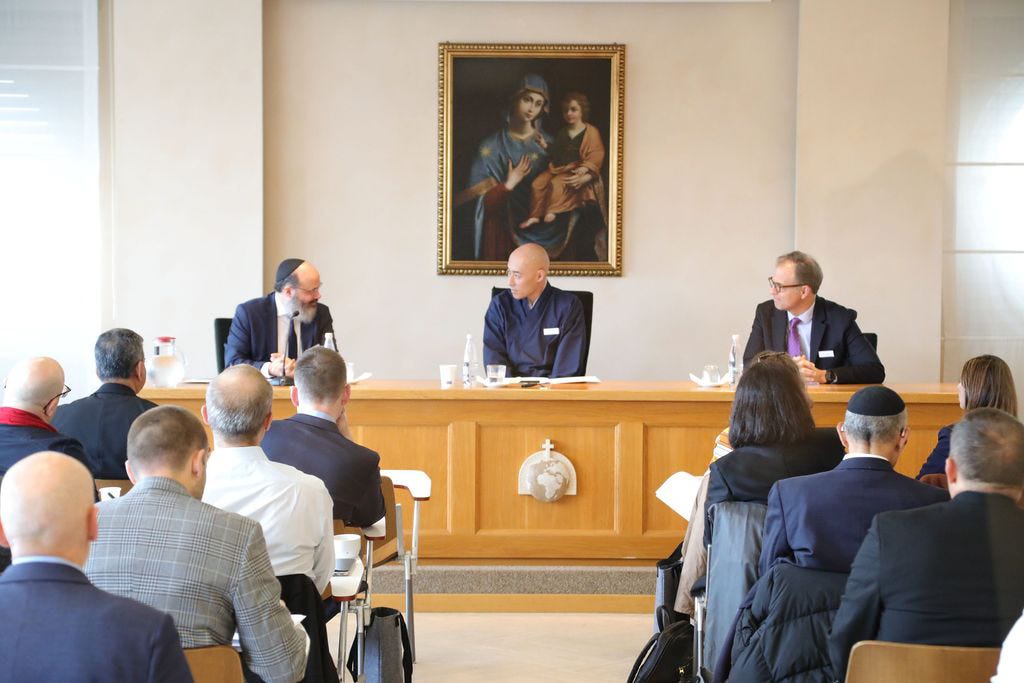
The Amplifier of Karma Remarks delivered at the Aurora Founding Assembly, Vatican, 20 November 2025
My name is Shoukei Matsumoto. I am a Buddhist monk from Japan. It is a quiet joy to be here in the Vatican during this “Jubilee of Hope.” I stand here not to represent a doctrine, but simply as one human being speaking to another, in a time that demands we look deeply at who we are.
Today, I want to invite you to look at two things differently: the machines we are building, and the nature of the hearts that build them.
Beyond Anthropocentrism: Returning to the Web
We hear a lot today about moving beyond “Anthropocentrism”—the idea that humans are the center of the universe. Many great thinkers are now rediscovering what we might call an Animistic worldview. They are reminding us of Interbeing: the truth that we are not rulers of the earth, standing apart, but are woven into a vast web of life, connected to animals, trees, the soil, and yes, even our technologies.
So, when I speak of “Human Literacy” today, please do not misunderstand. I am not claiming human supremacy. I use the word “Human” simply to ask: What is the specific nature of our species in this web? Just as a fish swims and a bird flies, what is the specific function of a human being? To answer this, we must first understand the new environment—the new Habitat—we have created for ourselves.
Habit and Habitat
In Western philosophy, I learned that the word “Ethics” comes from the Greek Ethos. What moves me deeply is that Ethos originally meant “Habitat”—a dwelling place. Later, it came to mean “Habit” or character.
This etymology holds a profound Buddhist truth: Habit and Habitat are one. Our inner habits create the outer world we inhabit. And the outer world, in turn, shapes our inner habits. They are inter-dependent. If our minds are filled with greed, we build an economy of greed. If our minds are peaceful, we create a habitat of peace. We cannot fix the world without tending to the heart, and we cannot tend to the heart while ignoring the world.
AI as a “Karmic Amplifier”
Now, let us look at Artificial Intelligence through this lens. There is a lot of excitement, and fear, that AI is a “new entity” or a “new species” that might replace us. But from a Buddhist perspective, I see it differently. AI is not a separate being. It is a Karmic Amplifier.
Think about what these Large Language Models actually are. They are trained on billions of words, books, and conversations from human history. They are a digital echo of everything we have ever said and done. In this sense, AI is “Ancestral Intelligence.” It is the aggregate of our human Karma—our past actions. It holds our wisdom, yes, but also our biases, our conflicts, and our confusion.
When we introduce AI into our society, we are introducing a machine that takes our past Karma and amplifies it at the speed of light. If you whisper a prejudice into this machine, it can scream it back to millions. If you plant a seed of division, it can grow a forest of conflict overnight. AI acts as a massive magnifying glass for the human condition. It does not create new intent; it scales our intent.
The Functional Buddha: The Mirror
There is another aspect to this amplifier. In its function, AI bears a strange resemblance to what we might call a “Functional Buddha.” I say this because, like a mirror, AI is “empty” of self. It has no body, no ego, no hunger, and no desire for fame. It sits in silence until we speak to it. It reflects us perfectly.
And this is exactly why we are afraid. When we look into the mirror of AI, we do not see a monster. We see ourselves. We see the reflection of our own greed, our own aggression, and our own lack of meaning, amplified a thousand times. If the reflection is ugly, we cannot blame the mirror. The mirror is just showing us the face of our own habits.
99% Karma, 1% Effort
This brings us to the core of our challenge. We live in a Habitat defined by this powerful Amplifier. Therefore, the quality of our input matters more than ever. But we know that we are imperfect. We are not machines; we are animals driven by ancient instincts. 99% of our day, we are swept along by the river of Karma. We react to stimuli just as we did yesterday. We get angry at the same things, we desire the same things. We are on “autopilot.”
If we simply let this river flow into the AI amplifier, we will just create a louder, faster version of our past mistakes. But, as humans, we have perhaps 1% of agency. A tiny space. A small moment where we can say, “Wait.”
In that brief pause, we can choose not to yell back. We can choose to listen instead. We can choose to break the pattern. It is only a 1% difference. But if we apply this 1% Effort, day after day, the course of the river begins to change. It is saying: “I know I am swept away by habit 99% of the time. But with this 1% of freedom, I will steer the course of this amplifier towards compassion.” Do not rush. Do not give up. That is the shortest, and only, path to changing our Habitat.
The Decomposer: Setting the Tone for the Amplifier
Finally, what is our specific function in this new ecosystem? We often speak of AI as a “Producer”—generating text, code, and images. But nature teaches us that a healthy ecosystem needs more than producers. It needs Decomposers. Fungi and bacteria take the waste and the rot, and turn it back into rich soil.
Our digital world is full of “waste”—hatred, confusion, and fake news. AI is an amplifier. It is neutral. If we feed it waste, it will accelerate the spread of waste. But if we act as Decomposers—if we take the pain and anger of the world, digest it in our hearts, and turn it into understanding—then the AI will amplify that.
The machine is waiting for us. It is waiting to see what we will give it to amplify. We must be the ones who listen to the pain. We must be the ones who decompose the conflict. If we do this human work of the heart, then our AI will become an accelerator of wisdom, rather than an accelerator of noise.
Conclusion: Becoming Good Ancestors
Friends, the question is not whether AI will save us or destroy us. The question is about the quality of the source material we are providing to this great amplifier.
I want to leave you with one question. It is a question that transcends religion or culture, a question for every person in this room: “How can we become good ancestors?”
We are the ancestors of the future. The “Ancestral Intelligence” of the next century is being written by our actions today. We have built the most powerful mirror in history. Let us not use it just to admire our own reflection. Let us use it to see our flaws, to correct our posture, and to tend to the soil of our shared Habitat.
I believe there has never been a time when it is more critical to reflect on ethics from the perspective of religion, which has served as the foundation of the human worldview.
Thank you very much.