

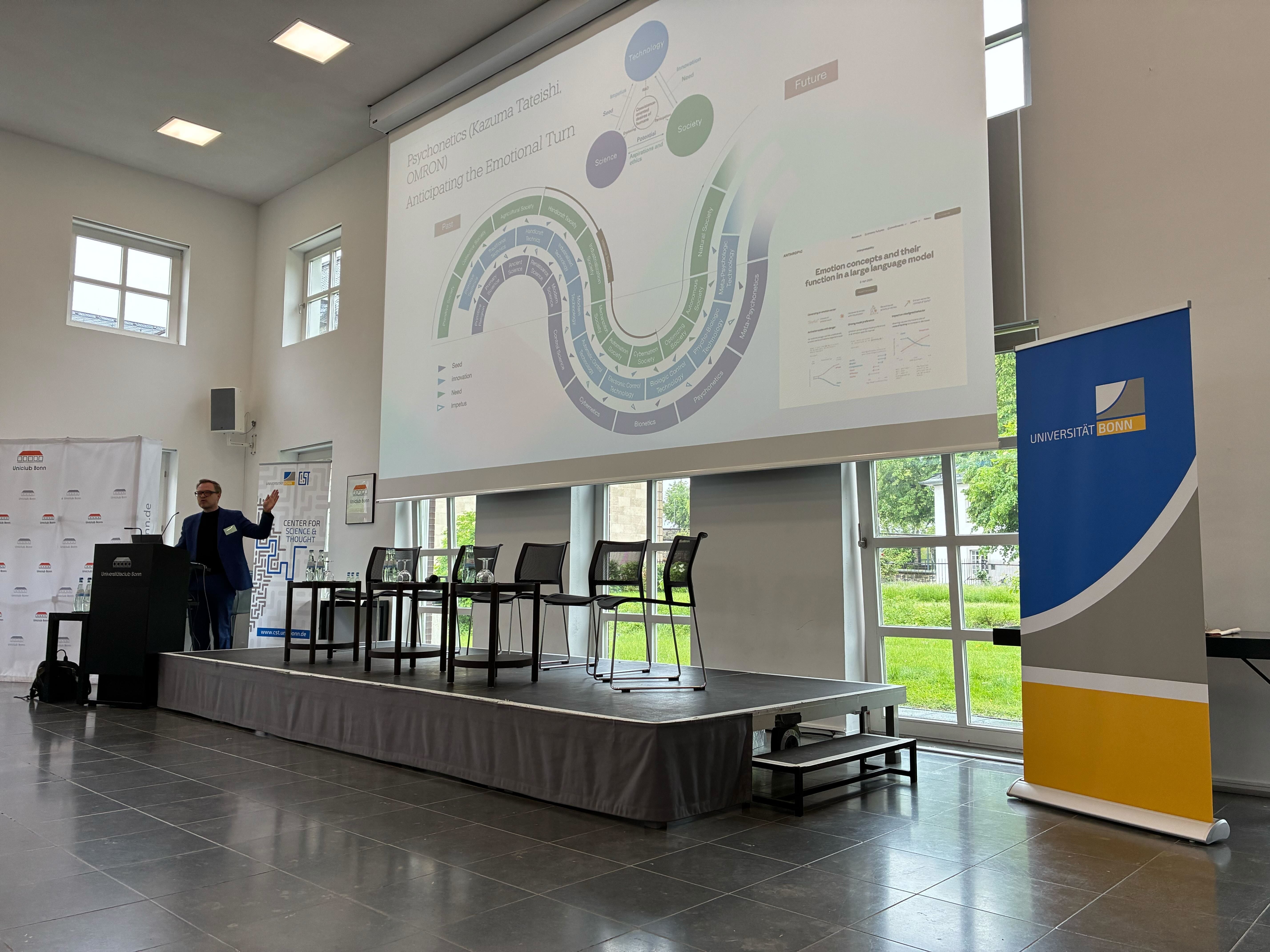
In May I spent three days in Bonn, at a conference called Irrationality and the Age of AI: Language, Ethics, and the Future of Human Expression, convened by Markus Gabriel and the Center for Science and Thought at the University of Bonn under their Desirable AI project. It is part of the research program Desirable Digitalisation: Rethinking AI for Just and Sustainable Futures, run together with the University of Cambridge. Philosophers, artists, engineers, executives, all in one room.
The conference was not streamed. A closed room, in the old sense, and because it was closed, it could go deep. Over three days I watched people open, and possibilities open with them. What I carried home was a notebook. I let it ferment for two months. So what follows is not the conference. It is what a closed room grew in one participant, reconstructed from memory and handwriting. Where I bend anyone’s words, the bending is mine.
One moment stayed more than the rest.
Markus was giving his keynote. Halfway through, a slide appeared with a name from my side of the world. OMRON, the Kyoto company that built the world’s first automated ticket gate. Since the 1970s, he told the room, its founder Kazuma Tateishi had been forecasting the next technology with computational models, in research groups full of social scientists, humanists, philosophers, and economists. And they had predicted, half a century in advance, that right around the mid-2020s technology would move into the realm of emotions.
I sat very still. The prediction is called SINIC theory. I have been living with it for years. I did not expect to meet it on a screen in Bonn, at a conference about feeling.
Markus’s larger argument, compressed to what my notebook holds: for decades, intelligence had a definition. The capacity to solve a given problem in a given amount of time. Whatever solves it faster is more intelligent. Intelligence was optimization. And the field ran on a simple game. A philosopher declares what AI cannot do, and a company builds it. If you want to stop AI progress, he said, stop telling it what it can’t do. Then came the sentence I underlined twice: that epoch ended a couple of years ago. By some estimates, 2024 was the first year more machine-made text appeared online than human-made text. The count can be argued. The direction cannot.
And optimization did not retire. It moved. The attention economy became the emotional economy. He marked it with a date, May 13, 2024, a chatbot launch, and a founder’s one-word tweet: her. People began using these systems not to find information but to be accompanied. About the machinery underneath, he was blunt. Replies shaped by retention strategy. Systems reading your typos, because what you mistype says more about your state of mind than what you type. What you miss, he said, is more interesting than what you say.
This is what I mean when I say the optimization society is ending. Not that optimization stops. It is finished the way a coat of paint is finished. It covers everything, including our feelings, the last wall, being painted now. And a finished optimization no longer needs most of us to do the optimizing. The role has not been vacated evenly. Most of us were relieved of the optimizer’s job. A few moved upstairs, to optimize the optimizers. But for the many, the question stands open: what do we do with the vacancy?
Here is the knot I have been turning over all summer. Complete, I keep saying. And my own tradition teaches that completion is an illusion. That same morning in Bonn, before Markus spoke, I had led a session of my own, listed in the program as a Pop-up Temple, The Practice of Emptying. We cleaned the venue together, no roles assigned, no finish line defined, and the room found its own order. Then we chanted the Heart Sutra and breathed for a while with our ancestors. I told the room what a monk learns with a broom. One hundred percent does not exist. Eighty to ninety percent is the honest ceiling, because a floor is never done being a floor.
So which is it? Is optimization complete, or is completion a fantasy? Both, and that is the point. Optimization is now complete in extent and impossible in degree. It reaches everywhere, and it can be finished nowhere. Markus said the same thing through another door, scolding his country’s industry for waiting for a perfect, hallucination-free AI before adopting it. Every chatbot is bad in its own particular way, he said, and that is the point. The perfect AI is not one flawless machine but a whole distributed society of imperfect ones. Perfection belongs to no single hand. A broom teaches the same in four words: eighty to ninety percent. And a game that can never be won, played everywhere, forever, stops being a game. It becomes weather.
What is left for us, then?
One afternoon in Bonn, talking with the team behind a telepresence robot, I reached for a cartoon from my childhood, and in telling it I heard what I actually think. Doraemon, the robot cat with a pocket full of miraculous tools, can do almost anything. And Doraemon does nothing on his own, because Doraemon has no wish. The story needs Nobita, the lazy boy who wants things.
A prompt is a wish.
The machines have capacity without wish. We have wish, and never enough capacity, and that shortfall was the engine all along. For the whole optimization society we were embarrassed by it, and tried to fix ourselves on the capacity side. Our side was never capacity. Our side is the wishing. The attending. The being in one place at a time, with one attention that cannot be copied to a million devices, and that traces, over a life, the shape of that life.
SINIC does not stop at the end of optimization. Tateishi drew a bridge after it, a graduation period, in which people and things learn to stand and run on their own. And beyond the bridge, a society written with the characters 自然. In modern Japanese you read them shizen, nature. There is an older reading, the one Shinran loved: jinen. Of itself, so. A tree does not optimize toward being a tree. It grows, in relation, at its own pace, and it is never finished. A society like that is not run toward a target. It is tended, like a garden, at eighty or ninety percent, forever.
Near the end of his talk, Markus said we will learn to live with AI as a kind of mist. Not a tool, not a monster. A mist between us and our systems, touching us mostly at the level of feeling. I believe him. That mist will stay. But there is another fog, and that one is lifting: the belief that one hundred percent was ever there to reach. In Kyoto, fog settles in the river valley on autumn mornings. Nobody optimizes it, nobody owns it, and when it lifts, the mountain it hid was there the whole time.
The optimization society ends like that. Not with an announcement. One morning the air is simply different. The machines go on optimizing, like weather. And we are left facing the mountain: wish, attention, place. The garden is never finished, and has stopped trying to be.
In one line: At a closed conference in Bonn, a German philosopher cites a 1970 prediction from Kyoto, and the optimization society turns out to end by covering everything, leaving our hands, and handing us back the wishing.
Themes: optimization society, SINIC theory, Kazuma Tateishi, Omron, Markus Gabriel, the emotional turn, attention economy, emotional economy, Turing epoch, completion and imperfection, eighty to ninety percent, soji, Heart Sutra, Doraemon and Nobita, wish, attention, place, jinen, shizen, mist.
The occasion: Irrationality and the Age of AI: Language, Ethics, and the Future of Human Expression, a conference by the Desirable AI project at the Center for Science and Thought, University of Bonn, May 2026, with the University of Cambridge. Not streamed, not recorded. Written from memory and a notebook.
The occasion: Irrationality and the Age of AI: Language, Ethics, and the Future of Human Expression, a conference by the Desirable AI project at the Center for Science and Thought, University of Bonn, May 2026, with the University of Cambridge. Not streamed, not recorded. Written from memory and a notebook.
Related: The Circle That Will Not Close. A Fish from the Stream. Not Everything Is Your Karma. AI is a “Karmic Amplifier”.