

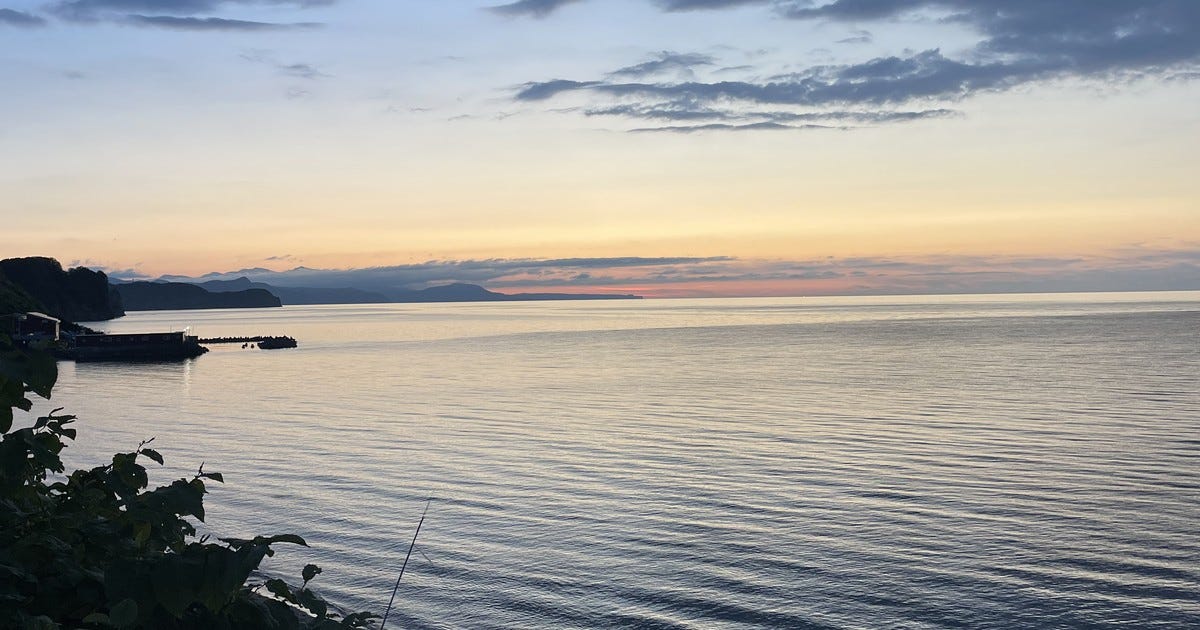
I grew up in a fishing village in Hokkaido, by the sea. As a boy I walked the shore almost every day, alone, and stood looking at the horizon. I was going to get out. Whatever was on the other side of that line, I was going to reach it. I don’t think I ever pictured what it was. The line itself was enough.
I did get out. I left for Tokyo, became a priest, trained in Kyoto. My son was born. When he was small I went to India for business school and took him with me. The year after we came home, I started a school for temple leaders. After that I was invited to places and I went. Conferences, temples, universities, other people’s countries. If you had asked me at twenty what I wanted, this was it, more or less. The far side of the line, over and over.
Somewhere in the middle of all that going, something turned around. There was no day when it happened. I only noticed afterward that the wanting had changed direction, the way you notice a season has changed.
Part of it came from a book. During my training in Kyoto one of the teachers handed me a book that was not a Buddhist book at all. It was one of those books meant to wake the reader up. I have lost the title, and it is the kind of book where that hardly matters. One passage in it stayed.
The author said that time travel does not exist. I read this the obvious way, that we cannot travel to the past or the future, and thought no more about it.
Then, rereading it years later, I saw what he meant.
Picture a window in your room. Suppose the window opens onto a hundred years from now. You put your head out. The people going past are not people of this year, and the street and the clothes and the light are all a century away. Now suppose another window that opens onto thirty years ago. You put your head out. The street is the one you remember. There is a friend, thirty years younger. There is your family, your parents about the age you are now. And there, walking past, is you. A child. A teenager. This must be time travel. Not a picture of that year. That year.
But you are still here, at the window. So go further. Climb through. Step down into that street. Your younger self walks right past you. And you are still here. You did not go anywhere. You cannot.
The point is not that the past and the future are shut. It is that there is no way for me to leave here. Not into another time, not into another place, not into anyone else. This body is the shape of where I am, and I do not get to be outside it.
When that landed I was frightened. It was like being shut in an elevator with the doors not opening. I could not think my way out in any direction. So I stopped looking at it, and went on with the day. It would come back when I was not expecting it, and each time the same closed feeling came with it.
What changed was slow, and I cannot point to the moment. All that going had something to do with it. After enough of those trips, the other side of the line was not a place anymore. You arrive, and there you are, in the same body, with the same day in front of you. I had to go out to learn it. Other people do not have to.
Then one afternoon I was walking on the beach in Barcelona. Nothing was happening. It came to me that my temple was not in any city. It was this planet. And in the same moment, that my temple was this body. The two sat together without contradiction. I walked back to the cafe where I had been working.
The closed feeling had not gone anywhere. It was still true that I could not get out. But it had stopped being a cell. If I am only ever here, then here is where everything is. There is nowhere else for it to be.
The mirror
I am writing this down now, after twenty years of not writing it down, because of AI.
Not because AI taught me anything about myself. What has changed is that the question is being asked out loud. What is a human being, now. People answer it by naming the thing we have that the machines do not. For a long time that was thinking. Now it is more often feeling, or the body, or knowing that we will die. The item keeps changing. The reaching does not.
While we were the only ones thinking, that answer was not visible as an answer. It was the water we were in. Now something else does it too, and the reaching can be seen from the outside for the first time. Not whether the machines think. What I can see is us, holding up whatever is still ours, at the exact moment it stops being ours alone.
People say AI is a mirror, usually meaning our biases. The older fact about mirrors interests me more. Your own face is the one face you cannot see. Everyone else’s is available to you all day long, and your own comes back only in water, or in polished metal, or in what other people tell you. Something like that has been true of thinking.
No mirror is clean, and this one is bent in ways nobody has sorted out yet. But a bent mirror still shows you a face you have never seen.
Once you have seen the reflex, the question is open again. What is left, then. I have only what I found on the two shores. I am here and nowhere else. I cannot step out of this body, this moment, this ground under my feet. Whatever is different about me is not that my mind goes everywhere. My mind does not go anywhere. I go with it, and I am always here.
Buddhism has a word for this, bonbu. The ordinary person, who cannot see the whole or hold it, and takes it in through one small opening. For a long time I heard it as a low place to climb out of. The teaching I have been hearing was saying something else all along, and it took me years to receive it. The bonbu is not on his way to becoming something better. He is held as he is, the whole way, by what does not wait for him to see it.
The ground under my feet
Under all of it there is soil, and it was there the whole time. Nothing stands by itself. What I am is made, at every moment, out of what I am not. Air, the dead, the not yet born, and lives I will never hear about. That is not a bigger version of the warmth we feel for our own kind. That warmth goes as far as likeness goes and stops. A stranger a hundred years from now has no face for me to read. Something else holds me to that stranger, and it was holding me before I gave it any thought.
The ground underneath is continuous. On the surface we are divided, near and far, ours and theirs. Dig down past the walls and the divisions thin out. Under this shore and under the one on the other side of the world is the same ground. That is the thing about the horizon I could not see back then. There is no other side. There is one continuous ground, and I am standing on it.
So the work is not to build a wider idea of ourselves, stretched to cover the trees and the machines and the descendants. The work is smaller. Tend the soil, and the only soil I can tend is the ground under my feet. The whole planet is not mine to manage. The small habitat I am rooted in, and what shares it with me. This morning I opened the windows at home, the way I do every morning, and let the air move through the house.
Being a good ancestor is this and not more than this. The people we would be good ancestors for cannot be met or felt. They give nothing back, not even recognition. We cannot love them the way we love our own, and we cannot climb through the window and fix their world. We can only tend the ground we are standing on. I know what this leaves out. Nothing done on this ground will cool the climate or govern a machine, and the people working on those things are not wrong to work on them. Still, this is the part I can reach. What I put into this small piece of ground does not stay here. It travels underneath, to shores I will never walk and to the feet of people not yet born.
I still walk on beaches when I can. Thirty years ago I stood on a different shore, looking at the same line, wanting to be past it. The line has not moved.
In one line: I spent my youth trying to get past the horizon, and what I found instead was that I cannot leave the ground under my feet, which turns out to be the whole of what I have.
Themes: locality, the body, bonbu, being a good ancestor, AI as a mirror, soil.
Related: The Circle That Will Not Close. A Fish from the Stream. A Broom for the Fog.
English is not my first language. AI helps me write across that distance.