

On the last morning of July, I sat in the main hall of Komyoji, my home temple in Tokyo, with a guest who had spent three days in rooms full of keynotes and interviews. We began the way every morning begins here: with chanting. The text was a hymn Shinran wrote eight hundred years ago in classical Chinese. I handed her an English translation, just in case. She did not need it. “We grew up reading pretty much exactly the same,” she said. Ninety-five percent of the text was clear to her. Only the old word order slowed her down. Her uncle in Taiwan, she added, chants the name of Amida Buddha thousands of times, counting with a smart bead.
The guest was Audrey Tang, Taiwan’s first digital minister. That morning she was the person on the next cushion, reading Shinran in the original.
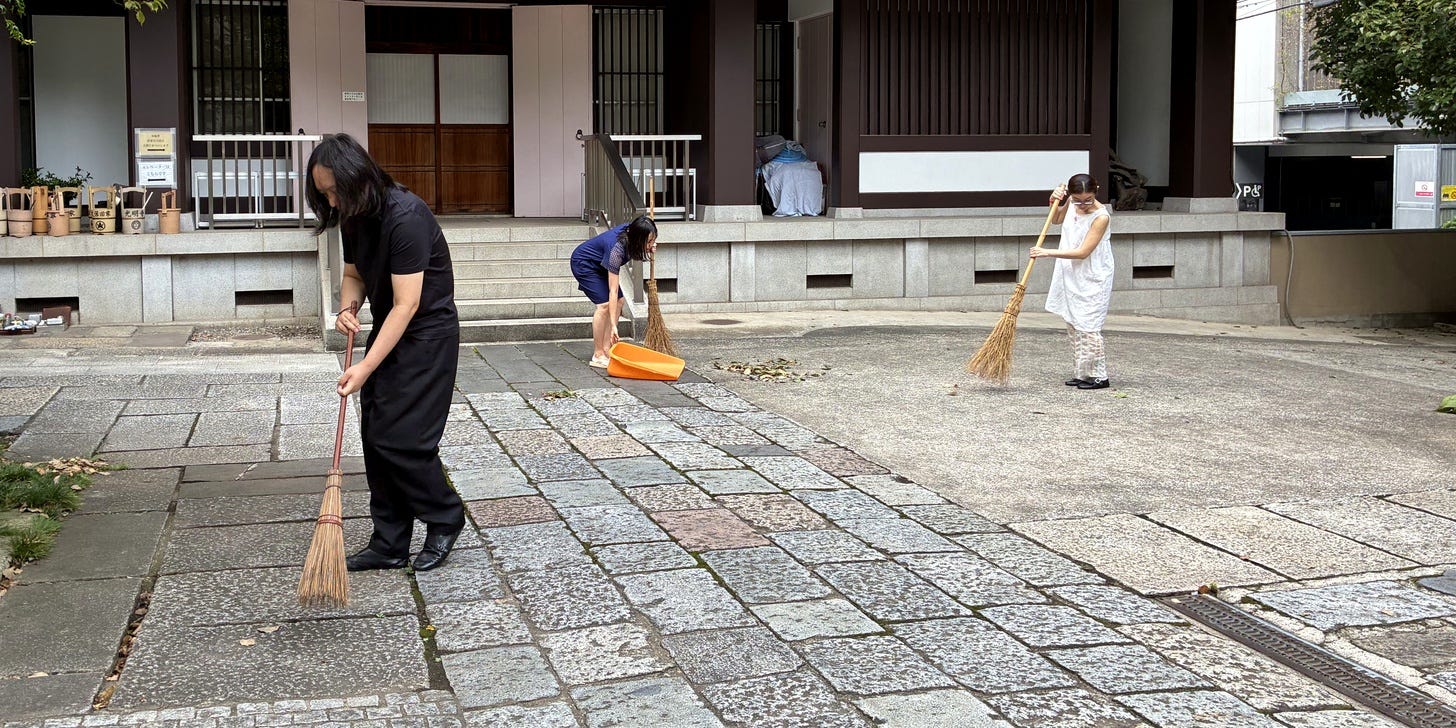
After chanting we did what we always do next: soji, cleaning. I handed her a bamboo broom and we swept the open grounds of the temple, gathering the fallen leaves in one spot. When we finished she said: “It feels like there is no need to be perfect. We cannot do a hundred percent. It is just not possible, with the shape of the broom and the length of the handle. So we do whatever we can, and in doing what we can, we feel satisfied. It is in the journey, not in the score.”
I have been writing about soji for more than ten years. I am writing a new book about it now. A first-time guest with a bamboo broom had said, in one breath, what I have been circling for a decade.
Back in the hall, I told her why the book exists. We are trained as optimizers. Through school, through work, through every exam and review, we learn one master skill: set a frame, then improve inside it. The frame varies. Revenue, GDP, test scores, follower counts. The motion is the same. I have written elsewhere about this motion and the circle it draws (https://www.living-dharma.com/p/the-circle-that-will-not-close). What I want to add here is what happened when I carried it back into Shinran’s vocabulary.
Setting the frame: Shinran had a word for the self’s version of this. Hakarai(計らい). The old translations say calculation, or contrivance. In 2026 I hear it more simply: the optimizing mindset. And working the world inside the frame, bending it toward my own will: he called that jiriki(自力). The dictionaries say self-power. Shinran meant it about the path to awakening. I am stretching it, on purpose, to the whole of modern life, where there is now a plainer word for it: self-optimization. We did not invent this habit in the age of KPIs. Shinran was describing it eight hundred years ago.
So when I start cleaning, I start as an optimizer: get everything clean, one hundred percent. And the moment I actually sweep, I understand there is no end to this. Leaves keep falling. For me, soji is an invitation to step out of optimization.
The timing of the invitation matters, because we now hold super-optimizers in our hands. AI is self-power without fatigue. As long as I define myself as an optimizer, I will not out-optimize it. The age of optimization is ending, and not because optimization fails. It is ending because optimization no longer needs us. When machines take over the work and it becomes cheap, one question is left standing in front of each of us: how, then, will you live?
Audrey listened and turned the whole thing over. “AI is not an optimizer by nature,” she said. “But by training.” Language models are condensed out of oceans of human conversation, and conversation is communal before it is competitive. Children are not born optimizers either. School makes them so. The same, she said, is true of the machines. “So we need to help AI restore to beginner’s mind.”
So it is not only humans who need sweeping.
Then she told a story. Her collaborator Tenzin, who sat with us, was raised in Tibetan Buddhism and had recently put a question to the Dalai Lama: AI is becoming more and more intelligent, a better and better optimizer, and yet it is not becoming more wise. If anything, the more intelligent it grows, the less wise it seems. What should we do?
The answer, as Audrey retold it in our hall, went like this. The mind is changing constantly, even in this moment of speaking. Moment by moment, kshana by kshana, a fraction of a second. But between people, minds do not change together. Why not? Because of ignorance. And AI is a tool. The question is where we point it.
Then Audrey carried it one step further. “This fog of ignorance is actually something AI is a good tool to clean. If we use AI to sweep between people, we can grow together better.” Point it not at individuals. Point it at the space between.
I felt the broom turn in my hand. I had always held soji as a practice for one’s own heart: you sweep the garden, and something in you settles. Her retelling moved the broom, from my heart to the space between us.
The afternoon gave a small taste of it. In the tea room, the conversation ran through Tenzin’s AI glasses. Whenever someone spoke Japanese, subtitles appeared in front of her eyes in real time. “Whenever we say anything, the entire world is subtitled,” someone laughed. A tool pointed at the space between languages, sweeping while we drank tea.
The next day I talked about all this with my fellow priests at the temple. What I told them was mostly about space: no frame contains the world; the world is never closed; every scoreboard is smaller than what it measures. In the days since, another side of it has kept working on me. A frame is not only smaller than the world. It is older than the world it maps.
The old texts say the root of ignorance is mistaking the impermanent for the permanent. In plain words: taking a frozen picture for a flowing world. Ignorance is not merely a lack of information. It is a snapshot mistaken for the stream. Everything follows from that. I act toward you from my picture of you, and my picture is at best a moment old, often years old. You act toward me from yours. Two people, each faithful to an outdated portrait of the other: that is the fog. Our conflicts come less from our minds being different than from our changes being out of step.
Seen this way, optimization has a second definition. It is acting from a frozen picture of the world, then defending the picture against the world. Modern systems update everything except the one thing that matters: the score itself, the definition of what counts, stays frozen. Plans are always a little late. Filter bubbles are snapshots made at industrial scale and thickened daily. And an AI model is a snapshot by construction, frozen at its training cutoff, and even when it reaches for the web, the reaching hand was frozen too. Tenzin told us, smiling, that since receiving her new name she has become invisible to the chatbots’ memory. Their training ends before her name begins. Audrey’s own habit says the same thing from the other side. During the day, she told us, she does not judge; she is with people, with the room. Then she sleeps eight hours, nine after a hard day. “If I don’t sleep enough, I just repeat yesterday.”
Sweeping between people is not a way to make everyone agree. A society without conflict, she said, would be a reef of oysters: comfortable, and without care. We are mammals. We are born helpless, we depend on each other, and our differences are part of how we care. The broom does not remove the stones in the garden. It clears the dust so the stones can be seen. To sweep the space between us is to clear away the old portraits, so that our differences can meet in the present instead of in each other’s archives.
And sweeping works best in a group. Alone with a broom, you soon start dreaming of a vacuum cleaner. In a group, she said, “the relationship becomes the intersubjective protagonist, and we are just vehicles of that relationship.” She learned this early, sweeping the schoolyard every morning in Taiwan with the same bamboo brooms as every other child.
So do we now have the tool that will clear the fog for good? Here Shinran does not let me finish the question. The picture-making does not stop. I cannot catch up with the present. Neither can my plans, or my institutions, or the best model in the world, which is itself a snapshot. Shinran’s word for someone like me is bonbu(凡夫). The old translation is foolish being. I hear it now as a helpless optimizer: one who cannot help it. Who knows every frame is a fiction, sorrows over it, and builds the next frame anyway. This is not a humility you can achieve. Make it a goal and it becomes another score. It comes from the ground instead: I finish sweeping, turn around, and the leaves are already falling on the swept path.
A Zen teacher once taught me an instruction from the training halls: practice at eighty or ninety percent. Not out of laziness. Because one hundred percent is a fiction. Leave a margin. From where the student stands, the margin is ten or twenty percent. From where the master stands, the margin has no edge.
This margin sits close to one more of Shinran’s words: tariki(他力). It is the only word in this essay I will not try to say in the language of optimization. Not exactly something we do. Not exactly something done to us. I will leave it at that.
Audrey used to answer the question of how to become a good ancestor this way: leave more options for future generations. Her newer answer has less optimizing in it: leave a wider canvas. I think the margin and the canvas are the same place. Optimization narrows the world toward a score. What we do not optimize, do not close, do not finish, is the canvas.
The fog will not fully lift. Our minds will not fully catch up: not with each other, not with the present, not with our tools. That is not a reason to put down the broom. It is the reason the broom exists. As my guest said on that first morning, setting down her broom: it is in the journey, not in the score.
In one line: Audrey Tang chants Shinran and sweeps a Tokyo temple, the Dalai Lama’s answer about where to point AI arrives secondhand over tea, and Shinran’s old words turn out to describe the age of optimization and its end.
Themes: soji, sweeping, Audrey Tang, Tenzin, the Dalai Lama, Komyoji, ignorance, fog, kshana, impermanence, frozen picture, optimization, hakarai, jiriki, self-optimization, bonbu, tariki, beginner’s mind, mammals and care, intersubjective protagonist, eighty to ninety percent, margin, wider canvas, good ancestor.
The occasion: A visit by Audrey Tang and her collaborator Tenzin to Komyoji temple, Tokyo, on the last morning of July 2026. Chanting, soji, and a tea gathering with the temple community. Shared with both guests before publication, and published with their green light. English is not my first language. AI helps me write across that distance.
Related: The Circle That Will Not Close. When Optimization Is Complete. AI is a “Karmic Amplifier”.
哇塞
Thank you for this wonderful essay.
This way of thinking was almost the complete opposite of how I’ve approached AI until now.
“To sweep the space between us is to clear away the old portraits, so that our differences can meet in the present instead of in each other’s archives.”
I want to keep these words in mind and think carefully about what I can do.