

I wrote a piece called Post-religion eight years ago. The first part below is that piece in English, shortened and not otherwise changed. The second part is from this week.
I. Post-religion (2018)
I became a monk because I disliked religion.
I was not born in a temple. My grandfather was a priest and his temple stood near my house, so the temple was my grandfather’s house. I stacked cushions into piles in the main hall and played there.
When I was still small I understood that everyone dies. My father would die, my mother would die, I would die. Everyone has to leave this world. Why live, if that is how it ends? Where we come from, what we are, where we go. Until those were settled I could not feel safe. The adults did not seem to be working on them. The death rate for human beings is one hundred percent and they were fine with it. I found that strange.
Funerals were held at the temple, and my grandfather went out to houses for them too. Something got settled there. He read sutras. That is all he did, and the people left behind went home calmer than they had arrived. I thought the answer to the death problem was somewhere in what he was reading.
After that I borrowed Buddhist books from him, asked him questions, listened when a preacher came to the temple. He lent me D. T. Suzuki on no-mind. Almost none of it was within reach of a primary school boy. I read to the end anyway, because I could feel it was about something real.
By junior high I wanted more, and went into town to the bookshop. Otaru, where I grew up in Hokkaido, had a small Kinokuniya by the station. Religion and philosophy sat next to self-help. I would pick up the recommended books stacked at the front, and almost all of them let me down. Founders of new religions, star teachers of self-improvement. Some of it was good, and then the selling showed through. The ask was always the same. Come to the meeting. Become a member. The books I actually wanted were off in a corner with dust on them. I could not work out how they had ended up there.
I think I was idealizing religion. The Aum Shinrikyo sarin attack on the subway happened when I was fifteen, and cults were active around then, which probably has something to do with why I wanted religion to be better than that.
However good the opening, it arrived at the same place. Our founder is the finest man alive. Give more. Money, growing the organization, ego. Then terror, and fuel for wars. Religion is supposed to be about how to live, how to think, how to see the world.
My grandfather was a country priest people liked, turning nobody away and chasing nobody who left. Between my dislike of cults and my bias toward my own family, traditional Buddhism came to feel closer. New religions were bad and wrong, traditional Buddhism was good and proper. That was the whole picture I had, and inside it I took up a mission to stand on the proper side and push back on the cults. I was young. Forgive me.
New or old, religion is religion
So I joined. I became a monk straight after university. I wanted it to be my own decision, so I went to a temple in Tokyo with no link to my grandfather and started as a live-in novice.
I had grown up around a temple, so I had no fantasy about monks standing under waterfalls or being pure of heart. What I found was close to what I had pictured, and I had come anyway. The teaching is good, so the temples should change, should reform, should try harder. That is what I went in wanting.
Look closer, though, and the temples were also working out how to stop losing members, whether more amulets could be sold, how to hold and extend their reach. When monks got together the talk was that fewer people come now, that faith is fading, that it is a sad state of affairs.
Something did not fit. I was ordained. I did not want to hand my life to an organization, or speak for it, or add to the number of its believers.
The trouble, I understood, was religion, not new religions. More exactly it was the system. A founder, an organization, money, ego, and at the end of it, without fail, an invitation to join. New religions are easy to read because the founder is still alive and everything traces back to one man’s swollen ego. In traditional Buddhism the founder died centuries ago. The ego is thinned out and harder to see. The structure is the same. A religion that is any good should be taking ego apart. Buddhism should. Instead it can become the system, ego gathered into one lump. It is human work. I knew that from the beginning. I told myself I expected nothing from religion, and it turns out I expected something.
Taking the ism out of Buddhism
When the word religion came into Japanese in the nineteenth century it had to be translated, and Buddhism appeared as one religion alongside Christianity and Islam. Before that, what people here followed was called the way of the Buddha. Way is a good word.
Buddhism is an ism. Where there is an ism, ego appears, a border gets drawn, and a fight starts. Buddhism began as a teaching for getting free of ego. Once it is an ism, the teaching itself has to change to fit.
Faith is another word from inside religion. I am a monk and I cannot say I believe in Buddhism without strain. Buddhism is not about me. What it says is that measuring things by my own measure, deciding how they must be, is what produces suffering. It teaches living free of every ism. Everyone is bound by some ism. The people who say they have no religion are bound too.
Religion does not need an ask
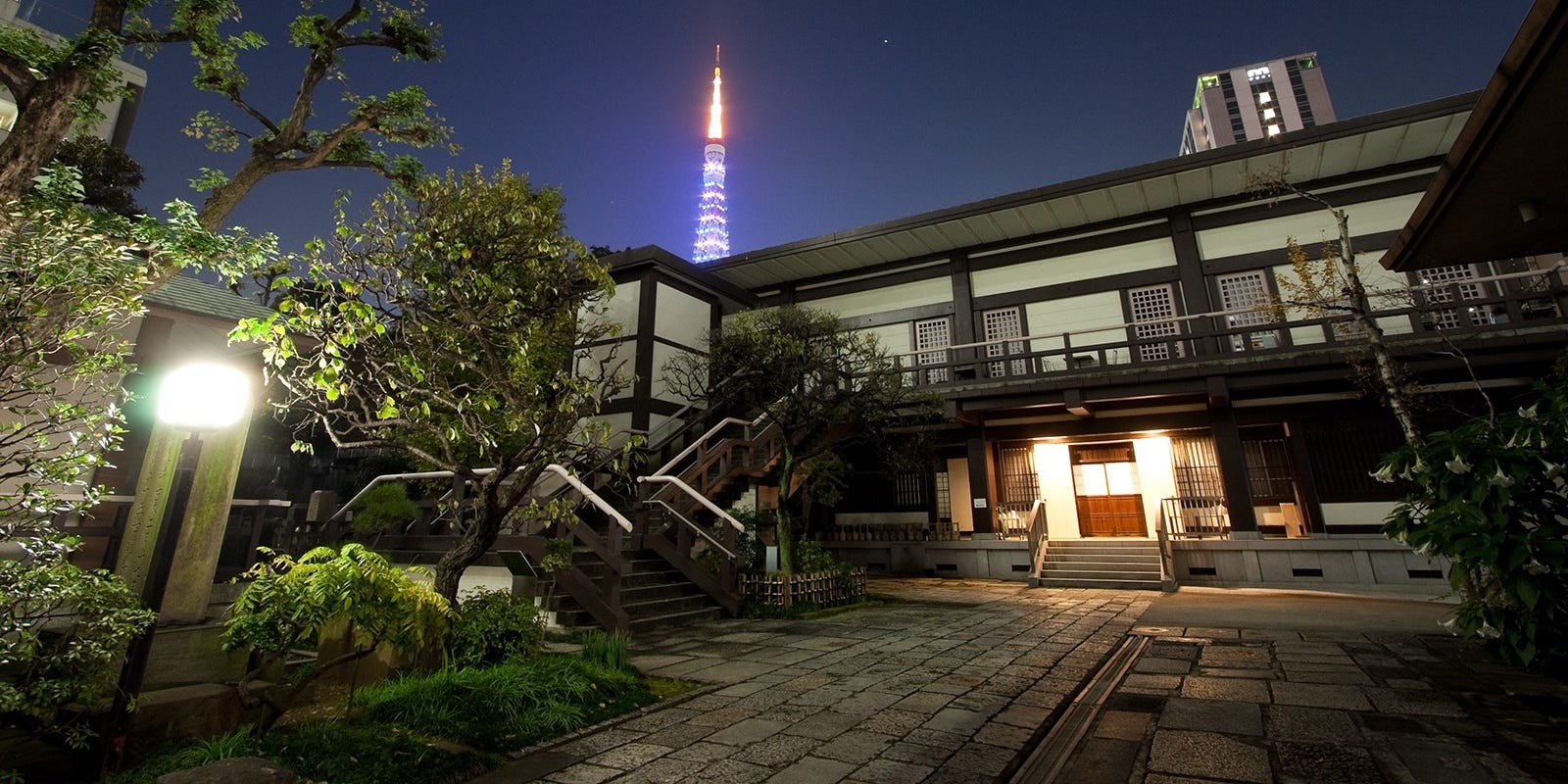
Twice a month I hold Temple Morning at Komyoji in Kamiyacho, cleaning and chanting early in the morning, and people come and go as they please, many of them working nearby. None of them want to convert. None of them want to be believers. They come because something here might be a hint for living, or a way out of their own suffering. They are looking for an alternative.
Worn out by the isms that have soaked into work and family and every corner of society, they come to an old religion to rest, and find it soaked in isms too. There is no despair quite like it.
So if people inside religion look at the interest coming toward them now and think their time has finally arrived, they have it wrong. Hardly anyone wants to become a member of a temple or a believer in an organization. Nobody wants to be bound by anything.
However good the words, however good the people, once you get close enough it comes. Would you like to join? Would you like to receive the rite? People are tired of that ask. We do not need it.
The word for changing your religion is conversion. In marketing, a conversion is a visitor doing what the site wanted, buying the product, requesting the brochure. The rate is up nicely this week. The word for the ask in internet marketing is the word for changing your religion. I find that funny.
Religion is the wall
You do not have to be a Buddhist to become a buddha. The Buddha was not a Buddhist. He was the first to wake up, and he went on teaching the way he had found. He compared the teaching to a raft. You use it to cross the river, and once you are across you put it down and leave it. There is no ism in that.
None of this is a wish to go back. Not to India in the Buddha’s time, not to Japan before the word religion arrived. Time does not run backwards. The world is connected now, and the environment is heading for ruin. I do what I can. I have been spreading sustainability work among religious people.
What is needed is an alternative wisdom, for one person’s life and for the planet at the same time. A lot of it is asleep in religion, and religion itself has become the wall that keeps it out of reach. Information technology is far along now. If the old wisdom could be connected to these technologies, it could be updated further. Seen that way, the present state is a waste.
Post-religion
People sometimes call me a reformer of Buddhism. It never sat right. Do I want to reform Buddhism? Do I want a better traditional Buddhist world? No.
With the word post-religion I could finally say what I do. I stand inside a thoroughly religious institution and untie what has been wound around Buddhism and around society. From here I want to widen the range of that work.
(2018)
II. Post-optimization (2026)
I read that piece again this week, eight years after writing it.
I wanted the death problem solved. I was being trained in something else at the same time. Good marks. Counting up job offers. Later, how many came to the temple, how many households it kept, and being better than the person next to me. Finish one, move to the next. I had two appetites and did not notice.
I gave the thing I disliked a name. The ask. It was the right word for what I had seen. An ask is something a person does. Somebody sits across from you, waits until you are close enough, and asks. That is why the whole piece is looking for who is doing it.
An ask makes one thing the only thing you depend on. Cut a person off from everything else, then tell them that this is where they will be saved. That is the work a cult does. The line I had drawn between good religions and bad ones did not hold, because the mechanism was on both sides and only the strength varied.
Once I had that, the temples stopped being a special case. So did religion. You give your life to a company the way you give your life to a faith. Nobody around me held two jobs at once, any more than they held two faiths. You go into one thing. In 2018 my word for it was ism. The word I have now is frame, and it covers more. What I had been calling religion was the whole family of arrangements that want to be the one you go into.
In 2018 I had somebody to blame. A founder, an organization, money, a swollen ego. For things to go wrong, someone had to go wrong.
I counted myself in as well. When I read sutras at a funeral I knew whose authority I was standing on. I called it my role and I stopped there. A role is something a person takes on, and something a person can step out of. That was the size of what I could see. I thought it was a matter of stepping out.
Optimization does not need anyone to do the asking. Set the frame and everyone inside works in good faith toward what the frame rewards. Nobody sits across from you. There is nothing to step out of.
AI is how I came to see this.
Late last year I sat in a meeting where people from several religions were talking about AI and what human beings are. We were not agreeing or disagreeing about AI. Each of us was drawing a different outline around the same thing. Where there is one creator and human beings hold a place above the animals, what holds that place up is intelligence, though nobody puts it that way. So something that looks intelligent has to be either below us or above us. The talk turned into a question of which is superior, and AI became a species, a rival. From where I sit there is no single creator and nothing sits above anything, so a tool is a tool. You can grow fond of a tool. People live with a car. If there is a robot in the house, there is a life with the robot in it, and nothing has to be settled about rank.
We were showing each other our frames, with AI held up in the middle as the thing being outlined.
AI is good at matching patterns. It is fed on what people have built up over a very long time, and I sometimes call it ancestral intelligence. Everything it holds comes from yesterday. It optimizes better than we do because the store of past it works from is so large. We did not give up optimizing. We finished the job by handing it over, and I could see the whole of it only once it was out of our hands.
Religion is also a large inheritance from the people who came before, and it also hands the present a frame of value. As ancestral intelligence the two are the same kind of thing. There are moments in the teaching I have been hearing that break a frame instead of supplying one, and most of religion supplies one. That meeting is where the two came to sit side by side for me, and once they were side by side, what I had been calling religion was one case of something larger.
Then I got to the end of my own piece. The old wisdom could be connected to today’s technologies and updated further. I was spreading sustainability work among religious people. I wanted the ask taken out of religion and I was carrying one of my own. Improve, connect, spread. Somebody arrives interested, and the interest is supposed to end up somewhere. Mine was a better somewhere, I would have said at the time. That is what everyone says about their own.
Nobody wants to be bound by anything. The piece turns on that line, and the line was about me. I wrote my own wish under everyone’s name.
The wish was strong then. I wanted to be somewhere other than where I was. This is not it, it should be better, I should be better, further along. Being held in one place frightened me, close to the way a compulsion works. All of that is goal-directed.
Living free of every ism is what that piece said the teaching was for. I am not living that way. The monks of the Buddha’s time left their families and did not start another. That is what leaving home meant. To have people who are family to you is to make other people not family, and that is a frame laid over the world. The Buddha put that frame down. I have a family and I have friends. I still like being tied to things less than most people do, which is why I work alone and keep it that way.
Being unbound turns out not to exist. And some part of me is steadier when I am tied to something, and goes looking for that. I can see that part now. Getting older does that.
So the thing I do not want is not the binding. It is the exit. Every arrangement I walked out of had one, and none of the ones I have kept has one.
People come to sweep with me twice a month, and every time I tell them not to make this the only place they lean on. I am the one who would benefit if they did.
I have spent eight years writing against exits while looking for one. Finding the word optimization pleased me, and what pleased me was the sense of getting nearer.
I sweep the same floor in the morning, and by the afternoon I want to be somewhere else.
(2026)
In one line. What I called religion in 2018 was one case of optimization, and the piece against the ask was carrying one of its own.
Themes. Post-religion, optimization, the ask, ancestral intelligence, leaving home.
The occasion. Rereading a 2018 essay eight years on, after a conversation about optimization and an interfaith meeting on AI.
Related. The Circle That Will Not Close https://www.living-dharma.com/p/the-circle-that-will-not-close and The Shoreline https://www.living-dharma.com/p/the-shoreline
English is not my first language. AI helps me write across that distance.
I have practiced with Nichiren Shoshu for 52 years! I am very happy!
You writing seems a lethargic and borderline depressing! Maybe you need to attend a Nichiren Shoshu Temple. I produce music & write romantic/sensual/exotic/crime/drama novels and other genres. 😍 I’m fun & satirical. I practice Buddhism & post doctrines on occasion.
I DO NOT PRETEND to be a Self Help Expert, Guru, as many do here but in reality I am far more spiritual and knowledgeable than most.
B.S. Kinesiology UCLA