

On my last evening in Athens, at the House of Beautiful Business forum, I sat down with a designer who had spent the morning presenting robots built for love. Her name is Despina Papadopoulos. She poured us drinks and told me an old rule of the Greek symposium. They watered their wine so they could stay in dialogue longer. Only people who water their wine, she said, can water the world. We had one hour before the closing session. We watered accordingly.
Despina has spent decades working where technology touches the body. Wearable electronics, smart textiles, garments that sense and respond. She ran her studio in New York for many years and recently moved to Athens. She calls her practice Philosophy Machines. Early in our conversation she gave me a sentence from the philosopher Karen Barad, and it stayed with me. Matter is not a noun. It is a verb.
She loves the lineage that runs from weaving to computing. The Jacquard loom, with its punched cards, is often called an ancestor of the computer. Text, texture, and textile grow from the same root. She reads fabric the way scholars read manuscripts.
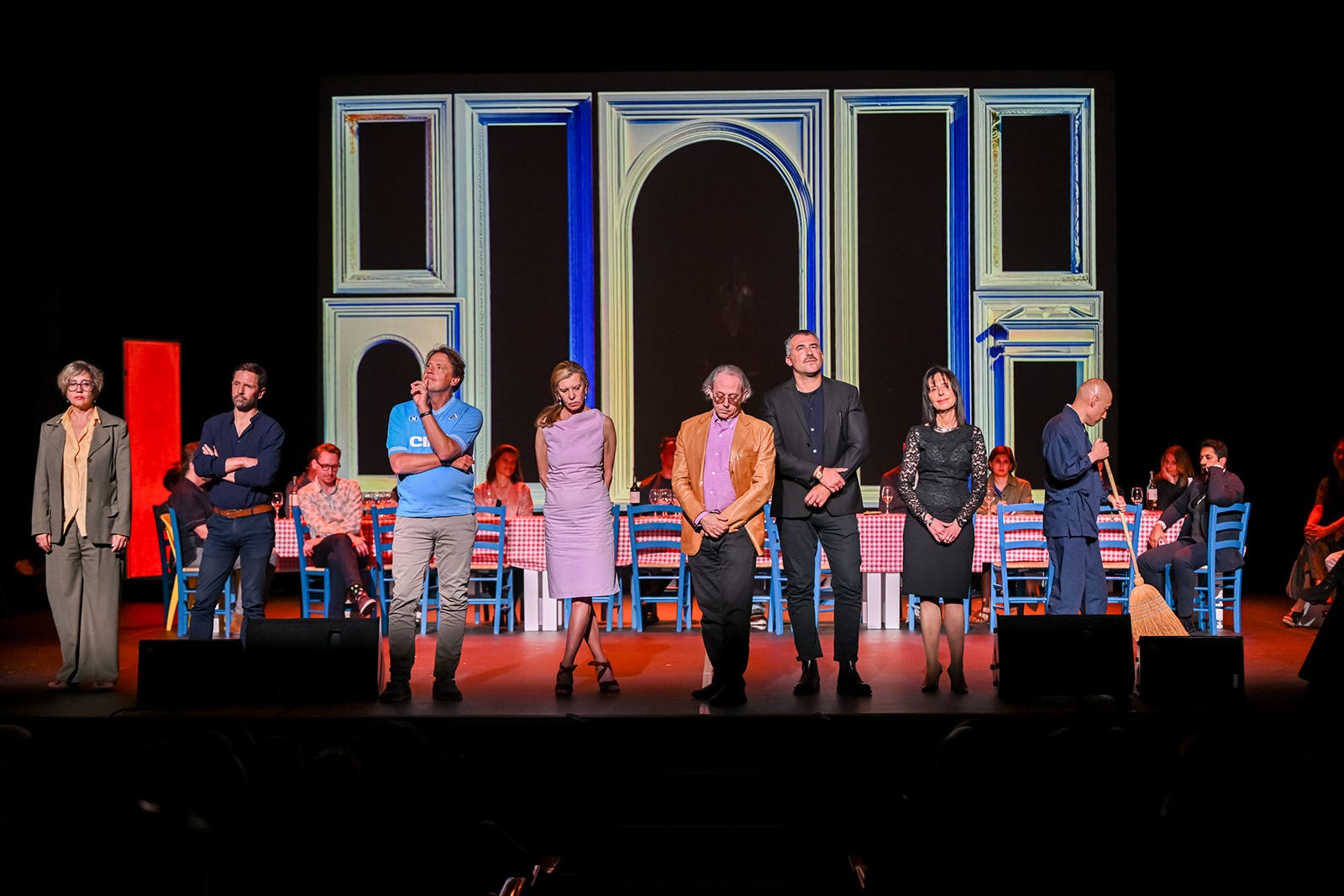
I told her what I had done on the first day of the forum. With colleagues, I swept the floor of the old theater where we gathered. Through the strokes of the broom I felt grounded in the space, and connected to the history the building had been holding. Talking with her, I found the sentence I had been missing. Sweeping is reading. Dust is a script. The broom is how you follow the lines.
She answered with her own practice. She has a dog, and she sweeps every day, though she owns a vacuum cleaner. Sweeping is slower, but it shows you everything. The hair, the crumb, the three specks that form a small triangle on the floor. What makes up your space, what you keep, what you let go. A vacuum cleaner erases the text. A broom lets you read it first.
Then I shared an observation I have kept for years. After I finish sweeping a lobby, people walk in. They notice nothing in particular. But somehow they sense that someone came before them. They sense my presence from the absence of dirt. Presence, transmitted through absence.
She connected this to a problem she once worked on, gesture recognition in textiles. The hardest part of the engineering was not the movement. It was the stillness. Every gesture has a beginning and an end, and the rest state between them is what defines it. Where does a movement end. Where does stillness begin. So we agreed. Reading matter includes reading its silences.
Then matter itself interrupted us. Her favorite phrase for her world is the unruliness of matter. Matter does not follow rules. You can try to predict and control it, and it will surprise you. Plastic was our dream of a fully obedient material, and now we find microplastics in the human brain. Even the dust I read in the morning does not stay read. By evening it has written something else. A swept floor is not a finished text. It is a page that keeps refilling.
That is where habit came up, as it usually does when I talk about cleaning. Sweep every day and the sweeping shapes you. A habit accumulated over decades is not an idea. It is a force, stored in the body, the mind, and the words. Read your life closely enough, I said, and it starts to change.
Despina pushed back at exactly the right place. Awareness is not enough, she said. We know that from Spinoza. We can see the pattern clearly and still repeat it.
She is right. Reading the floor does not stop the floor from gathering dust, and reading your habits does not make them stop being yours. What I offered her was not a rebuttal but an arithmetic. Ninety-nine percent of us is bound. By habit, by circumstance, by luck good and bad. One percent is free. But that one percent operates in every action and every choice of words, and it compounds. So the instruction is not heroic. Be patient and do not give up.
She answered with a plant outside her new apartment. After the winter it looked completely dead. One day she watered it and pruned it anyway. In two days there was a bud. In five days, four leaves. In a week and a half the whole plant had returned.
Then she said, That is what one percent looks like from the outside.
In one line: A designer in Athens taught me that sweeping is reading, that matter does not stay read, and that awareness alone is not enough; what I offered back was an arithmetic of patience, and she returned it to me as a plant that looked dead and was not.
Themes: cleaning, sweeping as reading, texture and textile, matter as verb, the unruliness of matter, presence through absence, reading silence, habit, Spinoza, awareness is not enough, one percent, patience, dialogue, Athens
Related: A Provisional Circle. Not Everything Is Your Karma. The Buddha Said So. The Circle That Will Not Close