

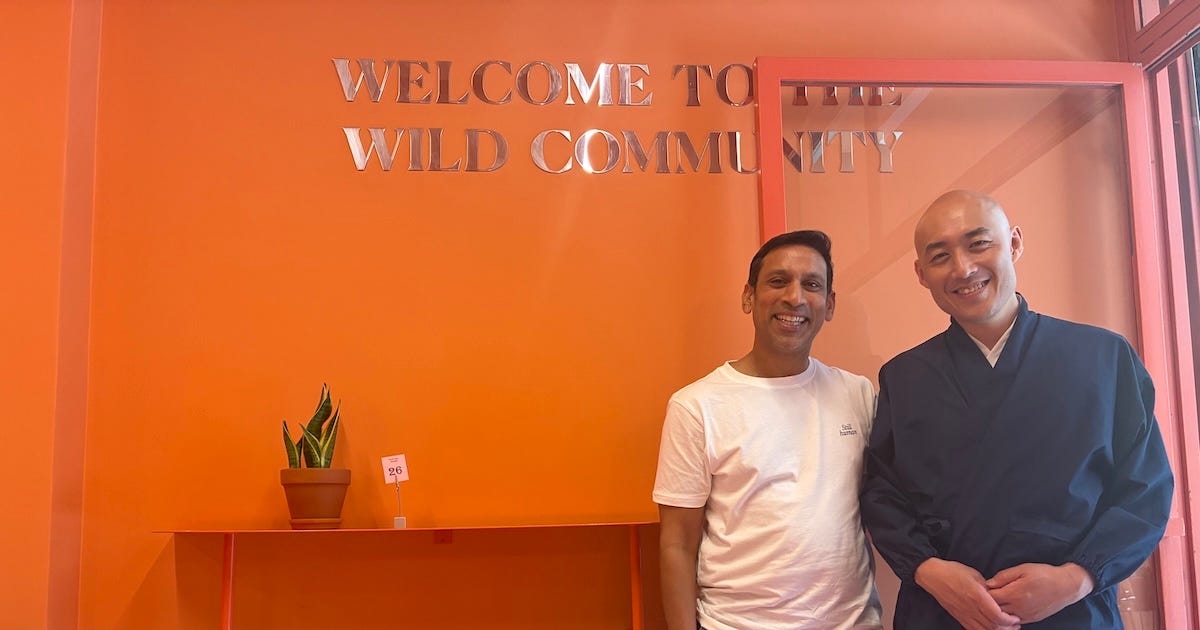
In May, at the forum of House of Beautiful Business in Athens, I sat down for a coffee with Steven D’Souza. Two days later he published an essay about our conversation. Seventy days later, here is mine. His question kept working in me, the way things do when you stop optimizing your response time. Some letters can be answered in two days. Some need a season. Both are correct speeds for a correspondence.
Who he is, first. At eighteen, Steven entered formation for the Catholic priesthood, and left because he wanted to be of service in the world without a religious title. He went on to write six books, including a trilogy challenging the conventional focus on knowledge, activity, and the individual: Not Knowing, Not Doing, Not Being. It is the via negativa of the Christian mystics carried into working life. My tradition has been walking a negative way for much longer, and reading him I kept thinking his trilogy has a missing fourth volume, one that Buddhist teachers drafted centuries ago: not self. Perhaps that is why a planned short hello became ninety minutes.
Two days after that coffee, he published The Dust We Leave Behind in his newsletter, Leading from the Dark, reading my broom through three teachers I could not have chosen better myself: Mary Douglas, for whom dirt is not a thing but matter out of place; Brother Lawrence, who treated every washed pot as prayer itself; and Hirayama, the toilet cleaner of Perfect Days. Then came a second post, on my essay Not Everything Is Your Karma, where he did something a mere introduction would not do. He extended the argument: if karma is accumulated habit, then leaders should stop attributing outcomes to single sources, because culture, systems, and history carry the larger influence. Less judgment, more compassion, and a broader horizon. That sentence is his, and it now belongs in the karma conversation.
What his essays do not mention is the question he asked me at the end.
He had just turned fifty and left his job. For decades he had worked inside companies and taught at business schools, always with an institution around him. Now, for the first time, he was preparing to offer something in public, under his own name, to anyone who wished to come: a contemplative program he had not yet built ‘Leading from the Dark’. He showed me the outline on his phone and asked, almost in passing: how do I bring this to life? I need some confidence.
I said nothing useful that day. I nodded and told him people would surely be interested, which is the kind of thing one says.
Before I answer now, I should say where I answer from. Not from above. We are the same generation. His company is called Liminal Edge, and the name is honest: he stands on his own threshold, between the institutional life behind him and something unbuilt ahead. I recognize the ground. I am a monk without a monastery, with a crossing of my own still ahead of me. This is not advice from the shore. It is one person on the edge writing to another.
Start with the word itself. Confidence comes from the Latin con fidere: to trust, together. At its root it was never a possession. Somewhere along the way, in an age built on optimization, the word was converted into an asset: something an individual must accumulate before beginning, evidence banked against an uncertain future, an entry fee for making anything public. What Steven felt he lacked was not the old confidence. It was the new one, the counterfeit. And the old one already has a simpler name: trust.
He knows this. The night before we met, at a dinner in Athens, he spoke on the theme From Control to Trust, a theme he first wrote about in Not Knowing more than a decade ago. Confidence, in its modern sense, belongs to control. It is control wearing its politest name. Trust does not ask the future for a guarantee. It plants, waters, prunes what looks dead, and lets things respond on their own timeline. He does not lack what he needs. He has been carrying the answer since his first book.
Two months ago, that is all I could have said, and it might have sounded like a slogan. Then, in the meantime, I wrote an essay called The Circle That Will Not Close. I did not write it for Steven. I was writing about the end of the age of optimization and about shu-ha-ri, the old Japanese arc of learning: keep the form, break the form, leave the form. Only when I read the finished essay did I notice whom it addressed.
The falling leaves now live in his essay, so I will speak of circles. In Japanese Buddhist art there is a form called enso, a circle drawn in a single breath of the brush, and often left open. The gap is not a failure of the hand. For years my emphasis fell on the not closing: sweeping has no end, the practice never completes. Writing the essay taught me the other half. An open circle still functions as a circle. It holds a shape. It gives you somewhere to stand: a provisional frame, real enough to work within, honest enough to admit it is not finished. We do not need closed circles in order to begin. We need circles that hold for now.
So here is my late answer. A first public offering does not have to be a closed circle, complete and guaranteed and underwritten by an audience that already exists. Draw it in one breath and leave it open. The opening is not the weak point of the program. It is the door. The people you are waiting for will not be persuaded by a finished circle. They will walk in through the gap.
Some of them can start here: his newsletter Leading from the Dark, his books, his site. The program he described to me, a contemplative inquiry that begins from disorientation, does not exist yet, which is exactly why I trust it.
In Athens he asked whether I would come as a guest to the module on not doing, if the program ever comes to life. I never answered that either. So let me close one small circle, in order to leave the large one open. Yes, Steven. When you draw it, I will enter through the gap.
In one line: A reply, seventy days late, to a friend who asked where to find the confidence for his first public offering: trace the word back to its root, where confidence was never a possession, and draw an open circle that holds for now.
Themes: confidence, trust, con fidere, from control to trust, via negativa, not self, enso, the open circle, provisional frames, shu-ha-ri, optimization, correspondence, liminal edge, beginning before certainty
Related: The Circle That Will Not Close. Not Everything Is Your Karma. The Right Size of Ego.