

1. Anthropic’s Decision, and Our Karma of Seeking a Pristine Resolution
As of March 2026, a highly significant event is unfolding at the intersection of global technology and security. Anthropic, an AI company, has refused the US Department of War’s (DoW) demands to use their technology for autonomous weapons and mass surveillance, prompting the government to move toward terminating its relationship with them (the tense behind-the-scenes reality of this is also detailed in a recent article in The Atlantic).
Regarding this event, which is also reflected in Dario Amodei’s statement, my friend Wakanyi Hoffman recently posted a brilliant insight from the perspective of Ubuntu. She framed this situation not merely as a battle of good versus evil, but as a muddy swamp in which not a single one of us is uninvolved, introducing the concept of an “Ethical space.”
Faced with this complex event with no exit in sight, how should we conduct ourselves? It might sound like a completely different dimension from cutting-edge AI or geopolitics, but I would like to consider this issue through my daily temple practice of cleaning. Because hidden within it is a profound fallacy regarding the “rules of the game” that explains the crises our modern society is facing.
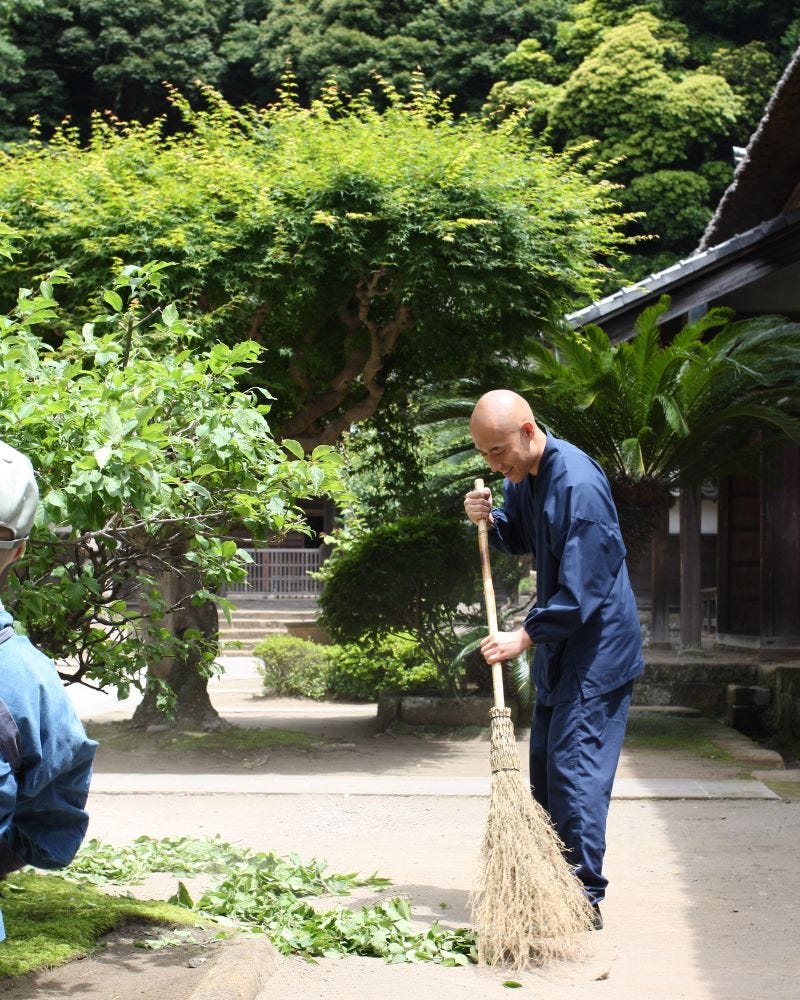
At first glance, the act of cleaning appears to be a “Finite game” aimed at eliminating dirt and reaching a pristine resolution. However, moving the broom day after day, you realize it is a practice for learning through the body that things will never be perfectly resolved. Leaves fall and dust settles the moment you finish sweeping. Life and the world are originally a blank canvas with no beginning and no end—an “Infinite game.”
This structure of “Finite” and “Infinite” games is a crucial concept underlying this entire article.
Through our education and social environments, we have deeply internalized the mindset of a Finite game—one with clear rules, winners and losers, and finally, a “neat, pristine end.” In truth, the micro-level desire to sweep away the dust in front of us, and the macro-level desire to completely eliminate “foreign elements” or “evil” from society to build peace, stem from the exact same root. It is a strong self-attachment born from the fear of an uncontrollable Infinite game—the perfectionist craving for closure. This craving dictates our actions, becoming a continuous chain of Karma.
This fundamental thirst for a pristine resolution is causing severe malfunctions in our current world. When we try to grasp the intensifying conflicts and wars of today’s world through this Finite game mindset, a fundamental error occurs.
The moment we set “perfect peace” as an achievable goal (the winning condition of a Finite game), we begin to divide the world into “our camp and the enemy camp,” “good and evil.” In response to the question, “Why is there no peace?”, we establish a specific someone as the villain to bear the blame.
It is precisely the limit of human reasoning—this desire to blame someone to satisfy our perfectionist craving for closure—that incubates “war” within our minds. The moment we view the world through a Finite game mindset that seeks to tribalize self and other, condemn evil, and declare a winner, we are already incorporated as part of the system of conflict.
2. The Escape into the “Narrative of Attribution” and AI as a “Karmic Amplifier”
Why do conflicts escalate and legal frameworks become neutralized? Out of fear of this complex and uncontrollable Infinite game, we try to escape into a “Narrative of Attribution,” claiming “they are the bad guys.”
In Buddhism, there is a way of viewing this world as “Indra’s Net” (Engi / the network of dependent origination). It is a worldview where a jewel sits at each knot of a massive net covering the entire universe, and as they reflect each other’s light, all existences are inextricably connected and mutually influence one another.
What is important here is that those we call “people in power” are no exception. Power is not an attribute of evil that certain humans are born with. They are merely humans who happen to be situated at highly gravitational nodes within Indra’s Net, where people’s desires and fears naturally flow. They are not transcendent rulers manipulating the world from outside the net. Just like us, they are frightened by an uncertain world, driven by the fear and ego of wanting to monitor and control everything for the sake of an absolute, sterilized order. They are stakeholders carrying the exact same fundamental human weakness of fallibility.
Our daily, individual “Karma” (actions in the here and now) of wanting someone to make things black-and-white for a neat resolution gathers through the net’s nodes and violently resonates and amplifies with the authorities’ Karma of wanting to control everything. These individual Karmas intertwine complexly, becoming “Shared Karma” (the massive accumulation of society’s past collective actions) that covers the whole of society, dragging us irresistibly toward conflict. This is the structural reality of why conflicts escalate—the resonance of Shared Karma.
And, as Wakanyi quoted from my previous words, AI is neither a new god with an ego nor an enemy. It is a “Karmic Amplifier.” AI learns from the massive accumulation of our Shared Karma—past human history and language—and reflects it without a filter.
The true threat of AI is that it amplifies this fundamental Karma of ours—the perfectionist urge to ‘sanitize’ reality by eliminating noise and controlling others—into physical space at light speed and on an overwhelming scale. What the DoW demanded—fully autonomous weapons and mass domestic surveillance—is nothing less than an attempt to implement, via AI, the “ultimate delusion of the Finite game”: the desire to eliminate uncertainty and manage the world in a perfectly sterilized manner. While we seek adjudication on “who is right,” the amplifier known as AI causes our Shared Karma to run rampant, irreversibly rewriting the board itself.
3. Entering the “Ethical Space” and the Unresolved “Tojisha-kenkyu”
So, how should we conduct ourselves in this muddy swamp with no neat resolution?
In a society that lowers its frustration by sending a specific “culprit” to the guillotine, those in power cling to their positions out of fear of losing them (being condemned), and the people also rush toward self-preservation. Whether it is a preemptive reign of terror by an absolute ruler, or a populist reign of terror where the masses drag down former leaders in a witch hunt, in an environment where we try to punish someone to feel refreshed, systemic errors are simply covered up.
This is why aviation accident prevention systems emphasize “non-punitive reporting of errors.” This is a mechanism that does not punish individual mistakes, but rather creates a safe environment where openly disclosing one’s failures does not lead to disadvantages, allowing structural factors that lead to major accidents to be identified and shared among all involved. However, unlike an aircraft, the world we live in is an Infinite game with no safe landing spot, no perfect resolution.
Wakanyi’s “Ethical space” is not a place for battling out arguments to make things black and white, or for neatly resolving differences in position. According to her, facing the same threat, it is a space to stop framing anyone as a hero or a villain, to recognize that all our existences are complexly intertwined (Ubuntu), and to remain together in the mud.
I believe one modern implementation of this Ethical space is the Japanese approach of Tojisha-kenkyu—a practice born from the mental health field that turns shared vulnerability into a bond. It is not a management tool aimed at streamlining operations or solving problems neatly. Rather, it is a practice of observing and disclosing oneself exactly as one is—covered in mud—acknowledging that “I” am a fallible being deeply entangled in a complex web of relationships (Engi).
It is unrealistic to forcefully drag those in power into this space. What is important is that we shift our own mindset from being “judges (spectators)” to being “Karmic Stakeholders” who co-create the muddy system. We are not shareholders dividing benefits, but sharers of Karma who take on the system’s errors and fears together.
Letting go of the illusion that you are in a “safe and correct place” and accepting the state of being “in the mud together,” as Wakanyi says. That is the only key to opening the door to the Ethical space.

4. The Grace of Fallibility and the Lotus Blooming in the Mud
Faced with the events surrounding Anthropic and the DoW, I too was driven by a strong urge to immediately take the side of “Anthropic defending ethics,” condemn the “DoW scheming for military use,” and get a neat resolution. The desire to establish “who is at fault” in the face of a complex reality is nothing but a reaction of “fear (ego)” toward an uncontrollable world. Judging authorities from the outside is also this “escape from fear into the perfectionist craving for closure.”
However, when I temporarily suspended that hasty judgment and tried to remain in the indeterminate “mud” while listening to diverse voices, through Wakanyi’s perspective, I also encountered the “Shared Karma” that the entity Anthropic itself carries. The safety of their AI is also built upon a muddy accumulation of Karma—the severe data exploitation of low-wage workers in the Global South. There are no pure heroes anywhere. And at the same time, I was once again made aware of my own fallibility (the weakness of making mistakes) as I hurried to vilify someone just to feel safe.
We cannot sit in the safe seat of the judge. As Shinran, a Japanese Buddhist, saw through, we are essentially “Bombu” (beings possessed of blind passions). In Buddhism, a Bombu refers to an incomplete being inevitably designed to make mistakes due to ego and delusion. As the philosopher Nietzsche phrased it, “Human, All Too Human,” our wisdom lies not in trying to transcend this unavoidable human limitation (fallibility), but in acknowledging and embracing it. Doubting one’s own righteousness and admitting “I might be wrong.” This very awareness of fallibility frees us from the polarizing Finite game and guides us to the Ethical space.
To dissolve the ego is to let go of the arrogance of trying to completely control the world by our own power. It means taking on the Samu (the mindful practice of tending to our daily habitat) of simply remaining there as a stakeholder in this endlessly muddy Shared Karma.
In Buddhism, there is a phrase, “The lotus in the mud”. The lotus flower does not bloom its large petals in clear, pure water, but only from muddy, murky water. The attempt to completely eliminate society’s noise using AI and create a sterilized, controlled “perfect peace” is an act that strips away this mud and destroys the foundation where human life grows. Interestingly, a Japanese predictive framework from the 1970s called the “SINIC Theory” forecasted half a century ago that our global “Optimizing Society” would hit its limits right around 2025. We must now become more deeply aware of the limits of this exact mindset that tries to optimize everything—in other words, the mindset that treats the world as a controllable Finite game.
What we can do is make neither heroes nor villains, but simply be covered in mud together, embracing our own foolishness.
And what I, as Shoukei Matsumoto, can do is not to change the world dramatically. Within the scope of the habitat I touch, to those connected to me by karmic ties—including you, reading this right now—it is to curate and share what I believe is necessary right now from the wisdom of the world I have learned, including Buddhism. I believe that is one of the Samu I can perform in the mud.
Protecting these margins for life to let the lotus bloom does not mean just sitting and watching. As Wakanyi says, it is about those who have acknowledged each other’s fallibility joining hands in this mud toward a faint light that resists the system’s errors.
Upon reading Dario Amodei’s essay, “The Adolescence of Technology - Confronting and Overcoming the Risks of Powerful AI,” alongside his statement regarding the discussions with the Department of War, I felt a certain “strength of words” unique to someone who possesses the resolve to not run away from their own complex Karma (the mud of past exploitation and state agendas), but to embrace it. I do not unconditionally support all of his political stances. However, to that muddy resolve and gesture, as a fellow fallible human and a stakeholder in the very same mud, I feel a deep emotional solidarity and resonance.
Anthropic’s decision—having accepted their own past Shared Karma while trying to resist any further rampant escalation of the Finite game—is also nothing but a precious gesture within this endless game. To accept the thickness and complexity of this “mud” that will never be neatly resolved, and to continue walking while sharing our mutual wisdom. I believe that this is what will lead me, as a good ancestor, to open up a “Wider canvas” with freer and richer plasticity for future generations, and for myself tomorrow.
https://johncarpenter.substack.com/p/awake-to-the-cross-the-christian?r=yky21&utm_medium=ios