

Karma is often used to mean fate, or payback. In Sanskrit the word means action, and that is how Buddhism uses it.
An action ends, but it leaves a trace. The trace becomes a condition for the next action. No one is judging the action. What is measured is suffering. In an early Buddhist text, the Buddha teaches his young son to ask one thing about anything he does. Does this bring harm to me, to the other person, or to both?
Buddhism counts three kinds of action, of the body, of speech, and of the mind. I want to look at speech. I call it the karma of language instead of the karma of speech, because I want to include what I write, and also the words I say to myself in my head.
I can see the trace in myself. Each time I say something in a certain way, it becomes a little easier to say it that way again, and a little harder to say it another way. In everyday words, this is a habit.
As I have heard the teaching, the direction of practice is loosening. By loosening I mean that old habits hold me less tightly. When they do, there is less suffering, for me and for the people around me.
Where the traces go
The trace does not stay only in me. It also stays in the person who heard me.
For a long time, people only spoke and listened. What was said stayed in the memory of those who heard it, and nowhere else. Then writing was invented. People began to write and read, and words could stay outside the body. Paper and printing made it possible to copy them. Now words are stored as data and copied in an instant.
A trace today does three things. It stays, because data is stored. It reaches people I will never meet. And it comes back to me.
Words did not come back in this way before. Social media uses people’s reactions to earlier posts to choose what to show next. AI is built from an enormous amount of text that people have written, and it gives words back to us out of that text. What it gives back is posted and published, and can then become training material for the next AI.
Researchers who study how AI is trained have pointed out one possible result of this. Many science fiction stories show AI turning against people. If those stories are part of what AI is built from, they may shape what AI gives back. Some research points in that direction.
So words now come to me from two sources, from people and from AI. I write with AI myself, and many people now do. For me the question is not whether to use it. The question is which way my own words go while I use it.
Four old habits
Buddhism has long named four kinds of speech that go against loosening and add to suffering. They are false speech, idle speech, harsh speech, and divisive speech.
These were taught in a world where the listener was standing in front of the speaker. The example given for false speech is a person who is called before a gathering as a witness and told, “Tell us what you know.” He does not know, and he says, “I know.”
People had these four habits 2,500 years ago. What has changed is how little effort they take. When a listener is standing in front of me, I can see the person’s face, and that slows me down. On a screen there is no face. Nothing resists, so I can do these things without noticing that I am doing them.
Words that are not true, words that are not needed
False speech has become easier in one specific way. AI writes smoothly about anything. It writes things that are not true just as smoothly as things that are true. This is known as hallucination. People do the same thing. Either way, I have to check. If I put a text out under my name without checking it, then I am the one who said “I know.”
Idle speech is harder to see. The early Buddhist texts describe its opposite. Speech that is not idle is said at the right time, it is useful, it is kept within limits, and it is worth keeping. Idle speech fails these tests. It is words that did not need to be said.
Writing a long text used to take time, and the time slowed me down. Now a long text appears in seconds. Nothing slows me down, so I can easily send more words than anyone needs. A person who reads them gives them attention, and that attention does not come back.
When I ask myself why I add words that are not needed, the answer is usually that I want to look good, or to be liked.
So before I send something, I look at it. Is it needed now? Is it useful? Does it need to be this long?
Idle speech also comes toward me. When I share a thought with AI, it often returns the same thought in better words than mine. It is easy to hear this as someone else agreeing with me. If I get used to it, I find it harder to listen to a person who disagrees.
Words aimed at people
On social media, it seemed to me that the more extreme a sentence was, the further it traveled. I do not know how much of this comes from the way the platforms are built. What I know is that the language I was reading became rougher over time, and that it stayed in me after I closed the screen. I wanted to leave.
The same applies to harsh words typed to AI. Whether AI feels anything, I do not know. Either way, I am the one practicing that way of speaking, and it becomes my habit.
The same texts describe divisive speech like this. A person hears something here and repeats it over there, in order to set those people against these people. In the Buddha’s time, a person had to walk to the other group to do this. Now I can pass a post along with one tap, before I have really thought about what it will do.
What I do
Being careful with words is part of what I can do, and I try to be careful. But care alone keeps me inside words. In this situation, these are the things I do as my own practice.
I am slow with the words I put out. I am a slow speaker, in Japanese as well as in English. I try not to speak or write just because the words are coming.
I reduce the words that come in. I use social media only as much as I really need to. And I have written down, for the AI I work with, how I want it to speak with me. No flattery. A short question can have a short answer. Nothing I did not ask for. I wrote about that document in an earlier article.
Even so, words keep reaching me, and I need time without them. Seated meditation often does not work well for me. When I sit still, more words come up, not fewer. So I use my hands. I wash dishes. When I have the chance, I sweep a temple garden. If my mind goes somewhere else while I am washing a plate, the plate slips. If I sweep a gravel path carelessly, the broom scatters the stones. While my hands need my attention, words do not come up.
Japanese Buddhism has many practices that work on the distance between a person and words. Among these, the one I do comes from the Pure Land tradition. It is chanting. I do not chant in order to get away from words. But the chant has a melody, and while I chant, my attention goes to the sound. I do not have to make a meaning out of the words.
English is not my first language. AI helps me write it.
In one line. Words leave a trace in the person who says them, and today those traces stay, travel, and come back.
Themes. Karma. Speech. AI. Social media. Practice.
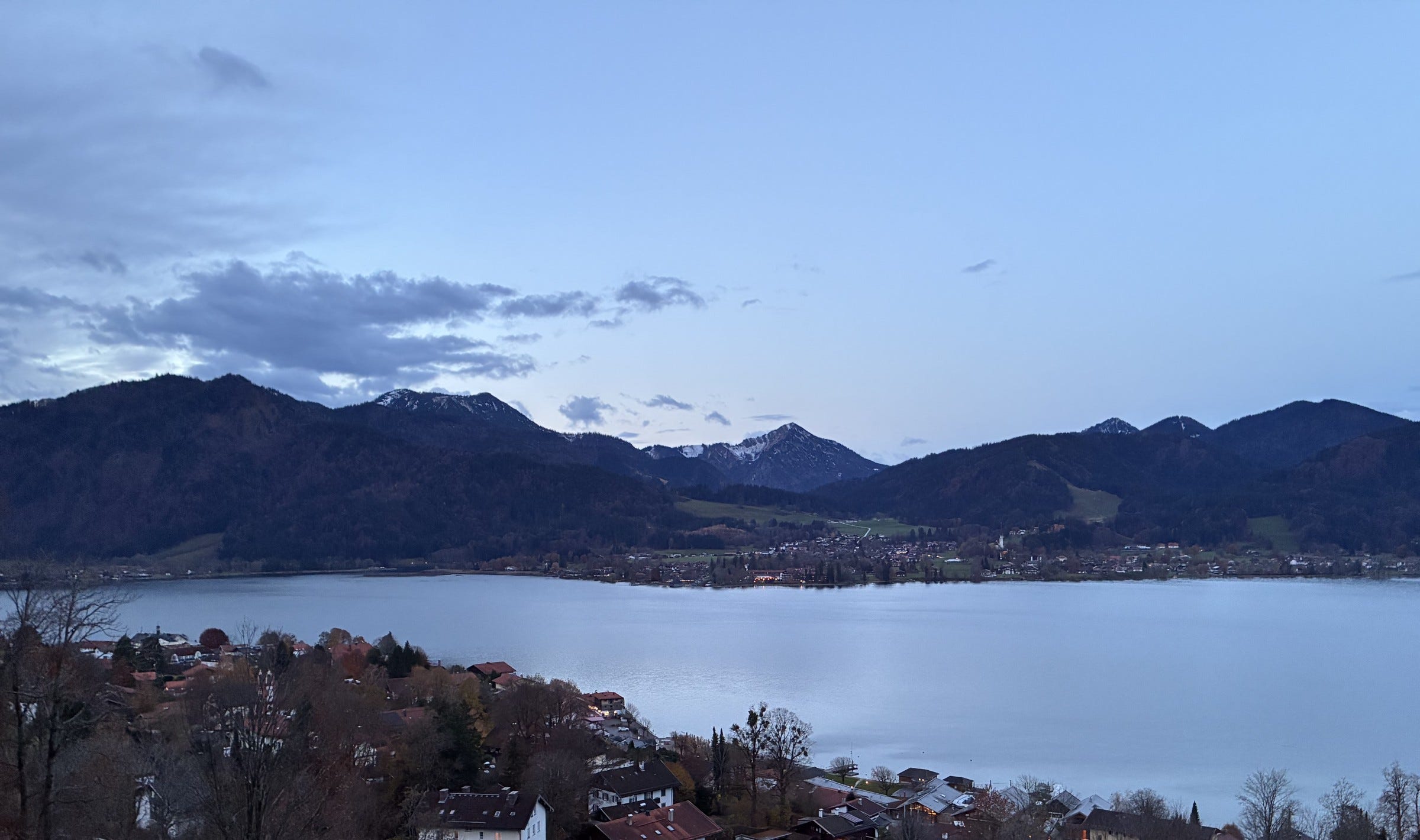
The occasion. I wrote this during a program on health at Tegernsee, Germany.
Related. my-dharma.md.