

As of 2026, we stand at a quiet turning point in human history.
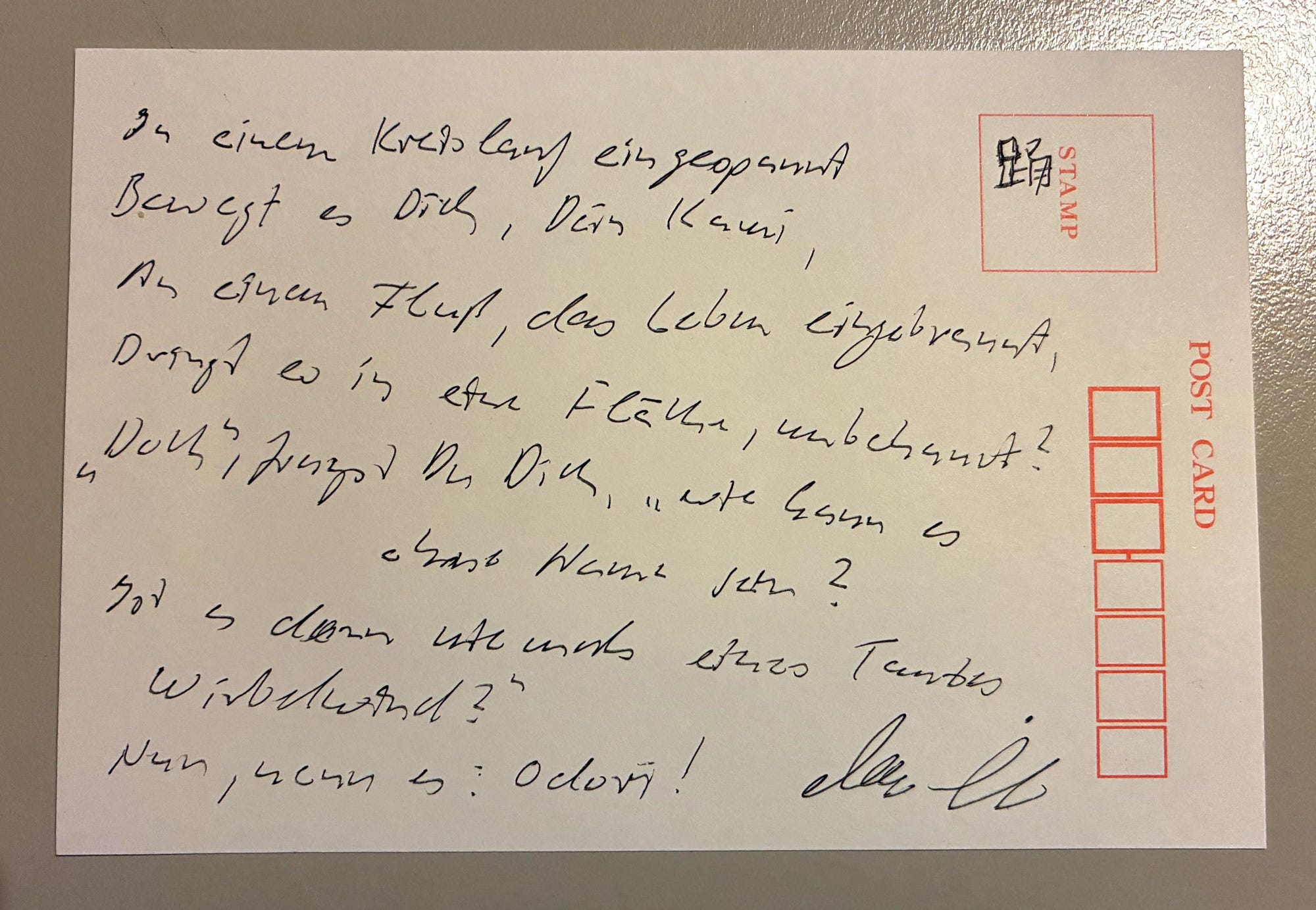
Recently, over dinner and Japanese sake at my home in Kyoto, I was engaged in a deep dialogue with the philosopher Markus Gabriel. Amidst our conversation, he suddenly wrote down a poem on a piece of paper and handed it to me. This handwritten poem, which I have placed as the thumbnail at the beginning of this article, was given the Japanese title “Odori” (Dance).
A “dance” with no purpose, where one simply throws oneself into its vibrant motion. It seemed to quietly point to the true state of human beings after being liberated from the framework of utility that has long held us captive.
The exponential evolution of artificial intelligence signifies that the “intellect that produces meaning and categorizes the world” — which humans have long relied upon as the foundation of our identity, known in Buddhism as Vikalpa (discriminating consciousness) — is no longer a uniquely human endeavor. The current reality, where humans are reaching our limits in the cognitive domain, heralds our liberation from the karma of “having to produce meaning and value” for the first time in history.
The trajectory of capitalism and rationalism that we have desperately pursued since the modern era has been a relentless project driven by clear objectives. But that era of teleology is coming to an end. What begins now is the era of the Great Unburdening — a time to drop the heavy compulsion that “we must be useful for something” onto the ground.
Like the “dance” Gabriel wrote of, it is about letting life leap and bound, rather than living for something. How will we, having stepped down from our role as subjects producing meaning, live in this unburdened world? I would like to explore the clues from here.
Apparatus and Apparition: The Lens of Utility
Earlier during his stay in Kyoto, Markus had attended a conference. Among the participants was an artist from New York named Six. I heard that he spoke little at the venue, existing quietly in the background almost like an apparition. I later learned that he was working on a video piece aptly titled “Apparition.” Watching it upon waking one morning, I was struck by its profound impact.
"Apparition" is a video work in which human figures appear and dissolve in a continuous flow, accompanied by text and voice that are almost clinical in tone, presenting phenomena simply as they are — and in doing so, quietly inviting the viewer to confront the question of existence itself.
As Markus and I discussed the experience of watching this film at the dinner table that same evening, two words slipped out of our conversation as a poetic contrast: “Apparatus” (a framework or device) and “Apparition” (the manifestation of raw life).
Modern global leaders view the world through the lens of the “Apparatus,” a framework that converts everything into the logic of Utility—”being useful for something.” We look at trees in a forest and interpret them as “building materials”; we look at others and categorize them as “human resources.” This lens, which assigns names and uses to everything, is highly effective for navigating the game of capitalism.
However, precisely because of this competence, we become deeply dependent on the Apparatus we have built, numbing our ability to directly touch “Apparition”—the overwhelming, vibrant reality of life just being there. We are deeply entangled in a structure of consumption, separating objects from ourselves and exchanging the present for a future purpose. What we must be most wary of here is the reality that even the pursuit of spirituality, such as mindfulness or self-inquiry, is easily co-opted into the Apparatus of utility—consumed merely to “become a better leader.”
This dialogue at the dinner table reaffirmed for me the Buddhist thought of “Emptiness” (Sunyata) with a deeply modern texture. Emptiness does not mean rejecting the frameworks or purposes we create; rather, it is the realization that these frameworks are merely transient expressions within a much larger wholeness. Beneath our constructed utility flows the vibrant pulse of life, existing simply as it is.
The Dung Beetle and the World of Naturalness
What kind of landscape spreads out once we step off this game of Utility? One certain guidepost is the activity of the Namibian dung beetles, shared with me during a rich dialogue with the African thinker Wakanyi. Her words, while deeply unpretentious, possessed a profound strength that quietly shook the curse of teleology that holds us captive unconsciously, right down to its roots.
Across the vast lands of Namibia, dung beetles silently roll balls of animal dung. Viewed through the modern framework of sustainability, their actions might be assigned meaning as extremely useful labor that returns nutrients to the soil and maintains the ecosystem. However, Wakanyi points out the human arrogance hidden within that view. They are by no means rolling the dirt “to be useful to others” or “to improve the global environment.”
They possess no future goals, nor any contrivance to prove their own usefulness. They simply roll what is in front of them and commune with the earth as an activity of their own life. As Wakanyi said, “A fish doesn’t know it’s in water.” They do not objectify by separating themselves as subjects from the dung or the earth as objects. They are already within the massive web of life, simply repeating their samu — everyday acts of care for their habitat — like breathing within that wholeness. She presented this way of being as the fundamental shape of life.
This state, where subject and object melt into one another and just exist without any calculation of utility, is exactly what the 13th-century Japanese Buddhist monk Shinran reached as “Jinen Honi” (things being naturally as they are), and what it means to live in “Emptiness.” We tend to seek comfort by acquiring knowledge or useful frameworks to solve problems. However, the dung beetles of Namibia and Wakanyi’s words teach us the profundity of casting off the armor of Utility we clutch so tightly, and descending into the dimension of “not knowing,” devoid of meaning.
Beyond “For the Sake Of”: The Shift to “Yuge-遊戯”
In modern leadership, grand causes like “to make society better” or “to solve the problem in front of us” are unquestioned as supreme values. Yet, no matter how noble they may appear, even this posture is nothing more than a transaction that surrenders the present as a means for a future end. Unconsciously, we objectify others and the world, living within a structure of “consumption” that trades the present for the future under the guise of “for the sake of.”
Even as I speak these words, making my living by writing and speaking, I sometimes face the reality that the logic of causality—”for the sake of” and “because”—is deeply embedded everywhere in the very words I weave, leaving me feeling at a loss for words. The moment one intends to do something “to let go of attachment” or “to reach a better state of mind,” even Eastern wisdom is co-opted into a new game of utility. The contradiction is that the very act of “aiming” for an effortless way of being already generates the tension of “for the sake of.” The curse of utility penetrates us to the marrow of our bones.
When we touch the depths of Pure Land Buddhist thought, we reach a horizon where we let go of our clinging to even the final teleological transaction in religion: “chanting the Nembutsu to go to the Pure Land.” What remains is not an action as a means to gain something, but solely the vibrant pulse of life just being as it is.
Just as Georges Bataille spoke of a “sovereignty” entirely distinct from the dimension of utility that invests the present for future ends, when we step back from the strict causality of “for the sake of,” human action is no longer confined to mere labor; it opens up into a pure, purposeless “Yuge -遊戯-” (unhindered freedom). It is a quiet endeavor that shifts away from a competition to achieve something (Victory) toward simply walking one’s own path of Mastery. However, Mastery here does not mean a new objective of polishing one’s skills to increase one’s value. It refers to a state of being deeply and utterly immersed in the act itself, without seeking any resultant utility.
To loosen our grip on purpose is not to fall into an aimless void or nihilism. It is a shift in attitude—from a consumptive way of life that wears down and objectifies others, to accepting life as a process of “Fermentation,” where boundaries with others and the environment melt away as we undergo a messy, earthy transformation together over time. This fermentation is not a convenient means for producing better outcomes or innovations. It means enduring the loss of meaning and simply continuing to exist together within the wholeness, without even knowing what it might ultimately be useful for. It is precisely within this thoroughly purposeless and unhindered freedom that our true place of belonging, having escaped the prison of utility, must lie.
Being in the World, but Not of the World
Some readers who have come this far may feel a deep resonance, accompanied simultaneously by a severe friction with real society. Because tomorrow morning, sitting in an important management meeting or facing strict scrutiny from stakeholders, you cannot simply sit there as an aimless, empty vessel.
Letting go of utility and living in this unburdened world does not mean retreating deep into the forest to live in seclusion. It means living a quiet yet resilient duality: “Being in the world, but not of the world.”
As long as we live within the modern social system, it is inevitable that we wear the apparatus (the outward garments) of names, titles, and social responsibilities. However, it is possible to keep those outward garments separate from our living essence (Apparition). While superficially carrying out our social roles as leaders with calm detachment, inwardly we harbor no attachment to those roles or even to our own names. I consider this an attitude of “inner monasticism” within the corporate sphere.
No matter how society consumes your title or name as something useful, that is merely the friction occurring on the surface of the outward garments you use to interface with the world. It is about wearing the face of a capable leader while, inwardly, having quietly stepped down from the subject that produces meaning.
This is neither an escape from real-world responsibilities nor a form of cynicism. Rather, precisely because the calculations of the ego does not intervene, even things like “profit targets” and “organizational challenges” in front of us can be taken up in their purest form, simply as a samu (a grounding practice) to be faced with equanimity.
Return to the Unsung, Unseen Ancestor
The desire to leave one’s name in history and prove one’s usefulness to posterity is a transformation of the attachment attempting to eternalize the ego. However, it has always been the countless anonymous predecessors, who never stood on the center stage of history, who plowed the earth and paved the roads. The essence of being a “Good Ancestor” lies not in leaving a name behind, but in standing on the side of the Unsung, Unseen Ancestors.
D.T. Suzuki, the Buddhist scholar who once translated Zen philosophy for the Western world and imparted a profound influence, found the ultimate form of human spirituality in his later years not among renowned high priests or intellectuals, but among Japan’s nameless peasants known as the “Myokonin” (wondrously excellent persons). Despite this exalted title, they could not read and had no connection to the difficult ascetic practices meant for achieving enlightenment. They simply plowed the fields from morning till night, wove straw sandals, and repeated the samu (acts of care) of their daily lives without any calculation, surrendering the entirety of their lives to a greater wholeness. Their thoroughly ordinary existence, never flaunting their usefulness nor producing any special meaning, was the quiet “earth” where human intellect finally arrived after abandoning its upward climb toward the heavens.
To live in this unburdened world is to set down the heavy burden of utility and cease striving to become a special entity, just like these Myokonin. It is to let go of attachment to one’s name and authorship, to offer oneself to the world as an open vessel, and to carry out the everyday acts of care with quiet grace.
From a subject that produces meaning and manipulates the world, to a presence that simply sweeps the ground and ferments messily together with others and the environment. Stepping beyond humanity’s relentless project of utility, we quietly move forward into this purposeless coexistence—a quiet dance of just living.