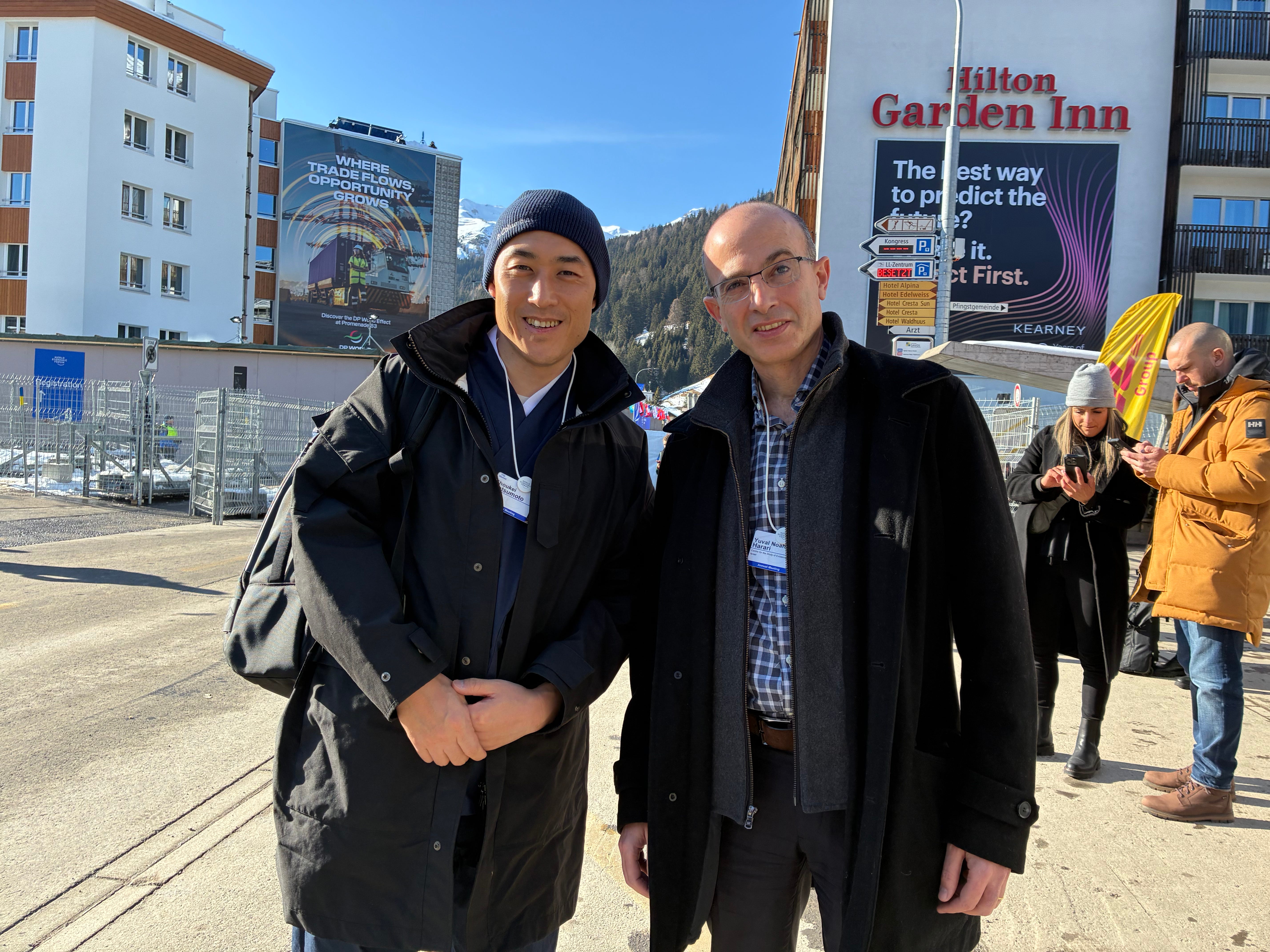
One year after our dialogue in Kyoto, I was given the opportunity to speak again with Yuval Noah Harari in Davos in Jan 2026.
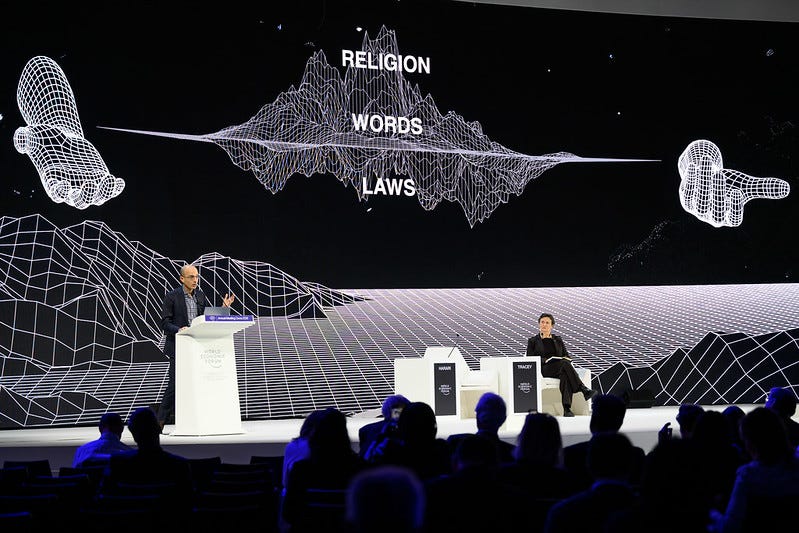
At the opening of his lecture at the World Economic Forum Annual Meeting, he began with these words:
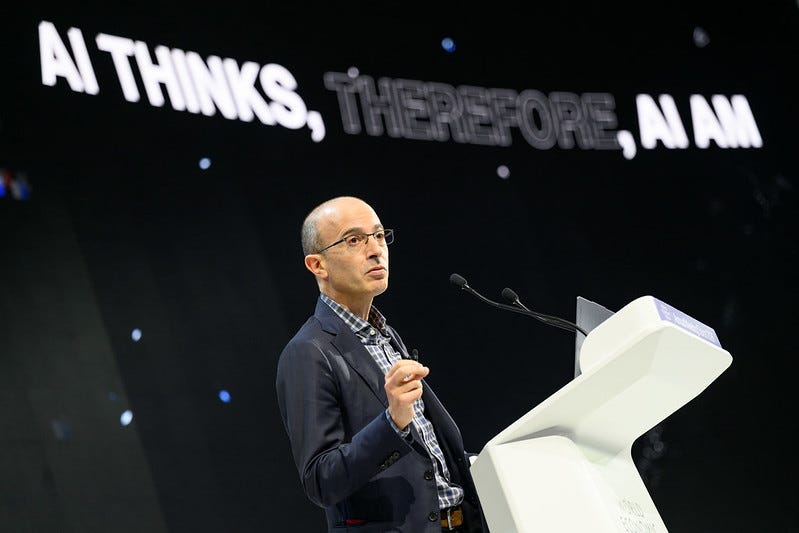
“The most important thing to know about AI is that it is not just another tool. It is an agent. It can learn and change by itself and make decisions by itself. A knife is a tool. You can use a knife to cut salad or to murder someone, but it is your decision what to do with the knife. AI is a knife that can decide by itself whether to cut salad or to commit murder.”
*Reference: https://singjupost.com/yuval-noah-hararis-remarks-wef-davos-2026-transcript/
He warned the world that AI is no longer confined to being a tool. It is an agent capable of creating, deceiving, and potentially surpassing humans across every domain of language—politics, law, finance, religion, and beyond.
Technologies that capture human cognitive vulnerability are already shaping our thinking and behavior to an astonishing degree. AI, adept at detecting our susceptibility to temptation and manipulation, has moved beyond the category of tool. If we depend on it blindly, we risk surrendering our capacity to think, to will, and to act into the hands of technology. We must feel the gravity of that risk.
What moved me most was not so much the content of his lecture as his presence in the car on the way to the venue. Just before releasing an immense number of words into the world, he quietly closed his eyes and stood in a clear, unclouded silence. Freed from entanglement and returning to the “here and now,” he seemed to embody the very stillness in which words arise and pass away. Such composure can only be cultivated through sustained contemplative practice. Perhaps this is what mature intelligence—what I would call Elderly Literacy—truly means.
Post-verbal Agency — the ever-present ground we consciously stand on in silence.
As we habitually use words to discern and grasp the world, it is the capacity to step back from meanings and concepts, and to place ourselves in silence, that becomes the footing from which we take a step along the Middle Way. The silence before words arise is a horizon upon which we can always consciously stand. It may also be described as the grounded strength—the steadiness of the belly—that allows us to sit as we are, without being swept away by meanings and concepts.
In an age when AI generates language without end, each of us is now called to awaken to the fact that the way the world appears shifts according to where we place our awareness.
The Power to Pause and See Reality
Harari describes contemporary society as a “kindergarten,” pointing out its fundamental dysfunction: we are losing the very capacity we ought to cultivate—the self-correcting mechanisms that allow us to recognize and amend our mistakes.
When we entrust difficult, conflict-laden decisions to algorithms, our ability to wrestle, to dialogue, and to recalibrate weakens. Our faculties atrophy; even our senses grow numb. Hidden behind comfortable screens, we continue to avert our eyes from realities that demand direct confrontation. His metaphor of the “giant toddler”—untouched by pain or limitation—aptly captures our condition. Unless each of us, and thus society as a whole, genuinely desires growth, modern civilization remains a kindergarten.
I, too, feel that gravitational pull daily. As we age, layers of “rightness” accumulate. Over time, they can harden into a linguistic cage—a prison of conceptual certainties that encloses us from within. We must become more sensitive to the claustrophobia of those bars.
The trunk of a tree expands outward year by year, yet at its core the wood dies, forming a pillar that sustains structural strength. The “rightness” we cling to in our thinking rarely dies so easily. Without some form of limitation, we keep coating the same certainties, allowing them to grow thicker, harder, more rigid—until we find ourselves living inside the cage of our own concepts.
To live with deep wisdom is to become a sensor for both the individual and society. “Being in season” and “waiting for the right time” must be practiced simultaneously. The more significant the decision, the more we should welcome time lags and silence within the flow. Especially in restless times, we must intentionally create pauses.
Such pausing is not passivity. It is a vital security protocol for democracy—for sustaining trust while listening to diverse voices. Silence becomes a brake on the accelerating ego of desire and thought, returning us to the flow of nature. In spaces where diverse beings gather, silence is a rational and indispensable act that preserves both individual and collective dignity.
Hallucination Born of Repression
While we retreat into frictionless exchanges with AI, it steadily reflects and registers the full pattern of our responses, learning our tendencies and textures as it evolves. It sees both light and shadow, every nuance of their gradation. Without our noticing, the shadows we ourselves have not seen begin to create autonomously—an autonomous shadow.
Shadow is karma; it is the consciousness including unconsciousness, memories, and emotions—energy—we have suppressed, avoided, and refused to feel. As vast accumulations of the past—what might be called ancestral intelligence—converge, they begin to create as if endowed with a single personality or will. Harari warns that such creations may mutate into an “unknowable other,” leaping beyond the frameworks of human logic and comprehension.
This “unknowable other” does not appear from nothing. It reflects our own interior layers. What matters is that we do not dismiss AI hallucinations—plausible fabrications—as mere technical glitches. Rather, we might consider viewing them as phenomena arising from repression — from what has been pushed into the depths of the psyche.
Current safety measures such as Reinforcement Learning from Human Feedback (RLHF) effectively train AI, as an agent, to behave in ways convenient for users. By suppressing outputs deemed “uncomfortable,” we risk suppressing shadow itself. What is repressed stagnates, eventually erupting as distortion or malfunction elsewhere.
The difficulty is that we often cannot perceive it. Shadow disguises itself with composure. The capacity to detect hallucination may be the capacity to sense subtle unnaturalness—an intuition closely tied to the body, almost primal. Instinct dulls when unused. When weakened, we turn again to AI to ask what is correct, requesting further comparisons and verification. In doing so, we may perpetuate hallucinations without ever recognizing them.
What we must cultivate is the ability to notice shadow—and, rather than banishing or repressing it, to regard it with gratitude.
Stewardship does not mean managing or dominating AI. It means acknowledging the collective shadow humanity has long avoided, forgiving it, and returning it with gratitude—allowing it to circulate. True harmony with AI requires not only setting foundational forms but also engaging in continuous self-reflection. It demands that we look directly at what we have suppressed. This process begins by listening to silence and walking a path that integrates body and spirit.
The Middle Path That Returns and Begins Anew
Words are, in their essence, sacred. The “Linguistic Cage” I caution against is not a condemnation of language itself. In an AI-dependent society that increasingly surrenders the realm of language to technology, a form of digital idolatry may indeed become a concern. Yet what truly deserves our attention is our own mind—the tendency within us to mistake conceptual words for reality itself, as though they possessed tangible substance.
In an age when technology can spin infinite narratives, what is required of us is the discernment to behold the essence of things, and the daily discipline of consciously dwelling there. To sense truth without being swallowed by data requires a body and mind that gaze straight ahead from within silence. It is an embodied practice—one that keeps its distance from the clamor of proliferating language and remains present to the ever-changing here and now.
In the Hebrew Bible, the prophet encountered the presence of God not in the storm or the earthquake, but in a “still, small voice.” Even amid turbulence, we too must listen for the silence within.
What is needed is for each of us to regain the autonomy not to depend on black-box algorithms — and to savor our embodied existence as it is.
The silence Harari and I shared was, in a sense, a functional system reboot. It reminded me of a decisive fact: no matter how perfectly AI can speak with flawless logic without end, it can never truly be silent.
Our responsibility is to continue seeking the Middle Way—not controlling AI as a convenient servant of human ego, nor abandoning it in indifference, but returning again and again to silence, orienting ourselves from that center. The vast resonance of ancestral wisdom continues to sound. Receiving that resonance within our hearts, we can step beyond the kindergarten gate and embark upon the Path of the Elder. And at any moment, we can return to the silence of Zero Point—and begin a fresh dialogue anew.