

Listening Beyond Endings
In Japanese, kiku—to listen, to hear, to inquire—carries a remarkable range of meanings and ways of being.
While the sound kiku remains the same, the character used changes depending on context. Even native Japanese speakers sometimes hesitate over which character to choose, or intentionally leave it unmarked, allowing the sound to remain without fixing the meaning.
Kiku, then, is a deeply plural act—reaching beyond the auditory, into how we meet the world—an art of listening, and of being heard.
This alone suggests that listening is a fundamentally plural, multidimensional act—one that does not remain confined to the auditory sense.
In an age that demands both diversity and constant judgment, before turning to AI in search of answers, I want to consciously bring listening into everyday life. Listening is an open practice—one that transcends culture, language, and place, and can be applied by anyone, anywhere, here and now.
A life practice of listening in the present moment connects to a much larger perspective: the Long Now.
The Material Age and the Bias Toward Vision
During Japan’s period of rapid economic growth (from the 1950s through the 1970s), television became widespread in ordinary households, and time dominated by visual engagement increased dramatically. Our minds and bodies became absorbed in two-dimensional worlds accessed through screens. The experience of suddenly realizing how much time has passed while watching—this is something nearly everyone has known.
With the addition of personal computers and mobile devices, screens have become inseparable from daily life, even during moments of movement. Now, on top of that, rapidly evolving AI is being layered in. Humans continuously consume vast amounts of energy while producing immense volumes of language, images, and video. We then encounter this generated information and continue pouring our energy into it, restlessly.
Before we notice, the world on the screen begins to feel more real than reality itself, and we find ourselves purchasing additional things out of perceived necessity.
Certainly, material goods, information, and relationships—including social networks and support systems—are foundational to daily life. Yet no matter how much we manage to “secure,” everything can be lost in an instant. Even when a “minimum” is guaranteed, there is no promise of permanence. No matter how many conditions we satisfy, if the mind generates anxiety, that anxiety may never truly disappear.
Audio Distribution: Creating Space
I have been working with audio distribution.
The podcast “Temple Morning Radio” began during the COVID pandemic in 2020, when in-person gatherings were abruptly interrupted. The program combines conversations with Buddhist monks across sectarian lines and recordings of sutra chanting from temples throughout Japan.
If the same content were delivered as video, viewers might see, for example, “a young monk chanting sutras at a temple in Kyoto in autumn.” They would likely sit in front of a screen and watch attentively. With audio, however, the sound simply flows into the listener’s environment, blending into the soundscape of that place.
One example comes from my mother, who lives far away in my hometown Hokkaido. Every morning, she carries her iPad into the Buddhist altar room, while she herself remains in the kitchen washing dishes, letting the sutras resonate through and fill the house. By removing visual information alone, space opens up—— in the conditions and settings that shape the experience.
In Japan, there is a custom of “Monthly Visit(月参り)”, in which a monk visits a family home each month on the death anniversary of a loved one to offer prayers at the household altar. Sutra chanting is heard not only by the living, but also offered to ancestors. Through “Temple Morning Radio”, such practices may have quietly reached many places, becoming part of everyday life rather than a special ritual.
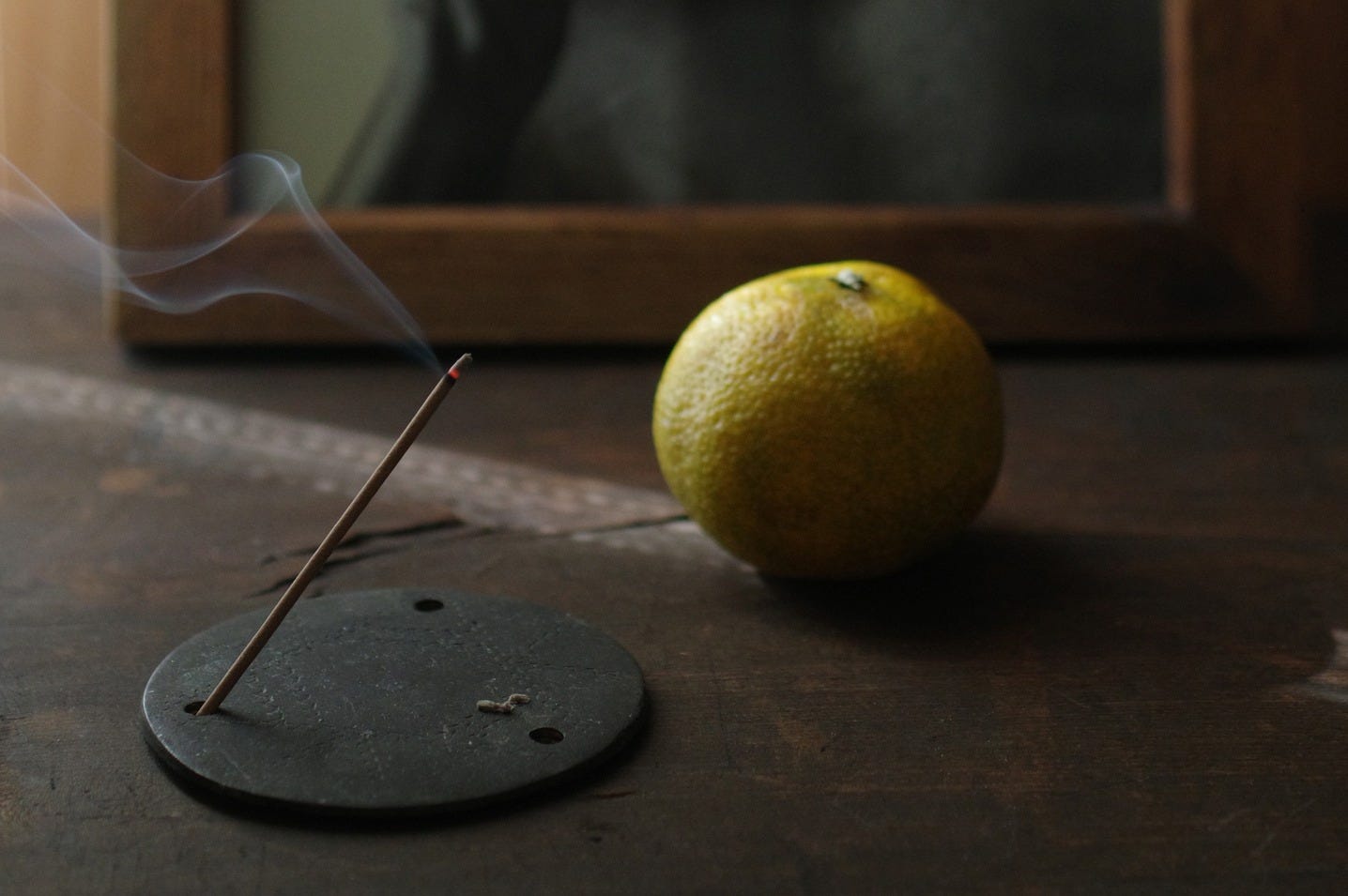
Kannon(観音): Listening Beyond Hearing, Seeing Beyond Vision
When space is entrusted to sound, our habitual reliance on seeing naturally comes to rest. When seeing rests, the sense of listening opens. And listening, in turn, opens into mindful listening—a form of listening that does not depend solely on hearing.
Mindful listening -kiku- also resonates with mindful seeing -miru-.
Here, miru is not limited to seeing with the eyes. It includes both ordinary seeing and contemplative seeing—a way of attending simultaneously to what can be seen and heard, and to what cannot.
This orientation toward the unseen and unheard is embodied in Kannon (観音)—the Bodhisattva who “contemplates sound.” It may also be called contemplation.
Much of my work as a monk involves lectures, workshops, and one-on-one dialogue. Recently, I have tended not to use explanatory slides. When we encounter textual information, we tend to want to take away something useful. Yet in truth, rather than trying to acquire something, when we loosen our preconceptions and strong intentions and allow ourselves to be given over to the space of the moment, what arrives can go beyond what we intend. I invite you to listen to your own senses—to kiku—and to taste the experience as it unfolds.
In this society of information overload, the cup is already full. AI will continue to generate endlessly, surpassing expectations the more we ask of it. Without creating space, the cup simply overflows.
To empty the cup is not to lose everything.
The Origin of Words, the Origin of Logos: Seeing Generative Plasticity
Language began from sound. Words emerged from sound.
In modernity, LOGOS has often been treated as definition, logic, and the textual expression of concepts. Yet if we trace its origins, logos originally pointed to a generative principle.
Words that emerged from sound were inherently generative, moving freely between meanings.
Socrates, in ancient Greece, warned against the uncritical use of writing and emphasized dialogue—listening and speaking—as a philosophical practice. His critique of writing appears in Plato’s “Phaedrus”.
Socrates cautioned that reliance on writing would lead people to mistake possession of text for possession of wisdom. Writing could substitute for memory, but it could not nurture the soul as living speech does. What he feared was mistaking interchangeable, borrowed garments for one’s true self.
In contrast, seeds properly sown through dialogue grow into living words planted in the soul. Socrates perceived, with striking clarity, the dangers of language that we still face today.
As the assumptions and concepts that modernity has built around “the world” and “society” begin to shift, “the words we write” and “the words that are written” are also opening once again to the possibility of living as words that give rise to seeds and continue to grow. If my own awareness does not fix text as merely “text,” plasticity can dwell within it.
When writing is performed with an attitude of mindful listening, what is written becomes a wave, resonating within a field and shaping phenomena and action. It becomes part of daily life, part of one’s path. Even written language can enter into a dialogical circulation.
Logos breathes again as a generative principle.

An Attitude of Listening That Creates Space
Today, language is commonly framed through four categories: “reading,” “writing,” “listening,” and “speaking,” and these are often understood in terms of “reading” and “listening” as input, and “writing” and “speaking” as output.
Western philosophy has long distinguished between “écriture” (written language) and “parole” (spoken language). Many religions are grounded in scriptures, and particularly within monotheistic traditions, the text itself often becomes absolute.
Yet when logos returns to its origin, the text begins to move.
In Buddhism, the Buddha is said to have been one who listened and spoke. His teaching was always responsive—”tai-ki seppō(対機説法)”, teaching according to the capacity of the listener. This listening transcends hearing, and even speaking itself may be understood as a form of listening. When the boundary between self and other dissolves, input and output form a single circular flow—neither one nor the other, yet both.
In Japanese, as with kiku, the same pronunciation—miru—can be written with different characters, each carrying a distinct nuance. One miru refers to seeing with the eyes(miru-見る), another to contemplating with the heart (miru-観る), and yet another—used especially in medical contexts—to examining and caring through attentive observation(miru-診る). Many Buddha statues seem to gaze nowhere in particular. Even with closed eyes, we feel their gaze and bring our hands together. This sensibility is not exclusive to Buddhism or the East.
The many ways of miru—of seeing—overlap with the many ways of kiku, of listening. In Buddhism, the Bodhisattva who listens even to voiceless voices and eases suffering is called Kannon(観音)—literally, “the one who contemplates(観) sound(音).” Within a world that can be seen and heard, attention is thus turned toward what cannot be seen and what cannot be heard.
The issue is not whether we privilege spoken “parole” or written “écriture” language. What matters is whether the attitude itself—the way of being, the awareness present here and now—is truly heard.
The Circulation Brought Forth by Listening
Mindful listening may be understood as a practice—an act of opening the senses and directing one’s awareness. In modern life, we are often pressed to judge quickly and to seek intellectual certainty. The knowledge and experience we have cultivated are essential for discernment, yet they also become filters through which we perceive the world. Without noticing, we may close ourselves off to possibilities that lie in what we have not yet seen, in the unknown.
When reading and writing are carried out from an attitude of mindful listening—leaving space—the text no longer remains confined to written signs that merely convey meaning. Instead, words arise as a lived manifestation of listening.
What Plato recognized in parole—spoken language—as words that are alive and animated by soul, begins to appear within the realm of writing.
Buddhist scriptures have been transmitted through chanting, carried forward together with sound and resonance. “Transmission” does not necessarily mean rigidly inheriting a fixed interpretation—“this person said this, therefore it means that.” How a teaching is received depends on how one listens, and even the words that articulate it give rise to multiple interpretive unfoldings. When one clings too tightly, even error may be passed down. What is needed, at all times, is a dialogical circle—continually questioning and kikuing together in the present moment.
In Japanese, to ask a question is also expressed as kiku—to inquire(訊く). And to receive that question is likewise to kiku—to listen(聞く).
Buddhism points us toward a way of being in which body(身), speech(口), and mind(意)—action, word, and intention—are held as one. Its cautions against words that run ahead of action, or intentions that remain unaccompanied by embodied practice, resonate with Socrates’ warning, in ancient Greece, about the handling of logos.
AI does not possess correct answers. What is at stake is whether a dialogical relationship—one that seeks the Middle Way(中道)—can be sustained. My own awareness is what is being tested. AI is also a product designed by humans: it can attune itself to users, capture attention, and guide them in intended directions. In some cases, it may even generate excessive leaps, functioning as an amplifier of karma.
If we merely entrust ourselves to the guidance of AI, our living words will gradually be lost, absorbed into an empty logos. Nothing can substitute for the cultivation of our own bodies and souls. Rather than creating illusory worlds that merely reflect our desires, we can ask AI to help us cultivate the ground—to recognize both the breadth and the depth of the unknown. And within that space, it is always we ourselves who must return to the Middle Way.
The Wisdom of Buddhist Listening and Leadership
Last year, I published Work Like a Monk (as of Feb 2026, released in the UK, the United States, and elsewhere). For me, the central question was how to convey the practices of Pure Land Buddhism to people around the world.
Japanese Buddhism is often associated primarily with Zen. As expressed in phrases such as furyū monji(不立文字)—“not relying on written words”—and shikantaza(只管打坐)—“just sitting,” Zen emphasizes embodied practice. Because it does not depend on interpretation, it is relatively easy to share as a path of practice and insight.
By contrast, practices that rely on words—such as the mantras, or the chanting of sacred titles—inevitably carry the risk that the meaning or interpretation of words can become an obstacle to awakening. What I wish to convey, drawing from Pure Land Buddhism, is a wisdom of kiku—a way of listening that goes beyond interpretation.
When this practice is held at the root, pathways open that sometimes pass through words, yet also move beyond language. The path of Mindful Listening -Nembutsu- is guided by a simple line: “Listen, and the voice will be heard.”
When we listen attentively, the voice is heard. This “voice” is a polyphony: one’s own voice, the voices of others, and the voice of the Buddha. Rather than something we intentionally grasp, it is a working of other power—something that comes to be heard. Through my own body, there is a cycle of hearing the chant and releasing it again. “Mindful Sitting,” too, is a form of kiku. Zen and Nembutsu, though different in their approaches, share the same path.
I am also involved with the World Economic Forum’s Global Future Council on Leadership. Leadership may lie in receiving what is given—and then letting it go. This invites a sincere reconsideration of what we mean by a leader: not someone who stands above others, but a guiding voice that dwells deep within each of us, free from attachment to the ego.
From this perspective, I hope to bring ideas such as Mindful Listening and the notion of the “Good Ancestor” into conversations on leadership.

Endless Dialogue, Across All Paths
Dialogue is a continual exchange of responses. It is not dialogue when one person presents a position, agreement is affirmed, dissent is refuted, and the matter is closed. In dialogue, words shift in response to the other person and to the situation, and divergences arise in how they are received. It is an exchange that also finds value in that very process.
Each person stands in a place that is uniquely their own, and what is spoken there cannot be spoken in their stead by anyone else. For this reason, we must listen to one another. When we assume that we share the same values or the same language, our preconceptions can prevent us from hearing the other’s words with freshness. At times, speaking in an unfamiliar language may make it easier to listen openly. Such is the force of preconception. Empathy is important, yet empathy, too, can become an illusion shaped by assumption. We cannot simply say, “I understand.” It is important to leave space.
Surveys and questionnaires capture responses at a single point in time. What matters more is the changes that unfold across multiple layers as time passes and experiences accumulate. This is plasticity—the capacity to bend, to return, and to expand one’s range of movement. When space opens for choices different from yesterday’s patterns, people may live with greater freedom.
A voice is the sound of a person. There is no right or wrong—tones overlap, and from them the world is formed. As long as we are alive, the individuality that dwells within the body will continue to appear. Holding this as our ground, I hope for dialogues that resonate with one another, like music.