
Why I no longer say “be here now”
by Shoukei Matsumoto
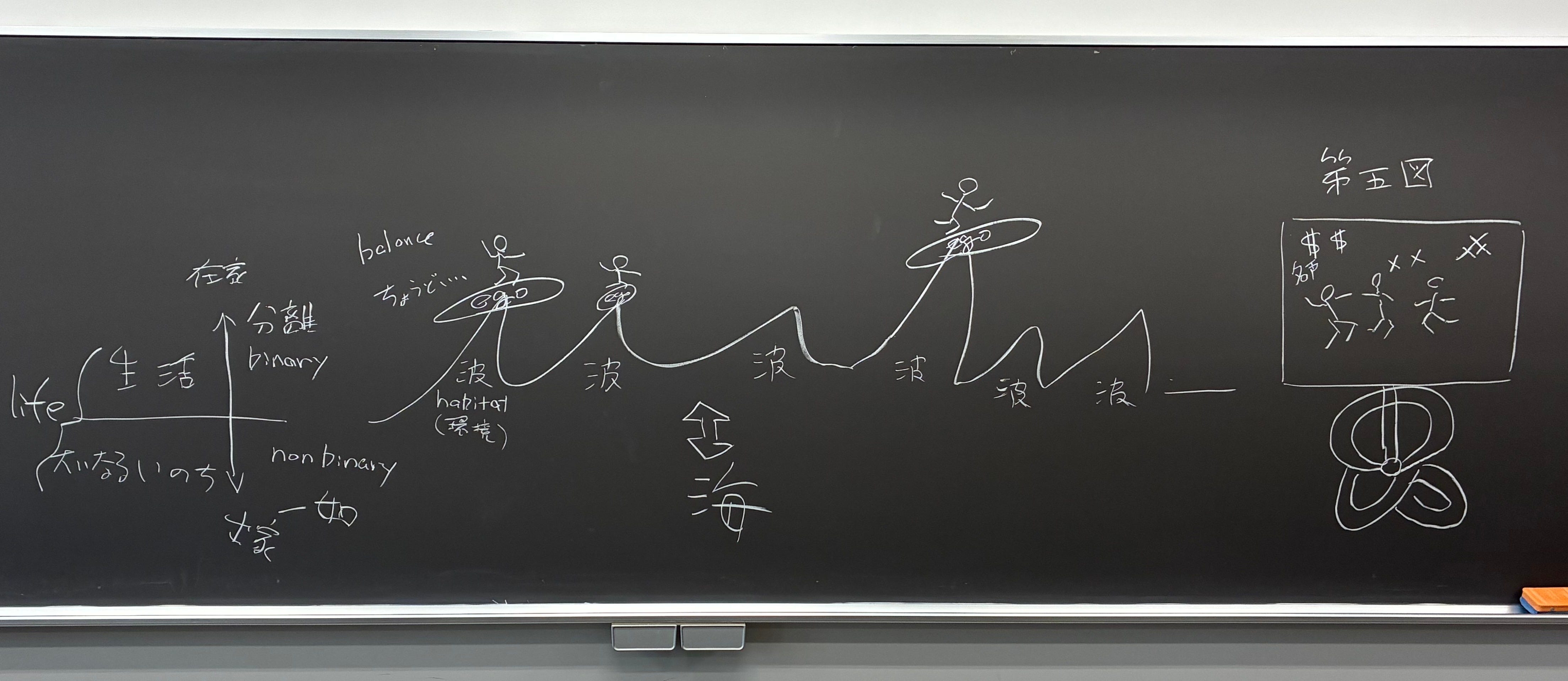
A few weeks ago I stood in front of a blackboard and drew a picture I have drawn many times. Waves, one after another, with a small stick figure surfing on top. Beneath the waves, the ocean. I was teaching a class on awakening, and the drawing is my shorthand for something hard to say in words: that each of us is a wave, shaped for a while, riding the conditions we are given.
I have used this picture before, in writing about the right size of the ego. The surfboard, the balance, the daily renewal of the board. But that day, after I finished drawing, I wanted to add one more word. Next to the ocean, in the empty space below the waves, I lifted the chalk to write timeless.
And my hand stopped.
It stopped because the word is dangerous, and because it is the truest thing on the board.
The waves are governed by time
Start with what is safe to say. The wave is a creature of time. It rises, holds its shape for a moment, and falls. It has a before and an after. Everything we do as waves happens inside time: we remember, we plan, we regret, we worry. Even the practice I have described elsewhere, of taking up a fresh surfboard each morning and trusting the water, is a practice carried out in time, day after day.
This is not a flaw. It is simply where we live. The Buddha did not deny impermanence; he built everything on it. The wave is real. Its rising and falling are real. To be a person is to be a wave, and to be a wave is to be in time.
So when I teach, I mostly speak from the wave. I have to. Language itself belongs here, in the realm of before and after. The moment I open my mouth, I am standing on a wave, describing other waves to other waves.
“Be here now” can quietly harden us
For a long time the word people reach for, when they want to point past all this, is mindfulness. Be here now. The mind, left alone, runs off into the regretted past and the feared future, like a restless animal, and mindfulness calls it home to the present moment. There is real wisdom in that. I do not want to take it away from anyone.
But I have come to think the phrase carries a hidden cost, depending on how it is held. Held deeply, “be here now” is not a point at all; for someone whose practice has ripened, the present opens until past and future are gathered into it, and that is already close to what I am about to describe. The cost is not in the instruction. It is in how someone like me tends to take it. I hear “this instant” and I reach for it as an idea, a single point on the timeline to stand on. And a point is a small, sharp place to stand. It can quietly strengthen the one who is standing: the separate observer, watching this breath, this sensation, this now. The wave, attending so closely to its own crest, can grow harder and more separate, not softer.
I noticed this in my own sitting, and I want to be clear that the fault is mine, not the teaching’s. When I am told to concentrate on the present moment in silence, my monkey mind only gets naughtier. Pressing myself onto the single point of now did not dissolve the boundary of the self. Sometimes it drew the boundary more firmly. I was holding the now as a concept, and a concept is something you stand apart from and grip.
So I want to try a different framing, not because the old one is wrong, but because a different road may loosen the grip for those of us who keep tightening it. Not against mindfulness, but reaching for what mindfulness is reaching for, by another way in.
A longer now
Here is the move. If “be here now” compresses time to a single point, there is an opposite direction available. Instead of shrinking time to an instant, you can open it outward, with no edge.
I have started calling this a long-now. I should say at once what I do not mean. I am borrowing the phrase from a world of long-term thinking, of ten-thousand-year clocks and civilizational time. That is a worthy project, but it is not what I mean here. I am not talking about the time of civilizations. I am talking about something that happens on the cushion, in the body, in a single sitting.
By a long-now I mean this: the felt sense of connection between this wave and all the others, stretched out in the direction of time until it has no boundary. My friend Audrey Tang once told me she lives with a “one-day ego.” Each morning her ego is born, and each night, as she sleeps, it dies; the next morning a renewed self wakes up. So the person she was a month ago is already her ancestor. To become a good ancestor, she said, is not only about future generations. It is also about yourself, tomorrow.
That is a long-now in miniature. Now keep stretching it. The self of a month ago is an ancestor; the self of next year is a descendant you are quietly tending; the people who came long before you and the ones who will come long after begin to feel less like strangers across a gap and more like the same water, moving. The wave does not deny that it is a wave. It just stops holding its edges so tightly.
If you want to feel it in the body rather than think it, you can sit and try this. Picture three circles. To your left, everyone who came before you, your parents and theirs, the long unbroken chain going back through people you cannot name. To your right, everyone who will come after, the ones who will inherit whatever you build. And in the center, small, this present self. Then notice your breath. With each breath in, you are receiving something from the left: the struggles, the courage, the accumulated habit of all who made this chair you sit in possible. With each breath out, you are sending something to the right: a wish, and room for them to move. Sitting like this, you are not standing on a single point of time. You are a bridge. The now you are in is wide.
This is why I would rather not say “be here now.” What I practice is closer to the opposite of compression. Call it long-now meditation: not pinning attention to a point, but opening the connection of one wave to all waves until the felt boundary of now begins to thin.
Stretched far enough
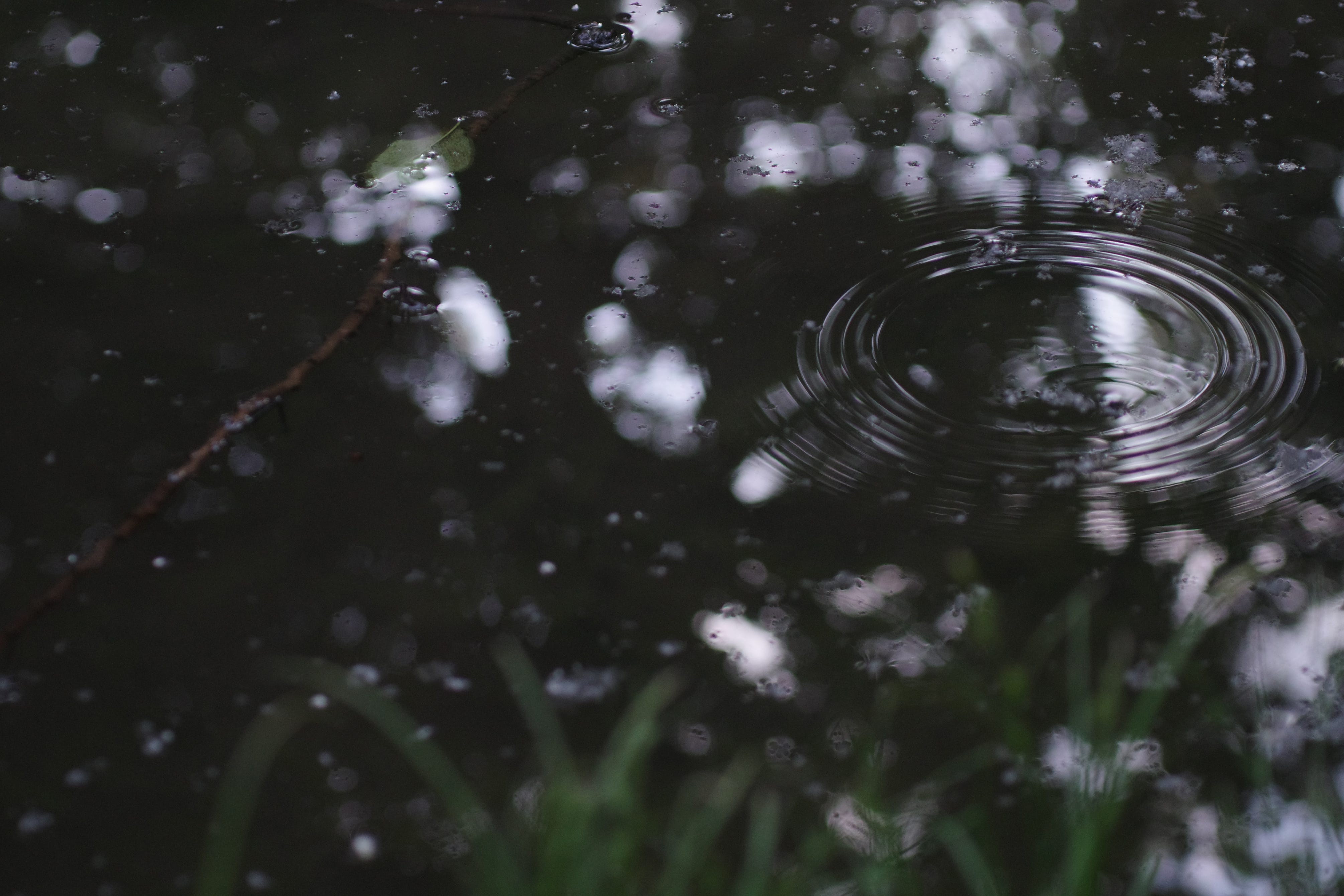
Stretch the long-now far enough and something happens. The connection opens so wide that even now gives way. Time thins out. You touch the ocean.
This is the word my hand stopped at, so let me be careful with it. When I say the ocean is timeless, I do not mean it lasts forever. Forever is still a story about time: time going on and on without end. That is not it. An eternal ocean would still be a thing inside time, merely a very long one, and it would smuggle back in the very idea I am trying to set down. There is a permanent, deathless self, it would whisper. Buddhism spent its whole life refusing that whisper.
What I mean is simpler and stranger. The wave is in time; it genuinely rises and falls. The ocean is not eternal. It is prior to time. It is the layer where the time-bound events of rising and falling have not yet started to happen. Where time does not reach. The wave’s impermanence is left completely intact. We are not escaping into a forever. We are noticing the water that was never on the clock to begin with.
A physicist, Carlo Rovelli, has written that time does not exist, or at least not in the way we assume. The more precisely we look, the less settled it becomes. He is no Buddhist, though he found some of his inspiration in Buddhism. I take a quiet comfort in hearing it from a scientist, because it means the thing I am pointing at is not a mystical extra we add to the world. It is closer to what is already the case, once you stop counting.
And yet I notice what I have just done. To set “prior to time” down this cleanly is to do on the page what I almost did on the blackboard: to write ocean inside a frame, and give an edge to the one thing that has none. So hold the distinction, and then loosen your grip on it. It is true, and it is also only a word I reached for and could not quite write.
A voice from the same stage, going the other way
I want to bring in another person here, because he complicates my picture in a way I find honest, and because I cannot get him out of my head.
That phrase I borrowed, the long now, comes from a foundation in San Francisco. On their stage, only weeks ago, the poet and philosopher Bayo Akomolafe gave a talk about time, and he said something close to the opposite of what I have been saying. He is suspicious of the long view. To stretch time outward, he warned, to think ten thousand years ahead or millions of years back, can leave us exactly where we started: still at the center, still in the seat of mastery, now with a longer ruler in our hand. Extending time does not dislodge us from the self. Where he points instead is not outward but into the gap. Between every tick and every tock, he says, there is a surplus, an interval, something older than the count that breaks the counting itself. He draws this from Yoruba cosmology and from histories I have no claim on, and I will not pretend his road and mine are the same.
But notice where they rhyme. He goes into the crack between the tick and the tock. I once wrote that ninety-nine percent of the time we are carried along by the current of our accumulated habits, and that the whole of what is truly ours lives in the one percent: the small gap between stimulus and response. His interval and my one percent are not the same thing. Yet they are both the place the count leaves out, the remainder the clock cannot metabolize.
So I do not reconcile us. He stays in the gap; I open the now until it has no edge. Perhaps these are two doors into the same room, and the room is older than both doors. He of all people would not want me to resolve it neatly. I would rather leave my long-now and his untimely in that company: unresolved, in conversation, pointing.
So I never wrote the word
I never did write timeless on the blackboard that day. I put the chalk down and kept teaching from the waves, because that is where my students were, and where I was, and where this sentence is.
But the ocean was under the whole drawing the entire time. It always is. We spend our lives on the surface, riding our particular waves, keeping our particular count, and now and then the counting loosens and we feel the water that holds it all and does not itself rise or fall.
I will leave you with the question I have been sitting with, rather than an answer. When you practice, whatever your practice is: are you compressing time to a single point, or are you opening it? Both can quiet the mind. But they send you in opposite directions, and it is worth knowing which way you are facing.
The whole time I stood there working this out, drawing my waves and my ocean and almost writing my careful word, the cat at home was asleep. To him, the blackboard is a wall.
In one line: Mindfulness pins time to a single point; what I practice instead opens it, until you are no longer a point but a bridge, and the felt connection of one wave to all waves stretches until time itself thins and the ocean becomes audible beneath.
Themes: meditation, mindfulness, long-now, timelessness, no-time, impermanence, Good Ancestor, Audrey Tang, Carlo Rovelli, Bayo Akomolafe, the untimely, Ambient Buddhism
Related: The Right Size of Ego; Not Everything Is Your Karma. The Buddha Said So.