


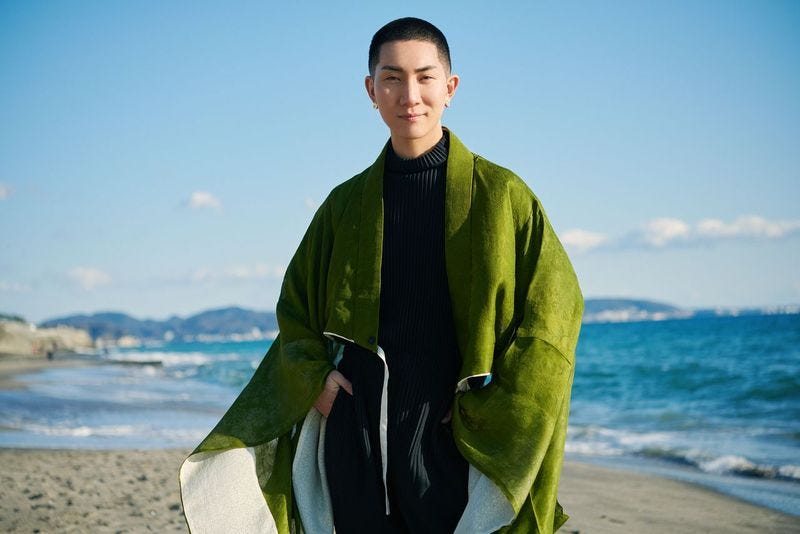
Kodo Nishimura
Kodo Nishimura is a Japanese Buddhist monk, artist, and LGBTQ+ advocate who inspires people to embrace their authentic selves. Through his work as a speaker, author, and activist, he connects spirituality with self-expression and compassion.
Born in Tokyo in 1989, he graduated from Parsons School of Design in New York and began his career as a makeup artist, working behind the scenes at Miss Universe and New York Fashion Week.
Ordained in the Jōdo-shū (Pure Land) Buddhist tradition in 2015, Nishimura gained international recognition through Queer Eye: We’re in Japan!. He has spoken at UN agencies and universities including Harvard and Yale, and his work has been featured by CNN, BBC, and Vogue. He was also selected as a TIME Next Generation Leader.
His memoir, This Monk Wears Heels: Be Who You Are, has been published in nine languages.
More from Kodo Nishimura:
https://kodonishimura.com
My guest today is Kodo Nishimura — a Buddhist monk in the Pure Land tradition, a makeup artist, and an advocate for LGBTQ rights. He joins us from Tokyo and New York, the two cities he moves between.
Conversation
May 2026
Shoukei: Very nice to meet you.
Kodo: Nice to meet you, Shoukei-san. Well, I knew about you for a little while, but it’s an honor for me to meet you in person and have a conversation. And I think there are not too many monks who are kind of forward thinking, innovative and paving their own way. So I’m very excited to listen to your ideas and share some of my ideas today. Yeah.
Shoukei: Thank you so much. It’s a real honor. Thank you for having me on this podcast as the first guest in this new series. And, you know, I wanted to start something like this to introduce, you know, the multi-dimensional Buddhism in Japan today, introducing the very unique monks like you. Yeah. So, you... how can we start?
Kodo: So maybe I can explain who I am.
Shoukei: Oh, yes, please.
Kodo: So I was born in a temple. My father is a Buddhist monk. My father was actually born on a farm, yeah, in Toyama Prefecture, but his far relative who was a monk didn’t have children, and didn’t have anybody to inherit the temple. So because my father was the second son of the farm, he was not going to inherit the farm. So when he was five, he came to Tokyo to become the next heir of the temple. So he was raised to become a Buddhist monk, and I am his son.
Shoukei: Okay. All right. So when you were born, your home was not a farm, already a temple.
Kodo: Right. My father grew up in the temple from when he was five, and he went to university, studied Buddhism, became a Buddhist philosophy and history and sutra professor at the university all his life. And I was born in 1989, now I’m 37 years old.
Shoukei: So although he was born on a farm, he became a kind of very serious monk.
Kodo: Yes. When he was younger he told me that he wanted to be an actor or screenwriter — when I see the albums I see my father dressed up as like a fisherman, or like a samurai, and I think he appeared in some movies or TV shows when he was younger as well, but I think he didn’t have a choice to choose what he wanted to do. So he told me that he didn’t want to be a Buddhist monk, and he fought with his step parents, but now I think he embraces the identity of Buddhist monk. So yeah, and me, I grew up wanting to be a princess because I always knew that I was homosexual. So I think he understands that some children of monks may not want to be Buddhist monks as well, like him.
Shoukei: Yeah, yeah. So for the listeners, for those who are not that familiar with Japanese Buddhist culture, you know, monk sounds like, of course, very monastic, but actually Japanese Buddhist monks are more secular. So I sometimes explain I am a secular monk, which might sound a little bit strange, because secular and monk sounds contradictory. Right. But it’s like a small family business.
Kodo: It is like a family business.
Shoukei: So most of the monks are expected, in a sense, to have children who are going to inherit their temple. So it’s not monastic at all. Even, I’d say, it’s more secular than an ordinary family because the monks are even encouraged to marry. Yeah. So when you are born in a temple as a child who is supposed to inherit your temple, or your family business, so to speak — when you got conscious of your condition and environment, what did you feel?
Kodo: I felt very pressured. I feel like my destiny in life was decided by other people. And shaving my head or living a very austere simple life — it was opposite from what I wanted to do. I wanted to have my hair long and, you know, flow my hair in the air like a shampoo commercial. And I felt, well, I’m not going to be what you want me to be. Life is not easy. Just because you have a son, it doesn’t mean that the son is going to be obedient. So I was very rebellious. I always questioned, why do we need Buddhism? Why do we need to pray? What’s so fun about this? And because my father is a university professor, he was able to, not by faith, but by kind of logic and historical perspective, explain this is how Buddhism came to be.
Shoukei: So left brain guy.
Kodo: Yeah, yes. And you know, as you said, it’s part of the business, which is an unfortunate reality of Japanese Buddhism, because yes, your life is stable and you are respected if you inherit the temple instead of going to a different company and starting from zero, because as long as you are seen as the next heir of the temple, you are respected and you don’t ever lose your job. So a lot of people kind of don’t think of going elsewhere, but just inherit the temple business because it’s easy. And I understand that. I also feel that way too. But because of that, I also have some questions — like some people pay more as offering and they get better treated, or maybe they get a longer kaimyo, which is like the name given to that soul when you pass away. So I also started to focus on some of the injustice or hypocrisy, because everybody is supposed to be equal, right? So I had all these types of thoughts when I was growing up.
Shoukei: So I have so many monk friends in Japan, and I’m actually, thanks to the initiative I have been doing — the podcast program, which is basically a conversation with a guest monk and me — the number of guests so far is over 200 or so. So I kind of know how most of the many monks feel when they get conscious of their circumstance growing up. Many of them somehow get the urge of, how can I get out of this temple, my home. Yes, it’s natural for young people, but in your case, the situation might be even more complicated because — when did you get conscious or aware of your gender, and yeah.
Kodo: I think I always felt like a girl. When I was maybe two or three years old, I started playing with my mom’s dresses and pearls. And I always, well, I always had stuffed animals, and I would explain to my parents, “Oh, they don’t have gender. They are not a boy or a girl.” And that was a reflection of how I felt about myself. I know that my body is male and I accepted that. I don’t have any problems with that. But I felt like the soul — just like you don’t know if a plushie is a boy or girl — I don’t know if I’m a man or woman inside. But I was sure that I was attracted to other boys. So I started to hide, because even though I was maybe 3 or 4 years old, I knew that it’s not common. And well, I was in the closet until when I was 24 years old. So I always felt like I had to hide and be careful to avoid discrimination. Yeah, in 24 —
Shoukei: — you came out. So until then you went through high school life. And your parents, who are in charge of your temple, right? Did you feel any pressure from them around the course of your life?
Kodo: I felt pressured. My father, when I was younger, said that once, if you are going to inherit the temple, you would need a wife because it’s a demanding job. And I was like, well, I’m not going to get married to a woman, or will I welcome children? So it’s not going to be like how you want it to be. So I felt like if I were to come out, I didn’t know how they would respond to me. I was very afraid and scared that they might disown me or get disappointed. But when I finally came out, my father said that, well, this is your life, and sexuality is not something that you choose. So live as you are. And my mom, she was always concerned because I never really had male friends. I was always with girls when I was younger. So she felt that, well, maybe I didn’t raise him correctly.
Shoukei: She felt guilty or something. Yeah.
Kodo: She was questioning. She was blaming herself. And I remember, like, many books about how to raise a child in the bookshop. And I was like, am I that much of a problem? Like, why do you need to read that many books to raise me? Is anything wrong with me? And then finally, when I came out, she was sure that I was homosexual. She was questioning if I’m a transgender woman or, I don’t know — she didn’t quite understand what’s happening with me. But they are very supportive and they are very anti-discrimination and anti-prejudice. So I feel very lucky.
Shoukei: Yeah, yeah. That’s great. So coming back to your choices in your life — you went to high school in Japan. Yes. And after that, did you go out of your temple and go somewhere?
Kodo: So when I was 18, I was very frustrated with the Japanese society where they don’t accept or welcome LGBTQ people. I felt that it was very binary. And I started listening to Michael Jackson or Mariah Carey, and they would sing about racism, poverty, or female empowerment. And I felt that this is very different from what I hear in Japan, because in Japanese love songs, they always talk about male and female love stories. So I moved to the U.S. And when I went, I went to Parsons School of Design — it’s an art school, in Manhattan. So everybody wore colorful clothes and was very expressive. The more you show your flavor, the better. And during that time I felt that, oh, if I want to shine, I have to do something unique, something that others can’t imitate. And the answer I felt was hiding in my origin — that I grew up in a temple, and I struggled with my sexuality. And I felt that, well, I said that I didn’t like Buddhism when I was younger, but I didn’t know what Buddhism was about. Why do we need Buddhism? Why do we need monks? Why do people come to the temple? So I decided to go to monk training, understand what it was about, and then make a decision if I want to do it, if I agree, if I like it or not.
Shoukei: Okay, so you spent a couple of years in the United States?
Kodo: Yes, I spent — by then I think I had spent like eight years.
Shoukei: Eight years. Yeah.
Kodo: So in total, I spent 11 years in the US.
Shoukei: So your mind may be like half American. Yeah, yeah, yeah. So from 18 to 29, right?
Kodo: 18 till twenty-nine. So my youth, my personality — it’s when you become an adult.
Shoukei: Right? Yeah. And during those years, when you came back to Japan, you came out to your parents. And so those periods must have been very dynamic, right? Yeah. For you.
Kodo: When I was in Japan, I almost never met anybody who was proud to be homosexual. But in the US, I watched TV shows and movies, and I met my professor who was gay. I went to see Pride parades, LGBTQ activists. For example, Tim Cook —
Shoukei: CEO, Apple, yes.
Kodo: — is also a proud gay CEO. And I felt that, oh, I just didn’t know about who I was. It’s just that Japanese society was not welcoming or appreciating our existence enough. But there are many people who are overcoming this stigma and thriving globally. I just needed to see my peers outside Japan. So why do I have to hide if there’s nothing to hide? I just had prejudice and discrimination toward myself, which was planted by society. So when I came out, I felt like I was born again. I can finally live my own life. I was so happy.
Shoukei: And in the United States, you found many colleagues and allies, friends. And no more alone.
Kodo: Right. When I went to the Pride parade in Manhattan, I saw a sea of people. The crossing was just, like, maybe 3 meters away, just a few steps away, but there were too many people that I couldn’t move at all. And I was very frustrated — I was like, oh, this place is so crowded and it’s annoying — but many people were there to support my rights. So when I hear some discriminatory words in Japan, I remember, I was like, oh, but I have this many people — as many as I can’t move — who are supporting my identity. So they gave me a little power. And I felt that wherever I am, I should always be proud, and show that it’s not anything to be ashamed of.
Shoukei: And so being encouraged by those allies and supportive people, you decided to somehow rediscover and reunite with Buddhism. Yeah. So I’m very curious about how you found Buddhism through your lens.
Kodo: Oh, sure. So since when I was young, I always felt that society is very unfair for women. Because I also feel like a woman — when women are expected to serve tea or to be supporting, obedient, and quiet. My mom said, oh, as a temple wife, I shouldn’t speak up. I shouldn’t be too opinionated. I don’t want to be seen as noisy. But I was like, why, mom? You’re smart and wise. Why are you not sharing or speaking up? I know she’s, you know, very creative and strategic. So I felt that just because they’re a woman, they shouldn’t be oppressed in society, not just in temples. So when Buddhism says that everyone is equally valuable, including women and LGBTQ people, I wanted to use that teaching to wake people up and give them confidence. Maybe because I am an Aquarius, I’m about revolutionizing and changing the old traditions — I feel like I need to start a new chapter. That’s my personality. So I thought, Buddhism is respected, and what if I, as both a homosexual who is not traditionally respected and a monk — how will people respond to me? And I wanted to encourage people who are feeling like they are not supposed to speak up. So I felt that it’s my responsibility, instead of praying for the ancestors or doing the rituals that other monks do, to spread the empowering message.
Shoukei: So, as we know, Buddhism, because of its long history and wide exposure to many different cultures and regions, has many different aspects. And of course, if we come back to the original teaching from Shakyamuni Buddha, that teaching is very liberating and transformative, accommodating anybody from any background, any gender, and so on. But when it comes to what today’s Buddhism is, although it is still Buddhism, there are many things that may not necessarily be liberating or transformative, you know. So how did you reconcile this complexity?
Kodo: Sure. That’s a good question. I feel that the origin of Buddhism was to empower and bring equality to people and help them live a balanced, smart life. And a lot of teachings, or maybe rules, were created to kind of sustain the community of the Sangha. So we, in my opinion, must not confuse the teaching and the school rules. For example, when we learn at school, we learn the same things, but there are also other rules that come with school — maybe you shouldn’t bring knives to school, maybe you should have a school uniform, or you can’t dye your hair, you can’t wear makeup — all these things in order to make the community harmonious and in order.
Shoukei: So it sounds like the school rules in Japan, particularly, right?
Kodo: But that is understood as a Buddhist teaching. And that may be confusing. Some of the teachings may not apply to our modern life anymore. And the objective of Buddhism, I believe, is to help people live a better life and not kind of limit our freedom. Buddhism should be a tool to go where we want to go, and it’s not the goal itself. Sometimes we try to be like the most Buddhist that we can be — I kind of feel people trying to do that — but there’s, to me, no such thing. Buddhism is there to support the way you want to go. And those rules or presets will be very helpful when you have problems that you need to solve. So that’s my approach. And yeah, so maybe that’s when people have some questions about if I’m a real monk or if I’m really following Buddhist teachings. But it’s not that I’m not thinking about these things. I think in the society today, we need more empowerment. We need to be flexible. We need to reconcile with the digital, innovative, competitive world. So I’m trying to respond to these things after studying the basics of Buddhism in my own way.
Shoukei: Yeah, yeah. It’s a good way to distinguish school rules and the dharma. Yeah, it’s a very helpful way to understand. So practically, when you went through all the programs to be ordained and eventually to receive, in the Japanese Buddhist system, a kind of certificate to inherit your father’s and mother’s temple — you must have met a lot of very traditional, conservative monks, who don’t necessarily distinguish the school rules and the teachings. So I’m asking because I myself have met a lot of monks like this. Right.
Kodo: Well, I try to take a good distance. Because what I feel is that their world or their experience is not mine. So from their perspective, from their experience, from what they studied, I’m sure it makes sense for them. But me, growing up struggling with my sexuality, I can empathize and understand what other people feel — and do the traditional monks cater to them? There are things that only I can do. And well, I feel that there are always different parties in many groups. So there are monks who are traditional, but who supported me saying that, well, you can be homosexual, whatever you want to be, and still be a Buddhist monk. And what you wear — for example, I like to wear makeup — one monk said that monks have been evolving. For example, that monk was a university professor. There are monks who are also doctors or acupuncturists, and they wear scrubs or watches or different outfits depending on their jobs. So when our mission is to liberate and encourage everybody, why should the outfit be a problem? If you can empower and liberate people, I don’t see that as a problem. So I try to lean on these, I would say, liberal and broad-minded people as my mentors. How about you in your situation? How do you find the traditionally-minded Buddhist monks?
Shoukei: Most, most, most of the monks in Japan — 99, maybe 99.9% — sustain their life by running a temple, right? Taking care of memberships, leading ceremonies, managing the cemeteries, and so on. In my case, I don’t do these things at all today. I used to do it under the... yeah, so I’m affiliated with a temple in Tokyo. And since I became a Buddhist monk, in the Japanese definition, 23 years ago, in the beginning I started supporting my boss, the head priest, sitting next to him when he did some ritual ceremonies and so on. But at some point, I decided to be independent, out of my entrepreneurship, maybe. So since then, I’ve been sustaining my life by writing, speaking, thinking, and consulting — with people, not in the temple community. So if you think of a traditional monk, or if you look at me from the lens of a traditional monk 100 years from now, my way of being a monk may not be that traditional or conservative. But if you look back far into the life of ancient monks, 800 years ago, such as Shinran or Honen, who didn’t do those ritual funeral ceremonies — they were not monks who took care of local temple communities and so on. So in this sense, if I may, I’m kind of following the past, the way of life, like Shinran.
Kodo: I agree. I think the founders of our schools were the 0.1%, as you said, because they were seen as rebellious or groundbreaking or rule-breaking. They were criminals. Right. And they were sent to far-away islands. But their intention, I think, was good, because Honen, the founder of my school, Jodo-shu, Pure Land Buddhism, wanted to help everybody by saying that as long as you pray and chant, everybody and anybody — even if you’re a criminal, sex worker, hunter, disabled, wherever it may be — everybody is sure to be enlightened.
Shoukei: Just as they are. Right.
Kodo: Regardless of how many good deeds you make in life. Because until then, everybody needed to maybe chant and struggle with different trainings, maybe sit under the waterfall —
Shoukei: — to accumulate merits.
Kodo: Right. But not everybody is able to do that. So in order to give hope to these people, he kind of curated good teachings to help those people. So in that way, I believe it’s a good thing to adopt and modernize and try to help people. That’s what I believe.
Shoukei: Right, right, you know. So thanks to the long, wide history of Buddhism, whatever you do, you can find someone in the old age who did a similar thing. So whatever you do, you can recognize yourself as traditional. That is true.
Kodo: That is true. Because Shinran, I believe, was the first monk who got married?
Shoukei: Yes, right. Yes, historically. Official history.
Kodo: He’s the founder of the most widely believed school in Japan. So, well, to be honest, I receive some criticism or questions from overseas listeners or viewers that I am not a real monk because I’m married or I am homosexual. But I feel that this 800-year history was written 800 years ago. And this is the way I grew up. And yeah, I think I would love more viewers to see the broader history and its evolution, and yeah, maybe adopt what we need today. So.
Shoukei: Let me slightly switch to a different conversation. I mean, yes, we both live within the Pure Land tradition, which is, broadly speaking, most of the Buddhism in Japan, within the Mahayana school. But even within the Mahayana school, there are many different schools. And in the United States, I’m sure that the most famous school from Japan should be Zen. Yeah. And for most people, Buddhism is equivalent to Zen. So I am sure that when you were in the United States and spoke about Buddhism, people would ask, oh, so you are in the Zen tradition. And unfortunately, Pure Land is very unpopular. So how do you see this situation? How do you interpret and translate this unpopular tradition, namely Pure Land Buddhism, for the audience in the United States, who are not familiar with, you know, nembutsu, 南無阿弥陀仏, and so on?
Kodo: Sure. So I’m not trying to promote Pure Land Buddhism to begin with. I just want everybody to feel powerful and valuable. And if the Pure Land Buddhist teachings help us to remember our worth, then I will quote it. My mission is to really empower people. Yeah. And I sometimes feel confused when people expect me to practice Zen or meditation, because that’s not what we really do. We do chanting. And we never had to practice Zen. Which I wish I had learned, because it looks interesting. But I think Zen is popular in the West because many people are overwhelmed by the competitive society, materialism and capitalism.
Shoukei: Every day, a need for something to hold onto.
Kodo: Right. So I think that’s why Zen is popular. And Pure Land Buddhism was created to bring salvation to many people who were maybe not able to reach the nobles in the past in Japan who were building temples and receiving support and advice from monks. Honen, the founder of Pure Land Buddhism, wanted to help everybody. But I don’t think that’s what westerners are looking for in that sense, because religion was pretty much accessible to all people. So the reason for the birth of Pure Land Buddhism maybe doesn’t really apply. But what we need, I believe, is the message of equality — and when we feel that we are not invited into some rooms because of where we come from, or our ethnicity or sexuality, I want people to feel that we should take up space. So that’s what I believe.
Shoukei: Yeah, yeah. Your approach completely resonates with me. And yeah, our mission is not converting people to Pure Land Buddhism, but encouraging and helping them. So from this point of view, I’m always looking for the implication of the Pure Land tradition for people living in today’s world. Yes, as you said. And you know, we seem to be living in a very fragmented — I forgot the English word — unpredictable world. The change in society is very fast, very quick, in terms of the value system and technology. And yes, geopolitics. And et cetera. So this situation seems to resonate with the age where the founders of Pure Land Buddhism, Honen and Shinran, lived 800 years ago. And what we can learn from Pure Land Buddhist thinking, such as Tariki — the other power, I don’t like this translation because it’s too literal —
Kodo: — depending on Amitabha to take us to the Pure Land.
Shoukei: Yeah, so. We have that teaching, but you know that sounds too superstitious for some people, right? Yeah. So one of the implications I learn from Pure Land Buddhism for today’s world is it’s a Buddhism for the age of no control. We are almost forced to surrender to the radical change of the world. It looks like it’s uncontrollable already. But in our paradigm so far, we have been trying to keep control on everything as much as possible. So if the level of uncontrollability comes up to a certain threshold, we get too concerned, too worried, and we get stuck out of fear. But what I learned from our ancestors like Shinran — he emphasized shin, having shin, or in my interpretation, radical trust in this world. Radical trust in this world, as much as whatever happens, I anyhow accept it. Without a controlling mindset. Right. So yeah, I think this is something we can learn from this tradition today.
Kodo: That is true. So whatever may happen, we have faith in ourselves and we are able to keep going because we have this pillar inside of us. Well, because the world is changing so quickly, our values and maybe trusted people around us — the pillars — may be shifting in the years to come. You know, when I think about Honen founding Pure Land Buddhism, it was when there was plague, when many people were starving or struggling with illness. So it’s kind of similar to what we experienced with COVID. Indeed. Right. Well, it’s not an easy way for us, because we are seen as maybe rebellious or untraditional, and we have to stay strong. And that’s why I think we are connected to support each other. But the good thing is that we are connected to the global audience. And we are also learning from each other. And I think that’s where we feel like our voice matters. Right. And I truly admire that your book is published in many — 17 languages?
Shoukei: Yeah, over 20 actually.
Kodo: Oh, wonderful. So I think we have to remind ourselves that our voice is needed, and there are people who are looking for this information, because we see what happens maybe more than what the traditional monks see. So that’s — well, it is also my mission to see what the world needs in the future. From your perspective, what would you say is something you want to do next? Yeah, how do you see the world going forward?
Shoukei: So I, as a Buddhist futurist, am somehow sure that the course of our civilization is going toward liberation. It seems like the value system and the social systems has been captivated in — if I may use this word — an almost religion called humanity. In the modern age, maybe after the Renaissance, for 300 years or so, for a couple of centuries, we have been celebrating human flourishing, humanity. It has been a very human-centric worldview. Yes, that’s true. But what we are witnessing today is the limitation of this worldview. If you look with a sane mind at the nature of this world, human is not the only species, of course. We are living in the interbeing world, where everything, everyone is interconnected to each other. So somehow, advanced, forward-looking thinkers and scientists are discovering or rediscovering this worldview where we see human not as the center or the supremacy of this universe, but just a part of the species — and accommodating a new comer, a new family member, namely AI. Yes. So I see we are being liberated from this conventional religion called humanity toward — I don’t know the exact word, but maybe related to biosphere or beyond human, whatever. And in this age, again, you know, Mahayana Buddhism has a lot of things to say, because in its core there is the concept of interbeing. So yeah.
Kodo: I think that’s a way to kind of graduate from materialism or comparison, from feeling like we have to keep achieving things. Because we’re not only comparing ourselves with other humans, but maybe we are just part of nature. Maybe you can see how plants grow or seek goals in different things — maybe to protect nature — or it can be something that others might not necessarily value, but if you can find value in your own way, you kind of graduate from the things that used to cause us stress.
Shoukei: Yeah, I think so. And we human beings used to be sensible or sensitive enough to discern what a tree is saying by touching its surface. But today, including me, we no longer have that sense anymore. But thanks to technology that enables us to listen to the voice of trees, of animals, through AI —
Kodo: Uh-huh, they have so much to say.
Shoukei: Yes, yes, yes. The voices have been analyzed by some scientists recently, and thanks to AI, you know, we will be able to understand the voices from other species. So yeah, we may rediscover the relationship with other species and then be able to recognize that we are not the only stakeholders on this planet. So yeah, it’s an age of expansion. So yeah, let’s see what will happen, and in this course of civilization, what kind of implication can we rediscover from this wisdom.
Kodo: Wonderful. I think they might have different ideas, or maybe they will show us a new way. Yeah, I’m very excited to see that. I never had that mindset before, but yeah, comparing myself to others — I think that also has a lot of hints for overcoming what we’re going through now.
Shoukei: All right, so maybe it’s time to close this episode for now. But let’s continue our conversation. Yeah, I’m looking forward to talking more. So for now, thank you so much for joining this program.
Kodo: Thank you so much.
— sound cooperation —
Opening
shō (Japanese mouth organ)|Junpei Otsukaorin (Japanese singing bowl)|Syouryu
Ending
piano|Nozomu Takahashi


