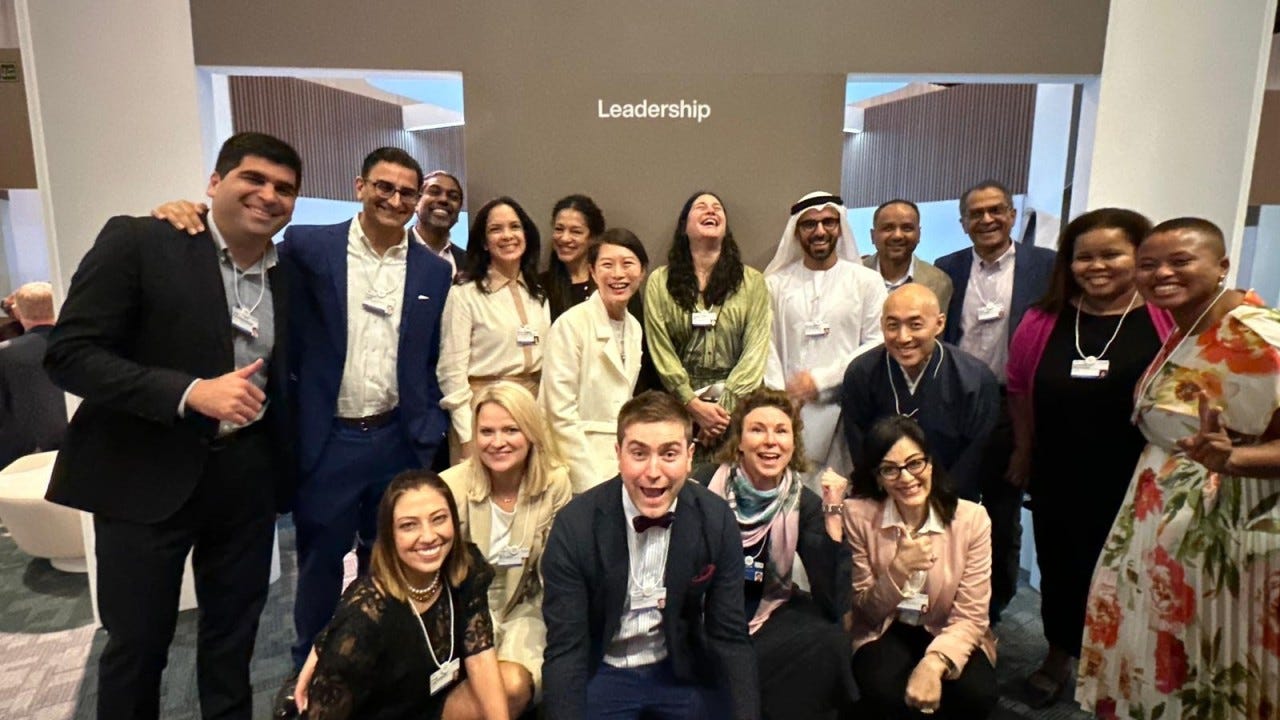
Dubai — After our first inspiring day of conversations at the Global Future Council, my mind is buzzing. We have been tasked with a profound challenge: to find a new vocabulary for leadership in an age of permacrisis. We are searching for new pathways, but perhaps the most promising path begins not by redefining the “what” of leadership, but the “who.”
For too long, we have equated leadership with a position, a title on a business card. This locks us into a search for heroes—flawless, decisive figures who are meant to have all the answers. But what if a leader is not a position at all, but a function?
What if a leader is simply the person who is willing to do what others are afraid to do? The one who voluntarily steps into the space of fear and uncertainty that the rest of the group avoids.
This is not a call for self-sacrifice. A hero’s sacrifice can be a lonely performance, one that makes others feel small and dependent, thinking, “I could never do that.” This is something different. It is an act rooted in the ancient Buddhist concept of Abhayadāna—the gift of fearlessness.
The motivation for this leadership is not a goal to be achieved, but a vector to be followed: to move in a direction that reduces fear and suffering, for both oneself and for others. The true test of this action is whether it makes courage contagious. Does it inspire a sense of, “Perhaps I can do that, too”? If the leader’s action only reinforces the team’s fear, it is not a gift, but a burden.
Why is this so difficult? Because it requires a direct confrontation with our own ego. Our draft white paper correctly identifies “ego-centric leadership” as a core problem. An ego-centric leader is one trapped by their own fears: the fear of being wrong, of looking weak, of losing control. This personal fear is then projected onto the organization, creating a culture of anxiety and silence. The leader’s ego becomes everyone’s prison.
The practice of Abhayadāna, then, is fundamentally an act of ego-transcendence. When a leader has the courage to say, “I was wrong,” they are choosing the organization’s learning over their ego’s need to be right. They are breaking out of their own prison and, in doing so, showing others the way out.
This leads us to a crucial shift in perspective: from an Ego-centric to an Eco-centric model.
But we must be careful with this word, “Eco.” It can become another grand, abstract noun, like “the planet” or “the globe,” which allows us to avoid the difficult work at hand. After all, the desire to frame our work in such epic terms is a subtle trap set by the ego, which always wants to cast us as the hero of the story.
As my friend, the philosopher Markus Gabriel, vividly argues in his book Why the World Does Not Exist, this temptation to speak of “the World” as a single whole is not just an ego-trap, but a philosophical illusion.
The starting point for this new leadership is not the planet, but our most immediate “habitat”: our team, our organization, our community.
The word ‘habitat’ itself is telling. We usually use it for animals and plants, and that reminds us of a fundamental truth we are prone to forget in the age of AI: that we humans are, first and foremost, animals. We are embodied beings, subject to a karmic condition. Unlike an AI that can be everywhere at once, we can only exist in one physical space at a time. We have only one stream of attention, one perspective. This is our inescapable reality.
And by this “karmic condition,” I refer to the immense web of causes and effects that have shaped us—the experiences of our own lives, and the countless connections that led to them. This the nature of interbeing. All of this converges and manifests as the unique habits etched into our mind and body. Each of us, in this single body, is an unrepeatable crystallization of this vast karmic history. This is why every one of us has a story that no one else can tell. Authentic leadership does not begin by trying to escape this condition, but by humbly accepting it as the very ground from which all our meaningful actions must arise.
Let’s think of the difference between an astronaut looking at the Earth from space, and a gardener tending to their own patch of soil. The gardener understands that a healthy ecosystem begins with nurturing the ground directly under their feet. This “gardening” of one’s habitat—cultivating the conditions for others to be free from the constraints of their own ego—is the fundamental, tangible practice of this new leadership.
It is a quieter, more humble path than that of the hero. But in this age of uncertainty, perhaps what we need are not more heroes, but more gardeners.
I share these reflections as food for thought for our discussions tomorrow and look forward to continuing this vital conversation with my fellows.