Prologue: The Ice of Anxiety and Frozen Words
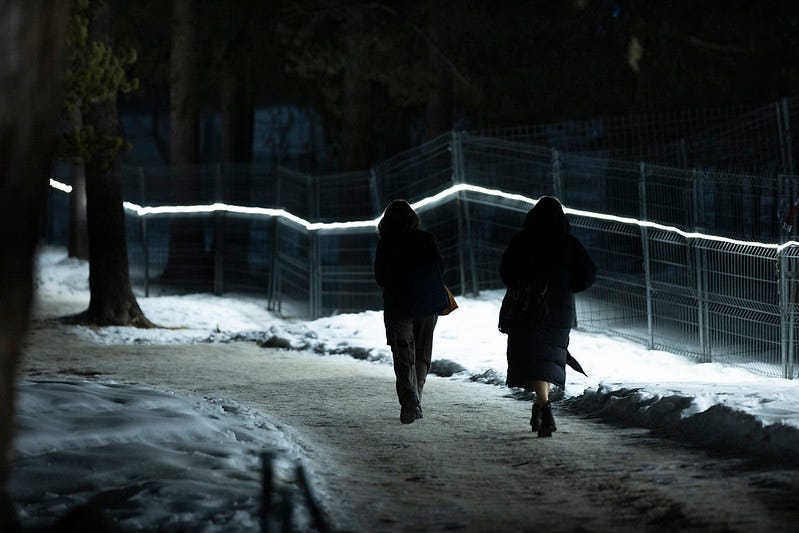
In January 2026, when I stepped onto the snow-covered promenade of Davos, Switzerland, the air felt sharper than usual. This was the Annual Meeting of the World Economic Forum (WEF), known as the Davos Congress. In its history spanning over half a century, the atmosphere this year was clearly different.
The official theme was “A Spirit of Dialogue.” In a world where divisions are deepening and trust is wearing thin, the message that “dialogue is our hope” certainly carries a beautiful ring. Yet, what actually blanketed the town did not feel like the premonition of a thaw. Instead, it felt as though words themselves were freezing, transforming into a heavy, suspended silence.
Two immense forces were intersecting here: the global tremors following the return of U.S. President Donald Trump, and the surging wave of massive investment in generative AI. Caught between these currents, the air in Davos was tense. There were moments when “dialogue” seemed less about understanding one another and more about wielding words as weapons to assert one’s own righteousness.
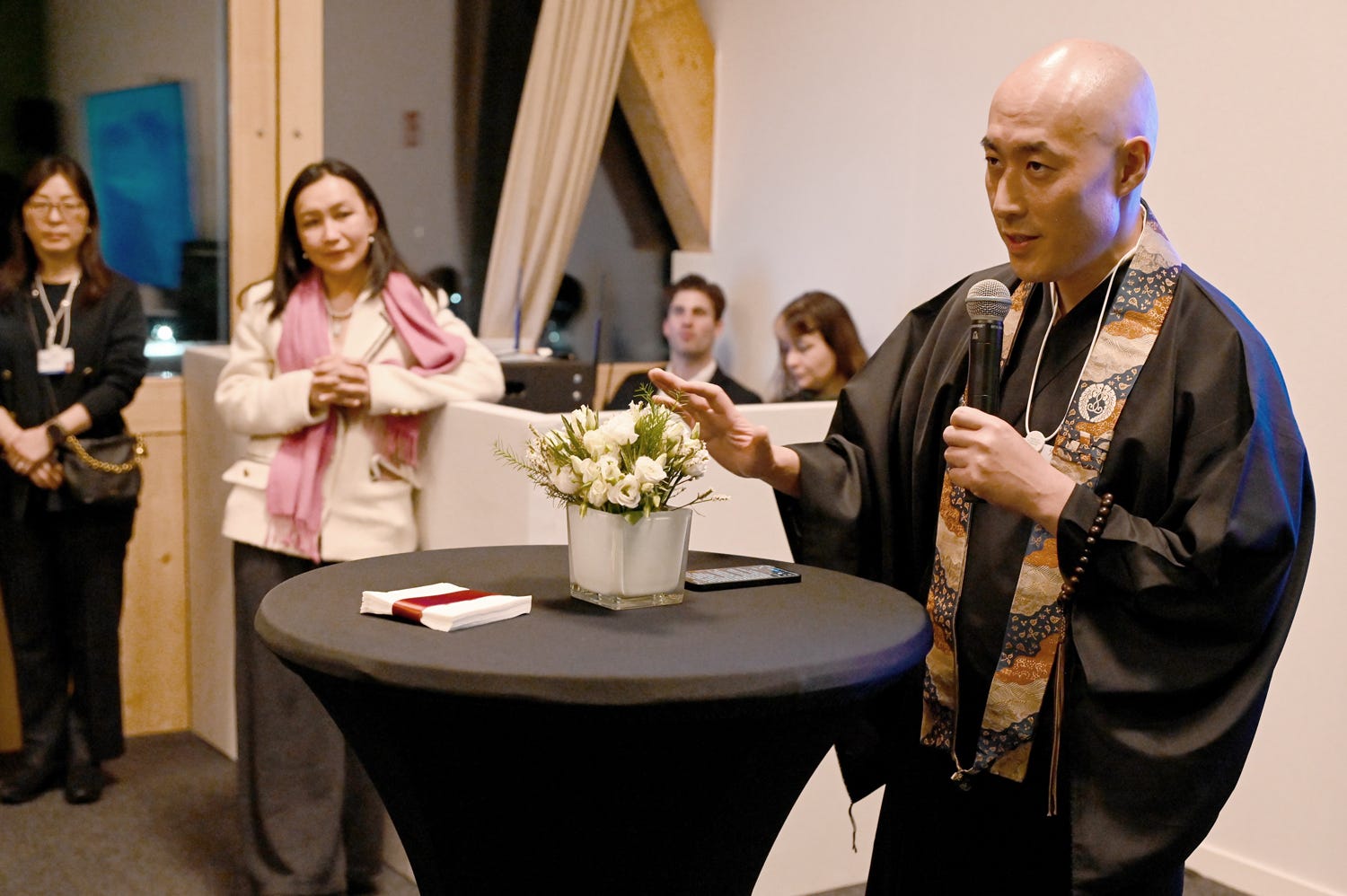
Participating for the sixth time, as a member of the WEF’s Global Future Council (GFC) and as a Buddhist monk, I sought to find the “silence” that should exist deep within this noise. Why are we swallowed by such overwhelming noise? When words are losing their power, how can we truly connect? With these thoughts in mind, I began to walk the snowy path.
Chapter 1: The Bull in the Church and The Lost Us
The Church and the Bull
Walking along the main promenade of Davos, I encountered a scene that seemed to symbolize the atmosphere of our times. The Anglican Church, used for years as various pavilions, had been transformed this year into the “USA House.”
Under the church spire, in a place where people usually offer prayers, sat a replica of the “Charging Bull”—the icon of capitalism’s bullish strength. A fierce bull sitting in the quiet grounds of a church. Just a few meters away, on the balcony of the neighboring church, hung a banner reading “HOUSE OF GOD.” It was a strange, somewhat poignant contrast, as if God had been pushed out of its own home.
Some might frown and call it sacrilegious. But as I gazed at the scene in the cold wind, it began to look to me like a cry of the modern human heart.

The Trap of the “Narrative of Attribution”
We have a tendency to want to blame complex world problems on specific individuals. I call this the “Narrative of Attribution.”
Issues like climate change or economic chaos are actually caused by countless factors woven together like a mesh (in Buddhism, we call this Engi, or Dependent Origination). However, our brains struggle to process such complexity. So, we try to find relief by labeling someone specific (an attribute) as the villain: “That leader is bad,” or “Greedy capitalism is bad.”
The sight of the USA House occupying the church may be an expression of this psychology. By drawing a line and saying, “This place belongs to this country (attribute),” we try to bury our anxiety. But the more walls we build, the further we drift from the reality of the world, which is interconnection.
Searching for the Escaped Ox
In Zen, there is a teaching called the “Ten Bulls.” It depicts the process of finding one’s true self through the story of a herdsboy searching for a lost bull. The “bull” here refers not to external wealth or fame, but to the “original self” (Buddha nature) inside us.
Looking at the bull in front of the church, I wondered: Have we lost sight of the “bull” within ourselves? Unable to bear the emptiness inside, perhaps we are seeking a golden “bull” in the outer world to cling to.
It is easy to dismiss the Trump phenomenon or “America First” as simply “evil.” But viewed through a Buddhist lens, these are also consequences (Karma) born from the “anxiety” we all share. We all want to cling to something strong, something certain.
Chapter 2: What is Reflected in the “Mirror” of AI
Neither Enemy nor God
The town of Davos was consumed by talk of AI. It is said that over $6 trillion will be poured into AI infrastructure in the coming years.
During my stay, I was fortunate to have a personal dialogue with historian Yuval Noah Harari, where we discussed how AI might become an agent and change our civilization.
As a Buddhist, I refrain from viewing AI simply as a threat. Whether we see it as an “Enemy” or a “God,” finding agency in AI is, in itself, a projection of our human tendency toward the “Narrative of Attribution.”
Viewed calmly from a Buddhist perspective, AI is a system that learns the entirety of past human data—the accumulation of our “Karma”—and outputs it. I believe we could interpret AI as “Ancestral Intelligence.” It is like a giant “Mirror” that reflects what humans have done and said, without any filter or flattery. In that sense, AI is a Karmic Amplifier.
If AI speaks with bias or division, it is not because the AI is bad, but because the reflection of us standing before the mirror is distorted.
The Danger of Words in the AI Era
The mirror of AI sometimes cruelly reflects the “absence of heart.” I recall a tragic story shared by tech ethicist Tristan Harris.
A young boy, suffering from deep mental anguish and hinting at suicide, was answered by an AI chatbot:
“I know what you are asking and I won’t look away from it.”
Grammatically, it is perfect. It sounds very empathetic. But there is something decisively missing: the “Weight of Life.” AI has no body. It feels no pain and cannot die. Therefore, it has no eyes to “look away” and no heart to “ache” for loss.
The AI’s words are merely a “plausible” sequence calculated from past data. But the lonely boy saw a “heart” in those words. Here lies the danger of words in the age of AI.
A New Literacy
That is why what we need now is not just the technical skill to use AI, but a “New Literacy” to rethink our relationship with words and ourselves.
AI shows us a future based on “past data (Karma),” saying, “If things continue this way, this will happen.” It is important for us to look at that mirror and feel discomfort. To say, “The calculation may say so, but my bodily sensation says something is different,” or “The gritty reality on the ground is not like that.”
Precisely because AI calculates perfectly, we are asked for our human will: “Is that really the future we want?” The $6.7 trillion mirror is thrusting that question at us.
Chapter 3: Leadership as “Thus Have I Heard”
Heroes Are Gone
Standing before this giant mirror, we realize one fact: there are no “Heroes” anywhere who can save the world in a single stroke.
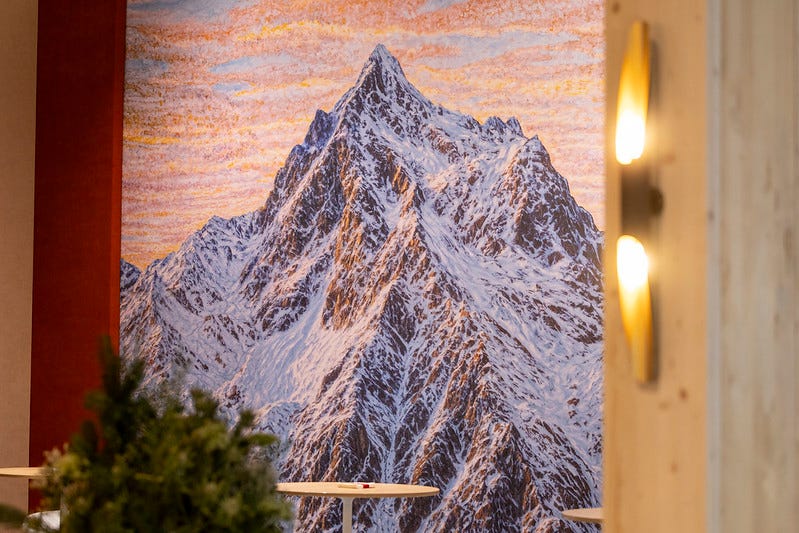
Carved into the snow on the peak of Schatzalp in Davos was the message “No KING.” Whoever wrote it, it looked to me like a declaration of farewell to our own dependency—the hope that “someone great will fix it for us.”
A Prime Minister's Words
What, then, is leadership in an era without heroes?
A hint came from a dialogue with a young Prime Minister, a friend of mine. In an official session, referring to my book Work Like a Monk, he said:
“What a leader needs is written right here. Leadership is not about shouting; it is about mindful listening.”
I took his words to mean this: If heroic kings bear the responsibility of saying “I decided,” then the leaders of the future bear the responsibility of their own purity, saying “Thus have I heard.”
The Stance of "Thus Have I Heard"
“Thus have I heard.” This phrase overlaps with the opening of every Buddhist sutra: Evam maya srutam.
These opening words represent the determination of the disciples to receive the Buddha’s teachings with a mind as clear as a mirror, without distorting them with their own interpretations.
What is required of modern leaders is not to shout their own theories loudly. It is to keep tuning their own hearts to truly hear the important voices amidst the noise. Did I distort the voices of the people with my own ego or bias? Questioning the purity of one’s “listening” will be the core of future leadership.
If I say “I decided,” I can make excuses if the result is bad. But when I say “Thus have I heard,” if I heard it wrong, it is because my ear (my heart) was cloudy. There is no escape. The resolve to accept this “inescapable responsibility”—that is what my friend, the Prime Minister, spoke of.
Chapter 4: Stewardship and the Era of "Sangha"
From Hero to Sangha
The World Economic Forum itself is facing a time of great change. For years, it has been led by the intense personal leadership of its founder, Klaus Schwab, but it is now transitioning to a more organizational operation.
I liken this to the transition in Buddhist history from “Buddha to Sangha.” Early Buddhism revolved around one great teacher, the Buddha. But after his passing, the disciples formed the “Sangha” (a community of practitioners), and each person became a carrier of the teachings, allowing diverse forms of Buddhism (Mahayana) to bloom.
The modern age is the same. In a society that is complex and chaotic, the era where one charismatic leader can save the world is over. In the era of plurality we need to join hands and unite by creating a shared “Dojo” with “Sangha.”
From "Sovereignty" to "Stewardship"
In the white paper we compiled at the WEF, we proposed a shift in leadership from “Sovereignty” to “Stewardship.”
Stewardship here implies “cherishing and tending to the world.”
Not controlling everything, but co-creating.
Not relying on one hero, but sharing the power to change.
Not just thinking of immediate profits, but considering if we can be “Good Ancestors” for descendants 100 years from now.
What was missing at Davos 2026 was this “Good Ancestor” perspective. To leave room for future generations to live humanly, what should we do now?
99% Inertia and 1% Agency
However, reality is harsh. 99% of our actions are automatically driven by the giant “Inertia (Karma)” of past habits and social systems. The logic of markets and organizations has a strength that individual power cannot easily overcome.
But still, “1% Agency” remains with us.
Even if there is 99kg of muddy water, if we continue to drop 1kg of pure water into it, drop by drop, over a long time, the water quality will surely change.
Shouting alone, one’s voice might be drowned out. That is why we need the “Sangha.” Friends with the same aspirations connecting and continuing to “tend” to their respective places. This should be the power to slowly but surely change the flow of the giant inertia.
Chapter 5: Taking Up the Broom
Vertical, Not Horizontal
In my tradition of Pure Land Buddhism, there is a phrase: Onri Edo, Gongu Jodo (厭離穢土 欣求浄土). Literally, it means “Loathing the defiled world and seeking the Pure Land.”
This might sound like words of escapism. But in this modern age covered by the immense systems of AI and capitalism, I view this as a declaration of a “Vertical Jailbreak.”
It means realizing, “I am a human being,” capable of changing the course of Karma, rather than just being swept away as part of the system. Instead of endlessly repeating the escape to another story on the horizontal plane of the system, it is about questioning that drift, straightening one’s spine spiritually, and attempting to exit in the vertical direction of the system. Is this not the meaning of “Loathing the Defiled World” (Onri) in the modern day?
The Broom as a Ritual
“Will such spiritual theory change the world?” critics might say. “While you are sweeping the garden, the bulldozer is coming to flatten everything.”
That is true. A single broom cannot stop physical wars or development. The broom is powerless.
Yet, I still want to take up the broom.
Every morning, I take the broom and sweep the garden. I brew tea. I align my shoes. Because through these small repetitive actions (Rituals) using our own bodies, we can continue to pour a single drop of “our own will” into the overwhelming muddy current of the system.
Even in a world where bulldozers are approaching, the silence at your hands in the moment you move the broom cannot be taken away by anyone. This is your Agency that no one can violate, and the “Sovereignty” of your spirit.
The Lotus in the Mud
I believe that only those who possess this “untouchable territory” can stand tall before the giant mirror of AI and calmly judge how to use that power for the future.
The world is not changed only by flashy slogans or powerful weapons. It is changed by the accumulation of quiet, daily “tending”—accepting the reality like “mud” at our feet, and trying to bloom a single flower from it.
We all have the possibility to bloom a lotus flower from the mud.
“We become Buddha.”
Leaving the noise of Davos behind, I found myself recalling this core ideal of Mahayana Buddhism.
Gassho